Network Operations 14 min readJul 23, 2026Updated Oct 20, 2026
5G Energy Saving: What the Savings Actually Cost
By Gaganpreet Walia
CEO, TELCOMA Global · 21+ years in telecom
The question this article answers
If you want the broad tour — symbol shutdown, carrier sleep, AI-driven scheduling, "real operator results" — read the primer first: 5G network energy saving techniques. One correction up front, because it matters for everything below: that primer (and most of the genre) leans on a "5G uses ~1% of global electricity / ~150 TWh" framing. That number is contested literature with no clean primary, so this pillar deliberately avoids it. We also avoid the "5G is 90% more energy-efficient per bit than 4G" claim — true only under a per-bit denominator that hides absolute traffic growth.
This article does a different, narrower job. It answers two questions the primer only gestures at:
How does 3GPP actually model what a base station burns — the TR 38.864 power model, its five states, and the transition costs that decide whether a sleep mode is usable.
What did Rel-18 and Rel-19 actually standardize, with the exact signalling, and what do the published savings really cost in throughput?
The contrarian spine, which the rest of the article defends: 3GPP did not standardize sleeping. Vendors shipped sleep modes for a decade without it. What Rel-18/19 standardized is not breaking things while the cell sleeps — telling UEs, neighbours, and CSI reports about the nap so nobody declares radio-link failure.
Every 5G & 6G certification course, free for 7 days.
A free account opens all 13 courses — 404 video lessons, labs and full practice exams — for 7 days, no card. Prime Membership keeps them and adds the certification exam and a verifiable certificate.
The economics are blunt. 3GPP TR 38.864 opens (clause 4) by quoting GSMA: "the energy cost on mobile networks accounts for ~23% of the total operator cost. Most of the energy consumption comes from the radio access network and in particular from the AAU." [confidence: REPORTED — the 23% is a GSMA figure that 3GPP cites; the underlying GSMA report is registration-gated, so treat it as a 3GPP-endorsed citation, not a measured number. Other GSMA material puts network energy at a wider 20–40% of opex depending on year and market.]
How much of that energy is in the RAN? GSMA's own operator-reported dataset — 7 operators, 31 networks, 28 countries — puts 73% of network energy consumption in the RAN [confidence: REPORTED; the GSMA page is bot-gated and was verified via snippet plus the 3GPP citation]. Ericsson, as a vendor, states RANs "typically comprise more than 75 percent of a service provider's network power consumption" [confidence: CONFIRMED as a vendor statement].
Put those together and the opex case writes itself, with a caveat about what you are multiplying. A feature that cuts 15% of radio power attacks roughly 15% × 73% ≈ 11% of network energy ≈ low single digits of total opex. Real money — but notice the three denominators already in play. We come back to them, because they are where most energy-saving claims quietly inflate.
There is one more piece of physics worth naming. Even on legacy hardware, idle power is not zero and not small. Peer-reviewed field measurements of live macro sites fit a linear model P = β₁ + β₂·load where the fixed term dominates — one measured sector was P = 581 W + 11.9 W/Erlang, i.e. idle ≈ 49% of peak [confidence: CONFIRMED, but GSM/UMTS-era hardware — use as a historical baseline, not a 5G figure]. "Even when all the TRXs were turned off, the BSs still consumed some constant power." That fixed cost is the villain the Rel-18/19 toolkit is built to attack.
How 3GPP models a base station's power: TR 38.864
The Rel-18 study is 3GPP TR 38.864 V18.1.0 (2023-03) [confidence: CONFIRMED — downloaded and read]. Its value is not a list of techniques; it is a model you can reason with. Two parts matter.
Three reference configurations. Set 1 is FR1 TDD, 100 MHz, 30 kHz SCS, 64 TxRU, 55 dBm — the mid-band massive-MIMO macro most engineers picture. Set 2 is FR1 FDD, 20 MHz, 15 kHz SCS, 32 TxRU, 49 dBm. Set 3 is FR2 TDD, 100 MHz, 120 kHz SCS, 2 TxRU. Numbers below are Set 1 unless stated.
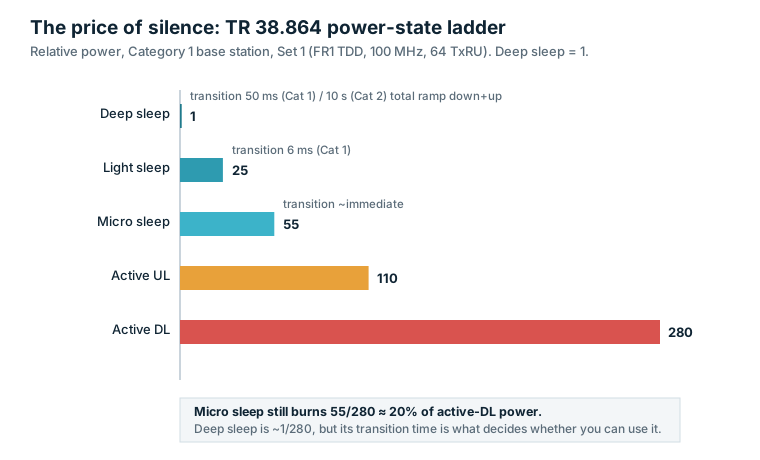
Five power states, with power expressed in relative units (deep sleep = 1). For a Category 1 base station, Set 1: deep sleep 1, light sleep 25, micro sleep 55, active UL 110, active DL 280.
Figure 1 — TR 38.864 relative-power ladder for a Category 1, Set 1 base station, with state transition times. Even micro sleep, doing nothing, costs ~20% of active-DL power; the only deep escape costs 50 ms (Cat 1) to 10 s (Cat 2) of transition.
Two derived facts carry the whole design space:
Idle is expensive. Micro sleep — no transmission, no reception — still burns 55/280 ≈ 20% of active-DL power [confidence: CONFIRMED as an arithmetic derivation from the TR's own values]. This is the quantitative core of "base stations burn power even when idle."
Deep sleep is nearly free but slow to enter and leave. Deep sleep is 1/280 of active DL, but its total transition time (ramp-down plus ramp-up combined) is 50 ms for Category 1 and 10 s for Category 2 [confidence: CONFIRMED — and note the wording: "transition," not "exit"]. Category 2 is the lower-power, legacy-style profile; its deep-sleep transition of 10 seconds is why the practical value of these features hinges on silicon, not signalling. "5G-Advanced energy features" often arrive only with a hardware refresh because Cat-1-class transition speed does.
The model also states a limit honestly: it does not capture states below deep sleep — "hibernating sleep or Quasi-off" [confidence: CONFIRMED]. Keep that in mind when a vendor markets "extreme deep sleep": it lives below the floor of the 3GPP model, so you cannot reconcile it against TR 38.864 relative units directly.
What Rel-18 actually standardized
Here is the spine again, now with spec pointers. Rel-18's normative network energy savings (NES) work lands in TS 38.300 (Rel-18) clause 15.4 "Energy Saving" [confidence: CONFIRMED — TS 38.300 V18.9.0, 2026-03]. The Rel-18 sub-clause list runs from 15.4.2.3 to 15.4.2.7 and ends there — which is itself a load-bearing fact (it tells you what is not in Rel-18).
Cell DTX/DRX (§15.4.2.3) — the headline feature. The UE is configured with a periodic cell-level DTX/DRX pattern (active and non-active periods), common to all configured UEs in the cell. The spec is precise about its limits: it "is only applicable to UEs in RRC_CONNECTED state and it does not impact Random Access procedure, SSB transmission, paging, and system information broadcasting"; single-TRP scenarios only; activated/deactivated by RRC signalling or L1 group-common signalling [confidence: CONFIRMED, verbatim]. Read that clause carefully — it is the proof of the spine. Rel-18 cell DTX/DRX explicitly leaves the always-on signals (SSB, paging, SI) running. It does not turn the cell off; it coordinates a nap around the signals the network still needs to keep cells discoverable.
The L1 mechanism: DCI format 2_9. The fast activation/deactivation of cell DTX/DRX uses DCI format 2_9, CRC scrambled by the new cellDTRX-RNTI: the format "is used for activating or de-activating the cell DTX and/or DRX configuration of one or multiple serving cells for one or more UEs, and/or for providing NES-mode indication of the primary cell" — specified in TS 38.212 §7.3.1.3.10, with UE procedures in TS 38.213 §11.5 "Adaptation of cell operation" [confidence: CONFIRMED]. This is the literal signalling that tells the UE "the cell is about to nap" so it does not misread the silence as link failure.
Spatial and power domain adaptation (§15.4.2.7). To mute antennas/transceivers without blinding the scheduler, the UE reports multiple CSI entries based on two or more CSI sub-configurations per TS 38.214 §5.2.1.6. Each sub-configuration corresponds to a spatial-domain pattern (a subset of spatial elements — antenna/transceiver muting) and/or a PDSCH-to-CSI-RS power offset (power-domain adaptation) [confidence: CONFIRMED]. This is the energy-cost counterpart to the capacity story in Massive MIMO explained and 5G beamforming: the same 64-transceiver array that buys capacity at peak can mute spatial elements at low load — but only because the UE was taught to report CSI for the muted hypothesis.
SSB-less SCell (§15.4.2.6). A carrier-aggregation SCell may run with no SSB at all; the UE takes timing reference and AGC from another serving cell [confidence: CONFIRMED]. It is the same principle 5G already applied to the carrier itself — the lean carrier that deleted LTE's always-on CRS — now extended to the SSB on a secondary carrier.
What is not in Rel-18: on-demand SSB and on-demand SIB1. They were studied in Rel-18 (TR 38.864 technique A-5) but not specified. They landed in Rel-19. The Rel-18 work item is widely cited as RP-223540 [confidence: REPORTED — consistently quoted in secondary literature but not re-verified against the 3GPP portal; the techniques themselves are CONFIRMED in the TSs].
Rel-19: turning always-on signals into on-demand signals
If Rel-18 taught the cell to nap around its signals, Rel-19 attacks the signals themselves. The work item is RP-234065 "Enhancements of network energy savings for NR" (approved RAN#102, Edinburgh, December 2023) [confidence: CONFIRMED — the WID was pulled directly from the 3GPP FTP]. The results are normative in TS 38.300 V19.2.0 (2026-03), §15.4.2.8–15.4.2.10 [confidence: CONFIRMED]:
On-demand SSB SCell (§15.4.2.8): RRC and MAC-CE activation/deactivation, FR1 and FR2, non-shared spectrum, with L3 measurement on the on-demand SSB supported.
On-demand SIB1 (§15.4.2.9): the gNB transmits SIB1 only upon an OD-SIB1 request carried in a random-access procedure; supported in RRC_IDLE/INACTIVE and in RRC_CONNECTED while T311 runs.
Common signal/channel adaptation (§15.4.2.10): an extended paging-frame parameter N (with a compensating Ns), DCI-indicated SSB adaptation for SCells with multiple SMTCs, and PRACH adaptation for 4-step contention-based RACH via DCI-indicated additional RACH resources.
The symmetry is the cleanest way to remember the whole program: cell DTX/DRX is the cell-side mirror of UE C-DRX; on-demand SSB/SIB1 is the cell-side mirror of UE wake-up. 3GPP is teaching the network the lean-carrier discipline it taught UEs back in Rel-15. For where these sit in the wider release picture, see the 3GPP release timeline and the 5G-Advanced (Rel-18) overview; for the full planner's view of what is shippable across releases, the 5G-Advanced Rel-18/Rel-19 feature guide is the cluster hub this article feeds.
One reported estimate for the headline Rel-19 feature: on-demand SSB NES gain of 8–20%, decreasing with SCell load, assuming a non-cell-defining SSB with no associated SIB1 [confidence: REPORTED — from the WID discussion summary, not a 3GPP evaluation read directly].
The honest numbers: ranges, not points
This is the section that should make this pillar useful where marketing is not. TR 38.864's evaluated gains live in clause 7 (Conclusions) — not "clause 8," a citation error worth flagging because the TR has no clause 8 [confidence: CONFIRMED clause number]. Crucially, every result is a range across companies, loads, and assumptions, and almost every range comes with a user-perceived-throughput (UPT) cost. Never quote one number from clause 7 without its load scenario and its UPT companion.
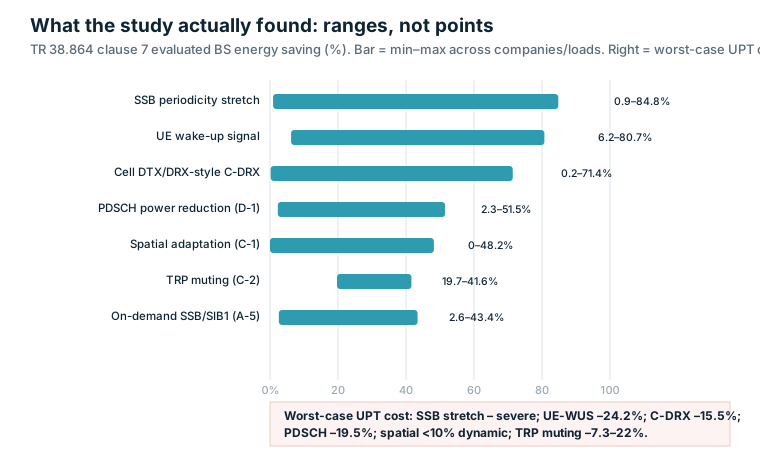
Figure 2 — TR 38.864 clause 7 evaluated base-station energy-saving ranges by technique family, each paired with its worst-case throughput cost. The same technique legitimately yields a low single-digit or an 80%+ figure depending on baseline, load, and BS category.
The ranges, with their cost column [all CONFIRMED, TR 38.864 clause 7]:
SSB periodicity stretch (beyond 20 ms, up to 1280 ms): 0.9–84.8% BS energy saving — but "UPT significantly decreases" as soon as traffic appears.
UE wake-up signal for the gNB:6.2–80.7% (DL-triggering variant), up to 24.2% UPT loss.
Cell DTX/DRX-style C-DRX alignment:0.2–71.4%, up to 15.5% UPT loss (and 62.4% in one configuration).
PDSCH power reduction (D-1):2.3–51.5%, up to 19.49% UPT loss.
Spatial-element adaptation (C-1):0–48.2%, with <10% UPT loss for dynamic adaptation but up to 87.08% for static muting.
TRP muting (C-2):19.7–41.6%, with 7.27–22% UPT loss.
The lesson is not that any technique is bad. It is that the same technique honestly produces 0.9% or 84.8% depending on baseline and load, and the high end almost always rides a throughput penalty. A study that publishes the ranges with the cost column is doing the engineering; a press release that publishes the top of the range with "up to" is doing marketing.
Where the watts actually go, and what the field results mean
Now line the model up against the named field trials — and watch the denominators.
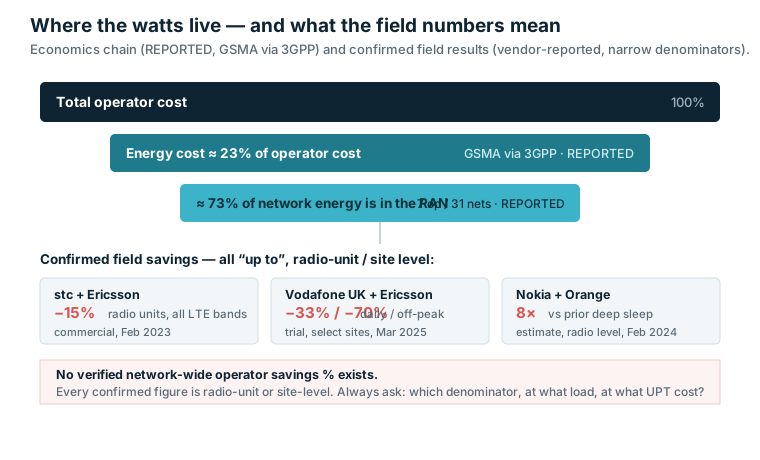
Figure 3 — From operator cost to verified field results. Energy is ~23% of operator cost (GSMA via 3GPP), ~73% of network energy is in the RAN (GSMA operator-reported), and the confirmed field savings are all radio-unit or site-level "up to" figures, not network-wide.
The confirmed field figures, decoded:
Ericsson + stc (Saudi Arabia), commercial, Feb 2023: Micro Sleep Tx (symbol-level shutdown of the radio's main power amplifier in idle periods) cut radio-unit power by 15% across all LTE bands [confidence: CONFIRMED]. Note: LTE, radio-unit denominator, commercial — but it is a vendor-reported figure with no independent measurement.
Vodafone UK + Ericsson (London), trial, Mar 2025: AI-driven features reduced daily power of 5G radio units by up to 33% at select London sites, and a "5G Deep Sleep" feature saves up to 70% during low-traffic hours [confidence: CONFIRMED]. Decode the qualifiers: "up to," "select sites," radio-unit (not whole-site), and the 70% applies only to low-traffic hours. This is the AI-orchestration story that AI-RAN and O-RAN RIC/xApps describe as a use case — but the spec techniques above are the substrate those control loops actually act on.
Nokia + Orange, MWC Feb 2024: "extreme deep sleep" cuts radio-unit consumption by a factor of eight versus the previous deep-sleep mode [confidence: CONFIRMED via trade press; Nokia primary bot-gated]. It is an unmeasured vendor estimate, radio-level, and — as noted — it lives below the TR 38.864 model floor.
Ericsson simulation, Nov 2024: stretching SSB/SIB1/PRACH from 20→40 ms saves "about 16%"; combining sparse SSB and PRACH (20→160 ms) "saves over three-quarters of gNB energy in low-load scenarios" [confidence: CONFIRMED as vendor simulation, not field measurement].
State the gap plainly, because it is the most useful sentence in this article: no verified network-wide energy-savings percentage from any operator deployment was found. Every confirmed figure is radio-unit or site-level and carries an "up to" qualifier. When someone quotes you "X% savings," your first three questions are: which denominator (radio / site / network), at what load, and at what UPT cost?
Start a free 7-day trial — no card — if you want the worked configs behind cell DTX/DRX and the on-demand-signal procedures in the full track.
An engineer's honesty checklist
When you evaluate any network-energy-saving claim — vendor pitch, internal trial, or a number in a deck — pin down four things before you believe it:
Baseline. Saving against an always-on, no-NES configuration is the easy case. Saving against an already-optimised cell is the real test.
Load point. Most high percentages are zero- or low-load results. They evaporate at busy hour, which is precisely when the network is most expensive to run.
Denominator. Radio-unit, whole-site, or network-wide? The three differ by a factor of several. Radio-unit savings of 33% are not 33% off the electricity bill.
The cost column. What did it do to UPT, latency, or accessibility? TR 38.864 publishes a UPT-loss figure next to almost every gain. If a claim has no cost column, it is incomplete, not impressive.
That is the difference between the spec and the sales sheet. 3GPP did the unglamorous half of the work — making sure the UE, the neighbours, and the CSI reports all know the cell is napping, so the savings do not come out of the user's throughput silently. The technology is real and the opex is real. The single-number version is not.
Energy saving, verified rather than claimed
Savings figures in vendor material are usually measured under conditions that
are not yours, so the useful skill is knowing which mechanism is running and