Emerging Tech 14 min readJul 11, 2026Updated Oct 15, 2026
5G-Advanced (Rel-18 and Rel-19) Feature Guide: What Ships in 2026, and What to Defer
By Gaganpreet Walia
CEO, TELCOMA Global · 21+ years in telecom
"Frozen" is a spectrum, not a date
If you plan networks for a living, the most expensive mistake you can make with 5G-Advanced is to read "Release 18 froze in June 2024" as "Release 18 features were available in June 2024." They were not. The first phone silicon that broadly advertised Rel-18 support — Qualcomm's Snapdragon X85 and MediaTek's Dimensity M90 — was announced at MWC in March 2025, roughly nine months after the spec was sealed, and the flagship Rel-18 mobility feature (L1/L2-Triggered Mobility) reached its first documented in-field demo only in 2026. The gap between "frozen" and "in your RAN" is the real planning problem, and it is the spine of this guide.
5G-Advanced is not a logo and not a single release. 3GPP applied the "5G-Advanced" branding "from Release 18 onwards" (a PCG decision in April 2021), and the program now spans three releases: Rel-18 and Rel-19 are done, and Rel-20 is the last 5G-Advanced-focused release before Rel-21 carries the normative 6G work. This pillar exists to answer a different question than the per-topic deep dives it links to: across the whole 5G-Advanced program, what is actually shippable in 2026–2028, and what should you budget for versus defer? The organizing tool is a deployment-maturity ladder — study → normative spec → silicon → live network — and the discipline of never confusing one rung for the next.
If you want the encyclopedic feature-by-feature account of a single release, the companion 5G-Advanced (Release 18) explainer is the canonical page; for the full cross-generation table from Rel-8 to Rel-20, see the 3GPP release timeline. This guide spans the family and grades each feature by how close it is to your network.
Why "frozen" needs four asterisks
"Frozen" is not a single event. Rel-18 alone had four freeze moments, and reading any one of them as "the release is ready" misjudges device lead times by close to two years.
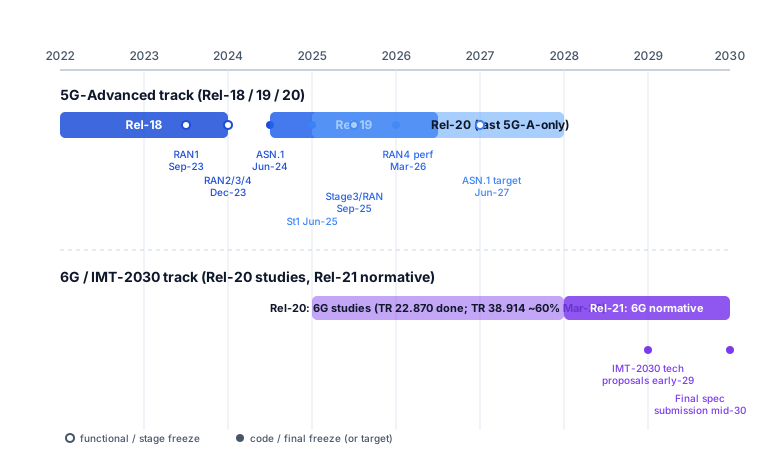
Per the TSG RAN Chair's published timeline, the Rel-18 RAN schedule was: RAN1 functional freeze September 2023 (declared on time), RAN2/3/4 functional freeze December 2023, first ASN.1 review March 2024, and ASN.1 freeze June 2024. Treat those December-2023 and June-2024 dates as planned-and-met milestones stated by the RAN Chair, not as a completion record of a specific plenary — the sources describe the schedule, not a "completed at meeting X" announcement, so do not over-attribute.
Rel-19 finished in two steps, per the official 3GPP Release-19 Summary: "Rel-19 was finalised in Sept. 2025 (Stage 3/RAN) and March 2026 (RAN4 Performance)." Stage 3 freeze means the running protocol text (the TS messages and IEs) is set; the RAN4 performance freeze months later is when the RF and RRM conformance requirements that vendors actually certify against are locked. A feature whose Stage 3 is frozen but whose RAN4 performance is not is not yet something you can buy a tested radio for. That is why the two-date framing matters for procurement, not just for spec trivia.
Figure 1 — Two-track 2022–2030 timeline: the 5G-Advanced release freezes (Rel-18/19/20) over the 6G/IMT-2030 track
Rel-20 sits at the hinge. Its Stage 1 was frozen June 2025; Stage 2 freeze is targeted September 2026, Stage 3 March 2027, with the final ASN.1/OpenAPI freeze targeted June 2027 (a target date, not yet achieved). As of the March 2026 work plan, 126 work items plus 74 study items were underway for 5G-Advanced in Rel-20 — and the first 6G studies have started inside it: the 6G requirements study TR 22.870 is complete (approved at TSG SA#111), and the 6G RAN scenarios/requirements study TR 38.914 was about 60% complete in March 2026. 3GPP has concluded it needs two releases for 6G — Rel-20 for studies, Rel-21 for normative work — against ITU IMT-2030 target dates of technology proposals in early 2029 and final specification submission mid-2030. For the bigger picture of where this is heading, see what 6G actually is.
The Rel-18 deployable baseline
Rel-18 is the baseline 5G-Advanced feature set — frozen, and therefore the first set you can realistically expect in silicon and software. Below is the planner's view: what each feature is, and who actually needs it. A theme emerges quickly: most of the value lands on fixed wireless, verticals, and the device universe beyond the smartphone.
XR enhancements (NR_XR_enh). RAN support for extended reality across three areas: awareness (PDU Set information from the 5GC, a delay-status-report MAC CE, a new BSR table), power saving, and capacity. Who needs it: operators targeting cloud gaming and AR with bounded latency.
Sidelink evolution / SL-U (NR_SL_enh2). Sidelink carrier aggregation in the ITS band n47, sidelink on FR1 unlicensed spectrum (SL-U) in bands n46 and n96/n102, and LTE/NR co-channel coexistence at 5.9 GHz. Who needs it: V2X programs and commercial proximity/wearable use cases. This needs new spectrum posture, not just software.
MIMO evolution (NR_MIMO_evo_DL_UL). Unified TCI extended to multi-TRP/multi-panel, two timing advances (2TA) for multi-DCI mTRP, coherent joint transmission (CJT) codebooks, TDCP reporting, doubled orthogonal DMRS ports for MU-MIMO, and 8Tx uplink transmission with up to 8 layers for high-end UEs (CPE, FWA, vehicle, industrial) plus simultaneous transmission across two panels (STx2P). One nuance worth getting right: the RAN1 MIMO feature work in Rel-18 has no DL-8Rx item — the 8-antenna RAN1 work is uplink. That does not mean Rel-18 ignored downlink 8Rx: the Rel-18 RAN4 work item NR_ENDC_RF_FR1_enh2 specified FR1 8Rx DL requirements for exactly the CPE/FWA/vehicle/industrial device class (single-carrier and CA). So the correct statement is "no RAN1 DL-8Rx MIMO feature in NR_MIMO_evo_DL_UL," not "no 8Rx in Rel-18."
L1/L2-Triggered Mobility (LTM, in NR_Mob_enh2). A cell switch based on L1 measurements and triggered by a MAC CE instead of RRC, with pre-configured candidate cells retained after execution for subsequent switches; plus CHO enhancements and NR-DC selective activation. Rel-18 LTM is the intra-CU/intra-gNB case. Who needs it: FR2 and high-mobility deployments where handover interruption hurts. This is software-side on a compliant gNB — no new spectrum.
RedCap evolution (eRedCap, NR_redcap_enh). Per TR 21.918 §6.2, eRedCap "restricts the peak rate in DL and UL to 10 Mbps... regardless of what other features the UE may support," via peak-rate reduction and/or baseband bandwidth reduction, positioning eRedCap "similar to LTE UE category 1/1bis, between existing 3GPP LPWA (NB-IoT/LTE-MTC) devices and Rel-17 RedCap devices"; it also adds eDRX in RRC_INACTIVE. For the device-class context and where RedCap sits relative to full NR, see the 5G RedCap (NR-Light) guide. Note for budgeting: this needs new devices, and no commercial eRedCap (Rel-18) silicon was confirmed in market during this research — only Rel-17 RedCap is verifiably shipping.
Positioning (NR_pos_enh2). Sidelink positioning with new SL-PRS and the SLPP protocol (TS 38.355); NR carrier-phase positioning for cm-level accuracy (DL/UL RSCP and RSCPD, double-differential operation with positioning reference units); PRS/SRS bandwidth aggregation; LPHAP with (e)DRX beyond 10.24 s; and positioning for RedCap UEs.
Air-to-ground (NR_ATG). The first NR ATG specification — ground base stations serving aircraft-mounted ATG UEs, with terrestrial-network coexistence evaluation (RAN4-led). Rel-19 then adds DL carrier aggregation and UL/DL MIMO for ATG.
UAV (NR_UAV). NR support for aerial UEs (heritage up to ~300 m altitude from the LTE work) — UAV-specific measurement reporting and interference handling, with lower-latency control than the LTE baseline. The system side continues in Rel-19 as UAS Phase 3.
Network slicing Phase 3. System-level slicing enhancements (TR 21.918 §13, including UICC slice-authentication and slicing charging Phase 2). The RAN-visible Rel-19 follow-ups ride in SON/MDT Phase 4 and AI/ML-for-NG-RAN slicing use cases; the one dedicated Rel-19 slicing feature is network-controlled slice selection (an authorized application replacing a subscribed slice with another under operator control). For the architecture, see what network slicing is.
MBS enhancements (NR_MBS_enh). Multicast reception in RRC_INACTIVE (mission-critical scale), shared broadcast/unicast processing, and resource-efficient broadcast under RAN sharing.
Network energy savings (Netw_Energy_NR). Cell DTX/DRX patterns (RRC- or DCI-2_9-activated) and spatial/power-domain adaptation via a new multi-sub-configuration CSI framework, preceded by study TR 38.864. Rel-19 extends this with on-demand SSB/SIB1. Deeper treatment in the 5G network energy saving guide.
The rest planners should know: network-controlled repeaters (NCR), mobile IAB, and NTN Phase 2 (NR_NTN_enh — smartphone-grade UL coverage at −5.5 dBi antenna gain, GSO+NGSO Ka-band, network verification of UE-reported location). The NTN / satellite 5G guide covers the orbital and architecture detail.
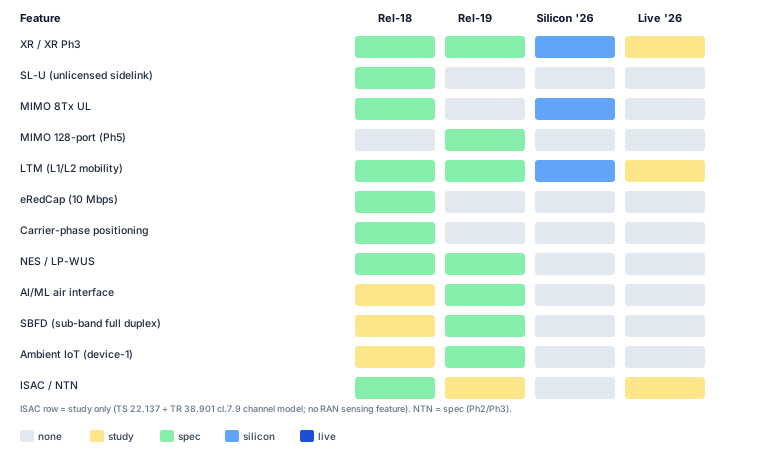
Two things that are commonly mis-filed as Rel-18 features were studies only: AI/ML for the NR air interface (TR 38.843) and duplex evolution (TR 38.858). Neither produced a normative Rel-18 air-interface spec. Both graduate in Rel-19, which is where the maturity ladder gets interesting.
The Rel-19 catalog
Rel-19 is where several headline topics moved up a rung — and where one of the most-hyped ones pointedly did not. The verified package, per the 3GPP Release-19 Summary:
AI/ML for the NR air interface (NR_AIML_air) goes normative — but one-sided only. The summary is explicit: it "standardizes a normative framework for one-sided AI/ML models at the gNB or UE — covering beam management, positioning, and CSI prediction — along with a generic lifecycle-management framework... Two-sided CSI compression and UE training-data collection is deferred to Rel-20." That line is the single most useful sentence in the release for an architect: the standard is telling you where the industry's multi-vendor interoperability confidence actually ends. The two-sided CSI-compression case — biggest theoretical gains, messiest cross-vendor encoder/decoder interop — was held back on purpose. For how these models map to real RAN functions, see AI-RAN explained.
MIMO Phase 5 (NR_MIMO_Ph5). UE-initiated beam management, CSI and CJT support extended up to 128 ports, 3-transmit-antenna uplink operation, and asymmetric multi-TRP DL/UL. Who needs it: massive-MIMO capacity in upper-midband.
Mobility Phase 4 (NR_Mob_Ph4). This is where LTM grows up: "enabling L1/L2-based inter-CU mobility, enhancing CSI-RS and beam-based measurements for LTM, introducing UE-triggered conditional LTM for intra-CU scenarios," plus the matching RRM requirements. (Rel-18 LTM being intra-CU is inferred from this Rel-19 "enabling inter-CU" extension; §23.1.4 of TR 21.918 does not use the word "intra-CU" explicitly.)
SBFD is a Rel-19 work item, not a study. NR_duplex_evo "improves uplink coverage, latency, and capacity by specifying non-overlapping SBFD operation in TDD NR" — simultaneous UL/DL on separate sub-bands, new sub-band configurations, RACH support, UL muting, and gNB/UE cross-link-interference measurement and coordination. The study was Rel-18 (TR 38.858); the spec is Rel-19. Anyone still calling sub-band full duplex "a study" is two years out of date — though, as below, "spec" is not the same as "in your radio."
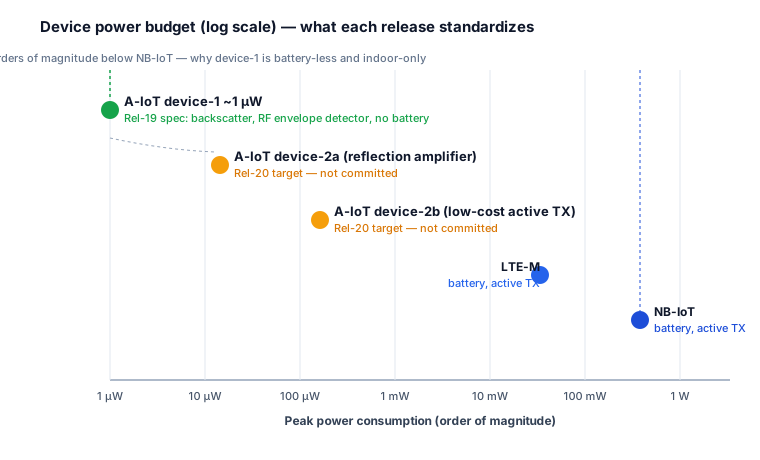
Ambient IoT graduates to a work item — device 1. Rel-19 standardizes the lowest device tier: ~1 µW peak power consumption, backscatter device-to-reader on an external carrier wave, an RF-envelope-detector receiver, OOK/BPSK with Manchester coding, no RRC/PDCP/HARQ/AS-security, and a new AIOTF core function. Scope is deliberately narrow: indoor inventory (rUC1) and indoor command (rUC4) per TR 38.848, FR1 licensed FDD, base-station-reader topology (D1T1). Devices 2a/2b and the UE-as-reader Topology 2 are targeted for Rel-20, not committed. Do not extrapolate device-1 to unlicensed or UE-reader scenarios. The physics and energy-harvesting detail live in Ambient IoT in 6G.
NTN Phase 3 (NR_NTN_Ph3). DL coverage, UL capacity, multicast/broadcast, regenerative payload operation, and RedCap device support over NTN. The system side (5GSAT Ph3) adds Store-and-Forward, UE-to-UE via satellite, and GNSS-independent operation.
Energy, Rel-19. Netw_Energy_NR_enh (on-demand SSB/SIB1) plus the LP-WUS/WUR work item (NR_LPWUS) — low-power wake-up signal and receiver procedures with RF/RRM requirements for IDLE/INACTIVE and CONNECTED.
XR Phase 3, topology, security. XR Phase 3 adds capacity/QoS enhancements (cancellable measurement gaps, UL/DL rate adaptation, optimized RLC/PDCP). Topology work brings wireless-access-backhaul mobile gNBs, 5G NR Femto, vehicle-mounted relays Phase 2, and NR sidelink multi-hop relay. Security adds 256-bit algorithm variants (SNOW 5G, AES, ZUC).
The three most-hyped Rel-19 topics sit at three different rungs of maturity, and vendor marketing routinely flattens them into one. Get this distinction right and you cut through most of the noise.
Figure 2 — Feature maturity matrix: Rel-18/Rel-19 status, 2026 silicon, and live deployment, coded study / spec / silicon / live
SBFD jumped from a Rel-18 study (TR 38.858) to a Rel-19 normative work item (NR_duplex_evo). There is deployable spec text. It is the most mature of the three.
Ambient IoT jumped from two studies (TR 38.848 → TR 38.769) to a shippable device class on paper — but a sharply bounded one (~1 µW device-1, licensed FR1 FDD, indoor only, BS-reader topology).
ISAC remains requirements plus a channel model. The Rel-19 deliverables are the SA1 study TR 22.837, the normative Stage-1 service requirements TS 22.137 "Service requirements for Integrated Sensing and Communication; Stage 1," and clause 7.9 "Channel model(s) for ISAC" inside TR 38.901 — there is no separate ISAC channel-model TR, and crucially no normative RAN sensing feature in Rel-19. If someone tells you their 2026 RAN "does ISAC per Rel-19," ask which TS the sensing waveform is in; there isn't one. The conceptual treatment of joint sensing-and-comms is in ISAC for 6G.
The same applies to the "new spectrum" headline: the 7–24 GHz work in Rel-19 is an exploring study, not a feature. Do not put either ISAC sensing or 7–24 GHz on a Rel-19 deployment plan; they belong on a Rel-20+ watch list.
What's actually shipping in 2026
This is where the maturity ladder pays off. "Frozen" is rung two; silicon is rung three; live network is rung four — and the population thins dramatically at each step.
Silicon. Qualcomm's Snapdragon X85 (announced MWC, March 2025) advertises "3GPP Release 18 support" and is "5G Advanced-ready," with peak DL 12.5 Gbps, UL 3.7 Gbps, 6-carrier aggregation across 400 MHz of sub-6, and a dedicated 5G AI processor. MediaTek's M90 (MWC 2025) is a 5G-Advanced modem rated up to 12 Gbps DL, aligned with Rel-17 and "forthcoming Release 18" features, with engineering samples in H2 2025. Two caveats: M90 details are from press-release syndication (REPORTED, not from a live vendor page), and "Rel-18-ready" silicon marketing predates the X85 — Snapdragon X80 at MWC 2024 already carried that label, so do not treat MWC-2025 silicon as the first Rel-18-capable parts.
Networks. Per GSA's State of the Market (data as of 31 March 2026, GSA-reported via secondary summary — the GSA primary is gated), roughly 11 operators had launched 5G-Advanced networks with about 35 investing, with commercial activity concentrated in Asia and a handful of others (China, Canada, Japan, Kuwait, Vietnam among them). This is the number to publish, not the older November-2025 figure of seven; that earlier count is now stale. Either way the headline for a planner is the same: two years after the Rel-18 freeze, the count of networks running anything branded 5G-Advanced is in the low double digits, not the hundreds.
RedCap (the Rel-17 baseline under eRedCap). GSA reported (April 2025) 30 operators in 21 countries investing in RedCap, with commercial launches including China Mobile/Telecom/Unicom, Dito (Philippines), STC Kuwait, and T-Mobile US. That is Rel-17 RedCap; eRedCap (Rel-18) silicon was not confirmed in market.
LTM in the field. Ericsson, KDDI and MediaTek completed what they described as the world's first in-field joint LTM demonstration, reporting roughly a 25% reduction in data interruption at cell change (announced 2026). The signal here is the stage: the flagship Rel-18 mobility feature was at field-demo stage in 2026, not mass deployment.
Per-feature activation evidence for the rest of Rel-18 (NES, XR awareness, SL-U) in live networks is thin — vendor software claims exist, but only LTM has a clearly documented field demo. Do not assume that a "5G-Advanced launch" press release means any specific Rel-18 feature is switched on; the branding and the feature activation are separate facts.
Ambient IoT: how far below RedCap device-1 sits
Because ambient IoT is the feature most likely to be oversold, it is worth putting its power budget on a log scale next to the IoT classes you already deploy. Rel-19 device-1 is roughly six orders of magnitude below an NB-IoT module — which is exactly why it is battery-less and backscatter-based, and exactly why its scope is so narrow.
Figure 3 — Ambient IoT device-class power ladder: Rel-19 device-1 (~1 µW) vs targeted Rel-20 devices 2a/2b vs NB-IoT/LTE-M, log scale
Device-1 is what Rel-19 standardizes. Device 2a (reflection amplifier) and device 2b (low-cost active transmit), plus the UE-as-reader Topology 2, are Rel-20 targets — useful for roadmap conversations, not for 2026 procurement.
Planning guidance: budget, defer, watch
Reduce the whole program to the question that matters at budget time — what does each feature actually require of you? Three buckets.
Needs new spectrum posture (plan early). SBFD (NR_duplex_evo) reshapes how you use a TDD carrier — non-overlapping UL/DL sub-bands, new cross-link-interference coordination. SL-U pushes sidelink into unlicensed FR1. Both touch spectrum strategy, not just a software load, so they need the longest lead time.
Software-only on compliant kit (lowest friction). Network energy savings (cell DTX/DRX, on-demand SSB/SIB1) and intra-CU LTM ride on a compliant gNB without new spectrum or new devices — these are the realistic near-term wins once the gNB software supports them. Inter-CU LTM follows with Rel-19.
Needs new devices (gate on silicon, not spec freeze). 8Tx UL (CPE/FWA/industrial), eRedCap, and ambient IoT device-1 all require hardware that, for eRedCap and A-IoT, was not yet confirmed in market in 2026. Tie these to verified silicon availability, not to the release freeze date.
Defer to Rel-20 watching. Two-sided CSI-compression AI/ML, ambient IoT Topology 2 and devices 2a/2b, and any normative ISAC sensing all belong on a watch list, not a 2026–2028 deployment plan. Rel-20's Stage 2 freeze (targeted September 2026) is the next checkpoint to re-baseline against, and it is also where the first 6G studies are taking shape.
The through-line for every one of these: the 3GPP feature catalog and the deployed feature set are two different documents. 5G-Advanced has quietly become the FWA-and-verticals program — UL 8Tx for CPE, eRedCap below RedCap, ATG, UAV, NTN-RedCap, ambient IoT, femto and WAB — while the smartphone gets little beyond a faster speed tier. Plan for the addressable-device universe that is actually expanding, grade every feature by which rung of the ladder it is on, and treat "frozen" as the start of the lead time, not the end of it.
The features, and whether they are in your network