IMT-2030 vs IMT-2020: KPI Comparison
The table below compares all 15 capability dimensions. Items marked (new) did not exist in the IMT-2020 framework.
| # | Capability | IMT-2020 (5G) | IMT-2030 (6G) Target | Improvement |
|---|
| 1 | Peak data rate | 20 Gbps | 200 Gbps -- 1 Tbps | 10--50x |
| 2 | User experienced data rate | 100 Mbps | 1--10 Gbps | 10--100x |
| 3 | Spectrum efficiency | 1x (baseline) | 3--5x vs 5G | 3--5x |
| 4 | Area traffic capacity | 10 Mbps/m² | 100--1000 Mbps/m² | 10--100x |
| 5 | Connection density | 10⁶ devices/km² | 10⁷--10⁸ devices/km² | 10--100x |
| 6 | Latency (user plane) | 1 ms | 0.01--0.1 ms | 10--100x |
| 7 | Reliability | 99.999% | 99.99999% (7 nines) | 100x |
| 8 | Mobility | 500 km/h | 1000 km/h | 2x |
| 9 | Energy efficiency | 1x (baseline) | 100x vs 5G | 100x |
| 10 | Coverage (new) | N/A | Ubiquitous (NTN + terrestrial) | -- |
| 11 | Positioning accuracy (new) | N/A | 1--10 cm (indoor/outdoor) | -- |
| 12 | Sensing (new) | N/A | cm-level resolution, sub-m range accuracy | -- |
| 13 | AI integration (new) | N/A | Native AI plane in RAN + Core | -- |
| 14 | Sustainability (new) | N/A | Zero-carbon network operation target | -- |
| 15 | Security/resilience (new) | N/A | Post-quantum, zero-trust | -- |
These targets are defined in ITU-R M.[IMT.VISION 2030] and further elaborated in the ITU-R Working Document towards a preliminary draft new Recommendation (PDNR).
6G Standardization Timeline
| Phase | Period | Activity | Key Milestone |
|---|
| Vision | 2023--2024 | ITU-R IMT-2030 framework approved | M.2160 Recommendation (Nov 2023) |
| Research | 2024--2026 | Pre-standards research, channel models, technology evaluation | 3GPP Release 19 advanced studies |
| Study | 2027--2028 | 3GPP Release 20 study items, candidate RIT proposals | SI approvals at 3GPP TSG RAN |
| Normative | 2029--2030 | 3GPP Release 21 specifications frozen | First 6G ASN.1/protocol specs |
| Evaluation | 2029--2030 | ITU-R evaluates candidate RITs against IMT-2030 | Technology selection complete |
| Commercial | 2031--2032 | First commercial 6G deployments | Initial operator launches |
This timeline mirrors the 5G cadence: IMT-2020 vision was approved in 2015, Release 15 was frozen in 2018, and commercial launches began in 2019.
Key Enabling Technologies
Technology Comparison Matrix
| Technology | TRL (2025) | Expected Gain | Primary Use Case | Key Challenge |
|---|
| Sub-THz (100--300 GHz) | 3--4 | 100+ Gbps per link | Fixed wireless, backhaul, short-range | Severe path loss (>120 dB at 1 m for 300 GHz), device power |
| Reconfigurable Intelligent Surfaces (RIS) | 4--5 | 10--20 dB SNR gain | Coverage extension, NLoS recovery | Real-time channel estimation, large element count |
| Integrated Sensing and Communication (ISAC) | 3--4 | Dual-function waveform, no added spectrum | Automotive radar, gesture recognition, environmental mapping | Waveform design tradeoff, interference management |
| Semantic Communication | 2--3 | 10--100x compression for specific tasks | Video analytics, machine-to-machine | Task-dependent codecs, standardization immaturity |
| AI-Native Air Interface | 3--4 | 20--40% scheduling gain | Beam management, resource allocation | Training data distribution, inference latency |
| Non-Terrestrial Networks (NTN) | 5--6 | Ubiquitous coverage | Rural, maritime, aerial | Doppler compensation, handover with LEO |
Sub-THz Communications
Frequencies between 100 GHz and 300 GHz offer enormous contiguous bandwidth -- up to 10--20 GHz per channel. However, free-space path loss at 300 GHz is approximately 20*log10(300/3.5) = 38.7 dB higher than at 3.5 GHz for the same distance. Atmospheric absorption adds 1--10 dB/km depending on humidity and specific molecular resonances (water vapor at 183 GHz, oxygen at 118 GHz).
Worked Example -- Link Budget at 140 GHz:
- Frequency:
140 GHz, distance: 50 m, Tx power: 10 dBm
- FSPL =
20log10(4pi50140e9 / 3e8) = 20*log10(2.93e5) = 109.3 dB
- Antenna gain (Tx + Rx):
2 x 30 dBi = 60 dBi (high-gain horn/phased array)
- Atmospheric loss at 50 m: negligible (
< 0.5 dB)
- Received power:
10 + 60 - 109.3 - 0.5 = -39.8 dBm
- With 10 GHz bandwidth, thermal noise =
-174 + 10*log10(10e9) = -74 dBm
- SNR =
-39.8 - (-74) = 34.2 dB -- sufficient for 256-QAM
This demonstrates that sub-THz links are viable at short range with high-gain antennas. Nokia Bell Labs demonstrated a 480 Gbps link at 140 GHz over 30 m in 2024.
Reconfigurable Intelligent Surfaces (RIS)
RIS panels consist of hundreds to thousands of sub-wavelength elements, each with programmable phase shifts. They passively reflect incident signals toward the intended receiver, creating constructive interference without active RF chains.
Worked Example -- RIS SNR Gain:
- RIS with
N = 256 elements, each providing phase-aligned reflection
- Ideal coherent combining gain:
20log10(N) = 20log10(256) = 48.2 dB
- Practical gain (with phase quantization, imperfect CSI): approximately
0.6 * 48.2 = 28.9 dB
- This means a signal that was 25 dB below demodulation threshold can be recovered
NTT DOCOMO and Metawave demonstrated a 256-element RIS prototype at 28 GHz in Tokyo, achieving 15 dB SNR improvement in NLoS urban canyon scenarios. The European Hexa-X-II project reported similar gains at 140 GHz with a 1024-element surface.
ISAC -- Integrated Sensing and Communication
ISAC reuses the communication waveform for radar-like sensing. 3GPP introduced ISAC study items in Release 19 (TR 22.837) to define sensing service requirements. The target sensing resolution scales with bandwidth: a 400 MHz NR carrier at FR2 provides range resolution of c / (2BW) = 3e8 / (2400e6) = 0.375 m. At sub-THz bandwidths of 10 GHz, resolution drops to 1.5 cm.
Global Research Programs
Four major programs are driving pre-standards 6G research:
- Hexa-X-II (EU): Horizon Europe flagship, 44 partners including Nokia, Ericsson, and Siemens. Focus areas include sub-THz, RIS, ISAC, and sustainability. Budget: EUR 60 million (2023--2025).
- 6G Flagship (University of Oulu, Finland): The world’s first 6G research program, launched in 2018. Published over 1,500 papers. Developed the first sub-THz OTA testbed at 300 GHz. Led the early definition of 6G KPIs that influenced ITU-R M.2160.
- Next G Alliance (ATIS, North America): Industry consortium with over 90 members including AT&T, T-Mobile, Qualcomm, and Apple. Published the 6G Green G roadmap and National 6G Roadmap. Focuses on North American competitiveness and spectrum policy above 100 GHz.
- NGMN 6G Drivers and Vision (Global operators): Published the 6G Drivers and Vision white paper in 2024, defining operator requirements. Key demands include 100x energy efficiency, AI-native architecture, and sub-1 cm positioning. Members include Deutsche Telekom, China Mobile, SK Telecom, and NTT DOCOMO.
South Korea's 6G R&D Program under the Ministry of Science allocated KRW 220 billion (approximately USD 170 million) through 2028, with Samsung and LG leading sub-THz IC and antenna development. SK Telecom demonstrated a prototype 6G link at 170 GHz in 2024 achieving 12 Gbps.
China's IMT-2030 Promotion Group, led by MIIT, coordinates research across Huawei, ZTE, and CATT. Huawei demonstrated a proof-of-concept ISAC system at 6 GHz with simultaneous 10 Gbps data and cm-level sensing resolution.
Spectrum Considerations
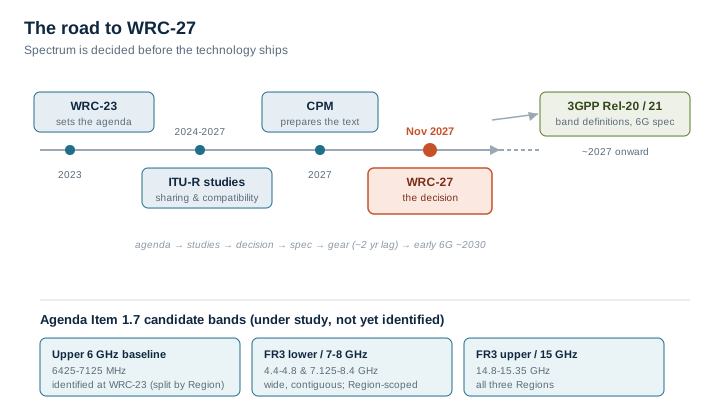
WRC-23 identified the 4.4--4.8 GHz and 6.425--7.125 GHz bands for IMT, providing critical mid-band spectrum for 6G coverage layers. The next WRC cycle (WRC-27) will address spectrum above 100 GHz for IMT-2030, with candidate bands at 114.25--174.8 GHz and 252--296 GHz.
The ITU-R has initiated sharing studies for these bands under Resolution 248 (WRC-23). Coexistence with passive services (radio astronomy, earth exploration satellite) at 183 GHz and 118 GHz absorption lines is a primary concern.
Architecture Shifts
6G architecture moves beyond the service-based architecture (SBA) of 5G Core:
- AI-as-a-Service plane: A dedicated AI orchestration layer manages distributed inference across RAN, edge, and cloud. 3GPP has begun studying this under TR 38.843 (AI/ML for NR air interface).
- Compute-communication convergence: Network functions dynamically migrate between edge nodes based on latency and compute availability.
- Digital twin integration: Real-time network digital twins feed optimization loops. The O-RAN Alliance’s digital twin framework (published 2024) provides the foundation.
- Post-quantum security: NIST PQC algorithms (ML-KEM, ML-DSA) are expected to replace current ECC-based schemes in 6G signaling.
What Actually Has a Date, and What to Ignore Until It Does
Read the timeline above again and take the two rows that matter: normative specs
around 2029-2030, commercial service 2031-2032.
That has a blunt consequence worth saying out loud, because almost nothing
written about 6G says it. Nothing you procure this decade will be 6G. Any
equipment sold to you as 6G-ready before there is a specification to be ready for
is a marketing claim, not a capability, and the honest question to ask a vendor
is which 3GPP work item they are implementing. Before Release 21 there is no
answer to that question.
So the short list of things with real dates:
WRC-27 is the only near-term decision that binds anyone. Spectrum allocated
there determines what 6G can physically use, and unlike a study item it produces
a treaty-level outcome on a fixed calendar. If you track exactly one 6G thing,
track this. We have a page on it: the road to
WRC-27.
Release 19 and 20 study items matter to you only if you contribute to them.
Reading study items as a roadmap is a common and expensive mistake — most study
items never become work items, and a study is not a commitment by anyone to build
anything.
Everything else on this page is research. Sub-THz, RIS, ISAC and semantic
communications are genuinely interesting and sit at low technology readiness.
They belong in a research budget or a university partnership, not in a network
plan.
When somebody senior asks you about 6G
They have usually read a press release and want to know whether they are behind.
The useful answer has three parts, and it takes about a minute:
- No specification exists yet. First normative 3GPP specs are expected
around 2030, first commercial networks after that.
- The one date to watch is WRC-27, because spectrum decisions are slow to
change and everything else is downstream of them.
- The work that pays off now is 5G-Advanced, which is real, specified, and
deployable — and most of the capability 6G will need (AI/ML operations,
energy-aware RAN, cloud-native cores) is being built there first.
That last point is the one worth defending. The teams that will handle 6G well
are not the ones reading 6G papers today; they are the ones who got good at
running an AI-assisted, energy-aware 5G-Advanced network. The skills transfer.
The press releases do not.
What Operators Should Do Now
- Track 3GPP Release 19/20 study items -- particularly those on AI/ML, ISAC, and NTN.
- Invest in sub-THz testbeds -- the 140 GHz band is the most mature for early prototyping.
- Evaluate RIS for existing mmWave deployments -- RIS can improve 5G coverage today and scale to 6G.
- Build AI/ML operations teams -- 6G will require ML engineers alongside traditional RF engineers.
- Engage with NGMN and Next G Alliance -- early participation shapes requirements.
> Key Takeaway: 6G under the IMT-2030 framework is not a distant concept -- ITU has already approved the vision, 3GPP Release 21 will deliver the first normative specifications around 2030, and technologies like sub-THz, RIS, and ISAC are already at TRL 3--5. Operators who begin testbed investment and AI/ML capability building now will be positioned for first-mover advantage when commercial deployments begin around 2032.
What to do with this before 2030
Nothing in this article is buyable, and that is the honest summary. The
features that carry 6G branding in vendor decks are Release 18 and 19 work —
5G-Advanced covers what is actually specified, with
the AI/ML and energy-saving items that get relabelled most often, and the
3GPP release timeline has the method for
settling whether a claimed feature exists in a release at all.
If you want to work on the parts of this that are real today, the AI-in-the-RAN
material is deployable now rather than in 2030 —
AI-RAN specialist covers where a model can
sit and what each position costs.