For RAN, core, cloud and 6G engineers
5G is everywhere.
Prove you can lead it.
Certification courses for telecom engineers moving into advanced roles: 13 courses with hands-on labs, each with a publicly verifiable TELCOMA certificate.
- Every 5G & 6G course free for 7 days
- No card needed
17 Years
Certifying telecom engineers since 2009
Pick the role you’re moving into.
Each route is the exact courses, in order, and each course ends in a graded exam and its own TELCOMA certificate. One Prime Membership opens every route.
Explore the certification courses
13 certification courses · 404 video lessons · ~52 h of video · 184 hands-on exercises · a certificate for each
See all courses →5G essentials
The system every 5G role works in: the radio, the core and the call end to end.
 Every route starts here
5G Foundation
What 5G actually changes vs 4G — architecture, spectrum and the core procedures, from first principles.

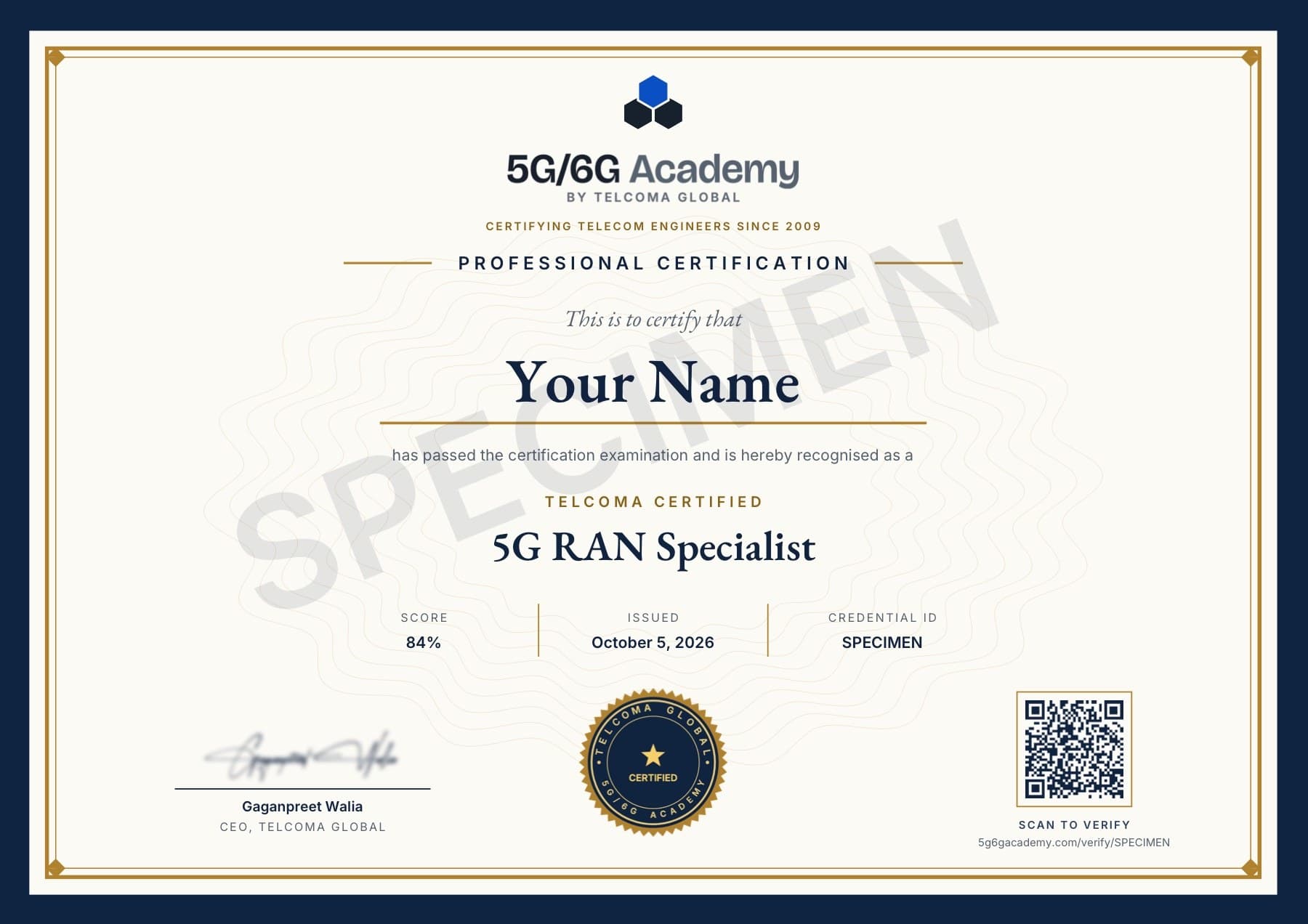
5G RAN Specialist
The radio access network in depth — ORAN, scheduling, beamforming and QoS, with 3GPP-accurate traces and configs to troubleshoot.

5G Core & E2E Specialist
Cloud-native core, slicing, security and end-to-end call flow — inspect a simulated 5G core, not a slide deck.
RAN engineering
For RAN planning and optimisation roles: plan a network you can defend in a design review, then prove why it misbehaves.

5G RAN Planning & Design
Radio planning as arithmetic you can defend — a link budget that ends in a cell radius, a capacity chain that ends in a site count, and the parameter sheet that leaves your desk.

5G RAN Optimisation & Performance
Why the call does not get in, why it drops, and why it is slow — told apart on evidence, with the denominator checked before the verdict.
Cloud & security
For telco cloud and security roles: run the 5G core on Kubernetes, and defend it.

Telco Cloud: Kubernetes, CNFs & GitOps
Kubernetes as the machinery under a running 5G core — why healing loses the session, how a node is tuned for a user plane, and a change you can take back out.
5G Security: SUCI to Post-Quantum
What a specification implements against what your network actually uses — the concealed identity and what it never proves, how far one token really reaches, and a migration you can defend row by row.
Private 5G & IoT
For private-network and IoT roles: design a plant’s own 5G network, and the devices it can afford.
 New
Private 5G: NPN Architecture, Spectrum & the Enterprise Edge
Whose network it is, which spectrum it may use, how many cells a metal hall really needs, and where the core sits when the WAN goes down.
 New
RedCap, eRedCap & Ambient IoT
Each cut that makes a 5G device cheaper — receive branches, bandwidth, listening time — and what it costs in coverage, capacity and reach, down to a battery-free tag.
AI in the network
For AI and automation roles: put AI where it pays in a network, and inside the radio itself.

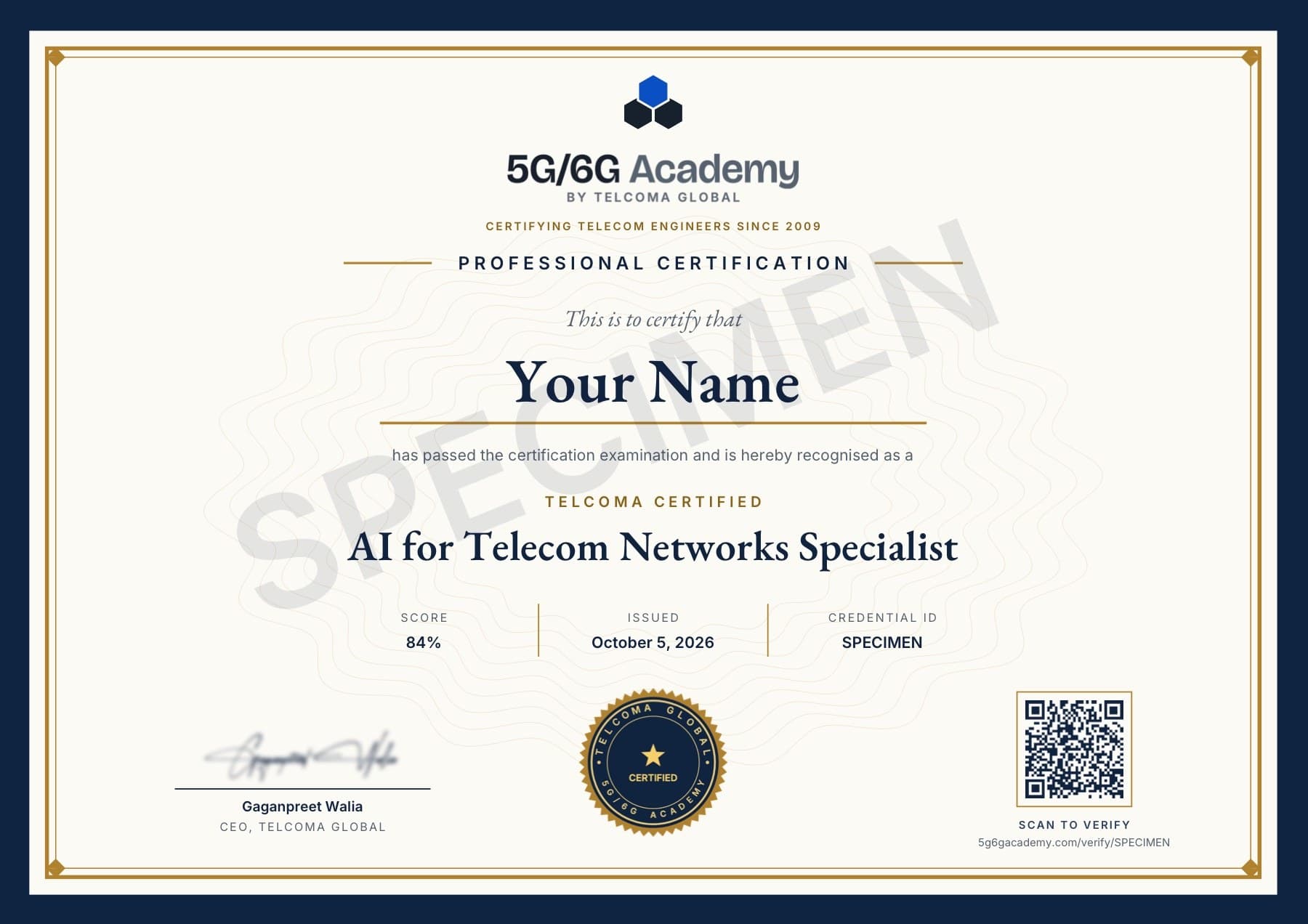
AI for Telecom Networks
Where AI already runs in a network — forecasting, anomaly detection, the core’s own analytics, and choosing a first deployment that cannot hurt you.

AI-RAN & the AI-Native Network
AI inside the radio itself — the 3GPP hooks that went normative, apps running on live networks, and energy numbers with honest denominators.
6G & satellite
For standards, NTN and satellite roles: what 6G has actually agreed, and the satellite link worked as arithmetic.

Road to 6G: IMT-2030 & the First 6G Specifications
6G as it actually stands, not as it is pitched — the targets ITU-R set, what the studies have genuinely agreed, and one ruler for placing any 6G claim.

NTN & Direct-to-Device: 5G from Orbit
The satellite link as arithmetic — slant range you can compute, a budget that closes in both directions, and the mobility a moving cell forces.
- 18:29:50.000NOTICENGAPSudden NG-C burst detected: 220 UEContextReleases/s from gNB-MET-SEC-E-012 (utility power event upstream)
- 18:30:00.080WARNAMFue_reg_rate=1420 req/s spiking (7x baseline) from 84 gNBs
- 18:30:03.020WARNAMFue_reg_rate=2100 req/s, queue_depth=640 (target<500)
- 18:30:06.040WARNAMFue_reg_rate=2483 req/s, queue_depth=1102, p99_latency=520ms (target<200ms)
- 18:30:09.080INFOAMFAutoscaler event: HPA observing cpu=71%, no scale-up yet (threshold 80%)
- 18:30:11.010WARNSBINausf_UEAuthentication pool in_use=60/64, p50=18ms, p99=140ms — pool nearing exhaustion (the AUSF is waiting on the UDM behind it)
- 18:30:14.030INFOAMFue_reg_rate=2412 req/s, queue_depth=1350, p99_latency=780ms
- 18:30:19.005DEBUGNASAuthenticationRequest dispatched for 98 UEs in last 3s
- 18:30:22.090WARNSBINausf_UEAuthentication pool in_use=64/64 saturated, new requests queued
- 18:30:28.110WARNAMFqueue_depth=1820, p99_latency=1240ms — SLA breached (target<200ms)
Troubleshoot it the way the job does.
You don't learn 5G from bullet points. The labs put you on 3GPP-accurate traces, configs and logs, and a simulated 5G core you can break and fix: the faults RAN and core engineers get called in for.
- Dissect 3GPP-accurate PCAPs, call flows and RAN procedures
- Break and fix a simulated 5G core in a safe sandbox
- TelcoMentor AI coach on call inside every lesson
A certificate your next employer can check.
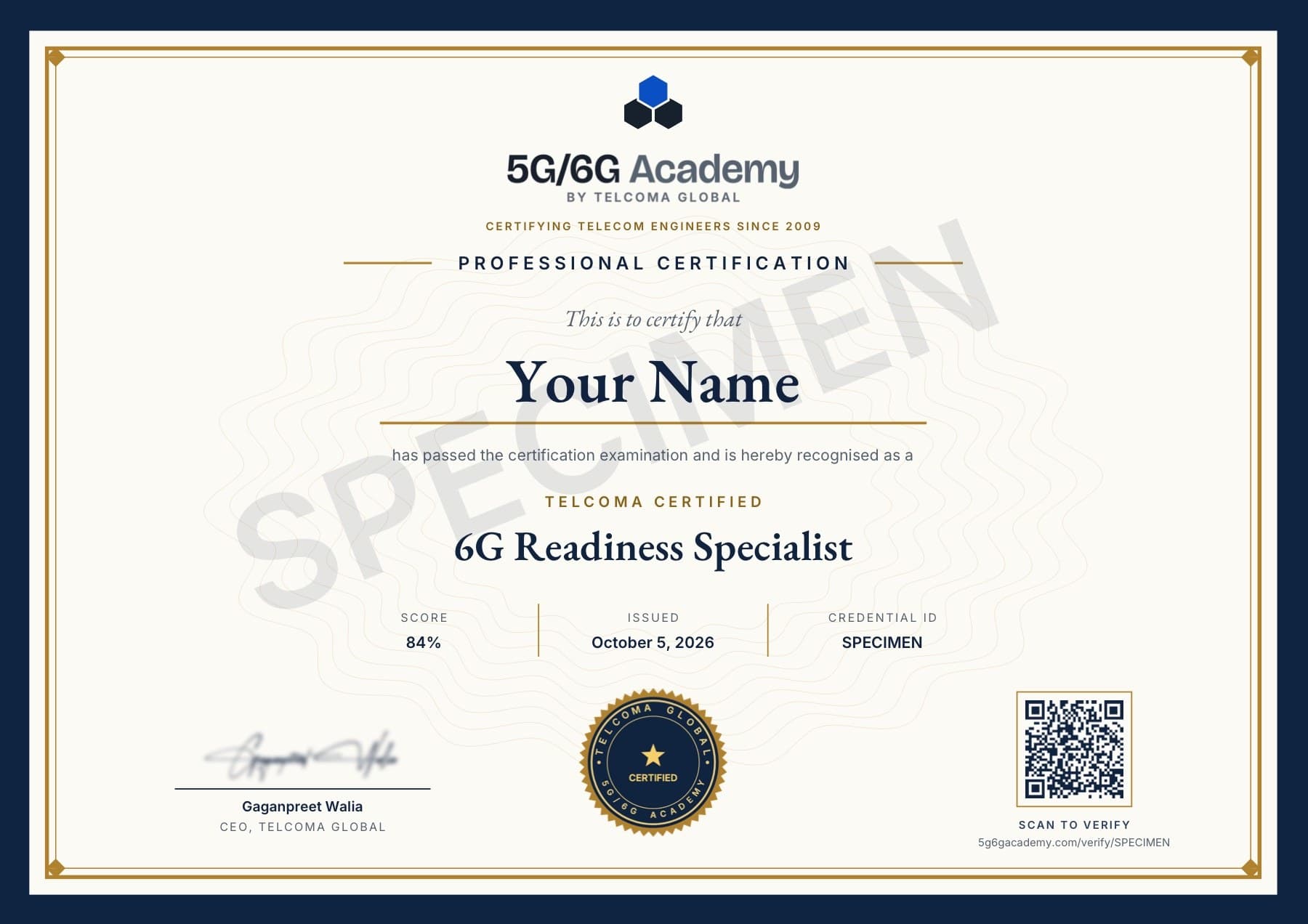
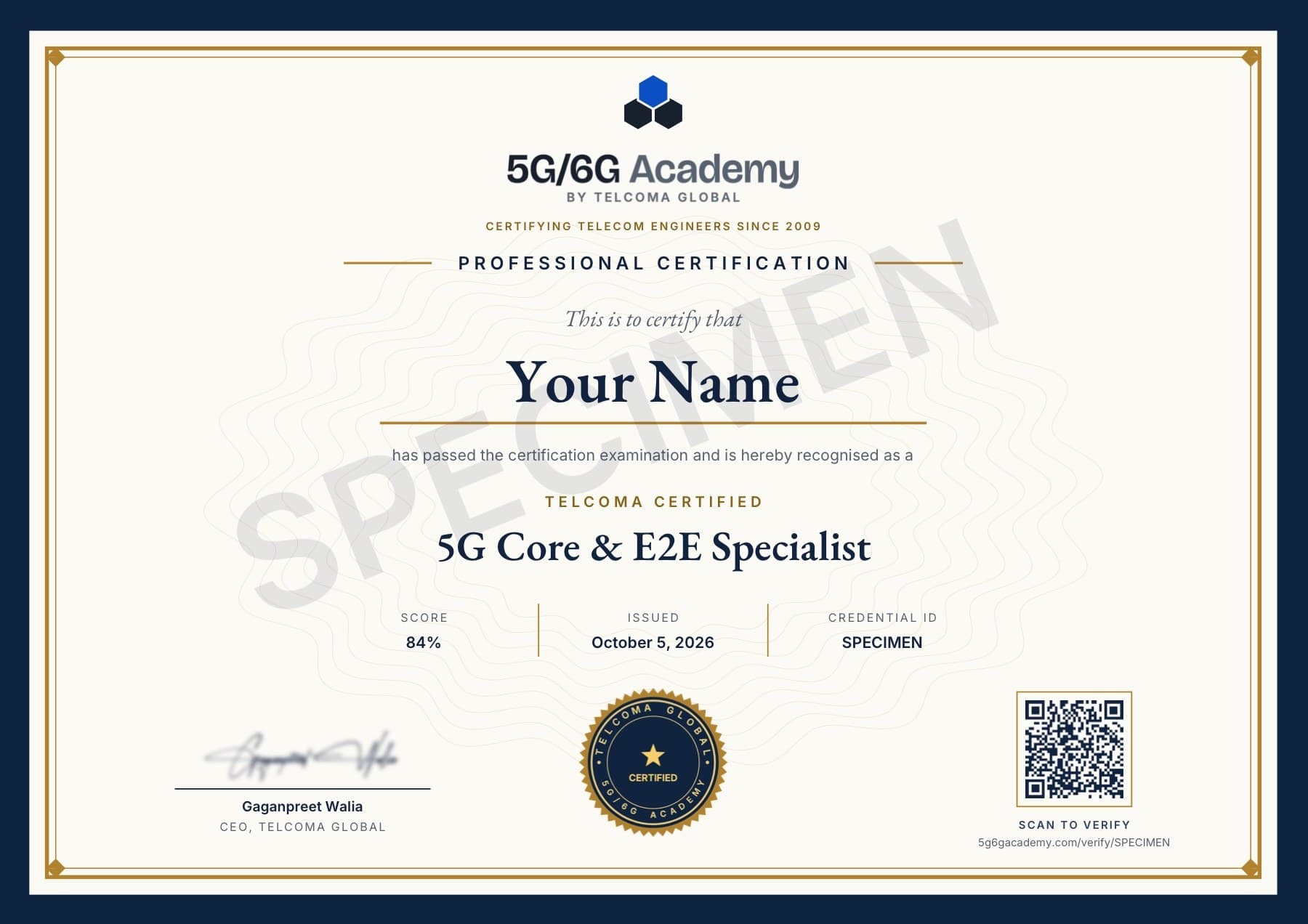
Pass a graded course exam and earn a numbered TELCOMA certificate, QR-linked to a public verification page and ready for LinkedIn.
When it gets hard, help is built in.
A coach that knows the course you are on. Ask anything inside any lesson or lab and get an answer grounded in what you're working on — not generic search results.
- Course-awareKnows exactly which lesson you're on and explains from its content.
- 3GPP spec referencesThe relevant specification is named where it applies, so you can check it yourself.
- Connects the dotsLinks concepts across levels — “this builds on the Core Network module.”
- Stuck? help in every exerciseWhere to look, then how to reason it, then the worked answer — so a hard lab never ends the session.
Beamforming focuses energy toward a specific user instead of broadcasting in every direction — same power, concentrated where it's needed.
That's how 5G NR lifts throughput without raising total radiated power. 3GPP TS 38.214
Every career route. One membership.
Prime Membership opens every certification course on every route, and every one we add: the hands-on labs, the full-length practice exams, TelcoMentor, and the graded exam that earns a publicly verifiable certificate for each course you pass.
New courses every month. 10 added since July, and every one is included in your membership.
- Every routeAll 13 certification courses, with new ones every month
- Certification examsA graded exam and a numbered, publicly verifiable certificate for each course you pass
- Hands-on practiceLabs, troubleshooting scenarios on 3GPP-accurate traces, and full-length practice exams
- Your price, keptYou renew at the price you joined at. 7-day money-back guarantee
The engineers who run the world's networks train with us
A selection of the operators, vendors, integrators, governments and institutes where our learners work.
Questions, answered.
Will this help me move into a more advanced role?
That is what it is built for. Pick one of 12 career routes, from RAN and core to telco cloud, security and 6G. Each lists the exact courses in order and what you will be able to do at the end, and each course ends in a graded exam and a publicly verifiable TELCOMA certificate you can show any employer.
Can I try it before paying?
Yes — a free account opens every certification course for 7 days, with no card: every module, the hands-on labs, the full-length practice exams and TelcoMentor. After the 7 days the first module of every course stays free on your account — its first lesson plays with no account at all — along with the 20-question mock exam, our articles, glossary and tools. The certification exam and the verifiable certificate it earns come with Prime Membership, or with buying that one certification on its own — either way backed by a 7-day money-back guarantee.
Can I cancel anytime?
Yes. Cancel anytime from your dashboard in one click. You keep full access until the end of your billing period. No questions asked, no retention calls.
How is this different from YouTube tutorials?
YouTube teaches you to recognize concepts. 5G/6G Academy teaches you to apply them. You troubleshoot 3GPP-accurate protocol traces, tune parameters in interactive labs, debug failed procedures, and break and fix a simulated 5G core. Plus TelcoMentor answers your questions grounded in the exact lesson you're on — not generic internet answers.
Are the TELCOMA certifications recognized?
Each certificate shows that you passed a graded exam on the course material. It carries a unique verification number and a QR code that opens its own public verification page, so an employer can check it without asking you for a copy. It is a TELCOMA credential, issued by TELCOMA Global — not a 3GPP, ITU, vendor or government accreditation.
What if I get stuck?
Help is built in where it happens. In a lesson, TelcoMentor — an AI coach that knows the lesson you are on — explains it from the lesson's own content, with the 3GPP specification reference so you can check it. In an exercise, the “Stuck?” help gives a nudge, then the method, then the worked answer, and points you to the exact lesson moment to rewatch.
Where should I start?
Where your experience is. Experienced engineers start in the specialist course for their field, and each career route lists its courses in order so you can see what it assumes. The entry course covers 5G from first principles for anyone new to it, from what happens when you make a call through the radio network and the core. A new account opens every course free for 7 days, so you can check the level before paying anything.