 Watch free
Free preview · Standalone-core dependency: device classes on two status rails — opens in the course player
RedCap, eRedCap & Ambient IoT
Every cellular IoT device class is a bargain with a price: each cut in receive branches, bandwidth, peak rate or listening time is paid back in coverage, cell capacity, airtime or reachability. This course prices each one with computed numbers — battery days, reach in decibels, a cell's admission rules, a battery-free tag's link budget — and ends on a class defended for each of six reference devices.
Every 5G & 6G course free for 7 days
- Lessons
- 29
- Video
- ≈3.0h
- Hands-on
- 4 labs · 7 checkpoints
- Before you start
- 5G Foundation
About this course
Who it's for. Telecom engineers in RAN, core, device and test, and IoT and device engineers new to 3GPP.
Before you start. 5G Foundation. RAN and core depth are not assumed — decibels, receive branches, bandwidth parts, random access and paging are built from zero where the course needs them.
This course includes
- 29 video lessons — the first needs no account, and all are free for your first 7 days
- Hands-on labs and checkpoints
- Study pack — question bank and slides
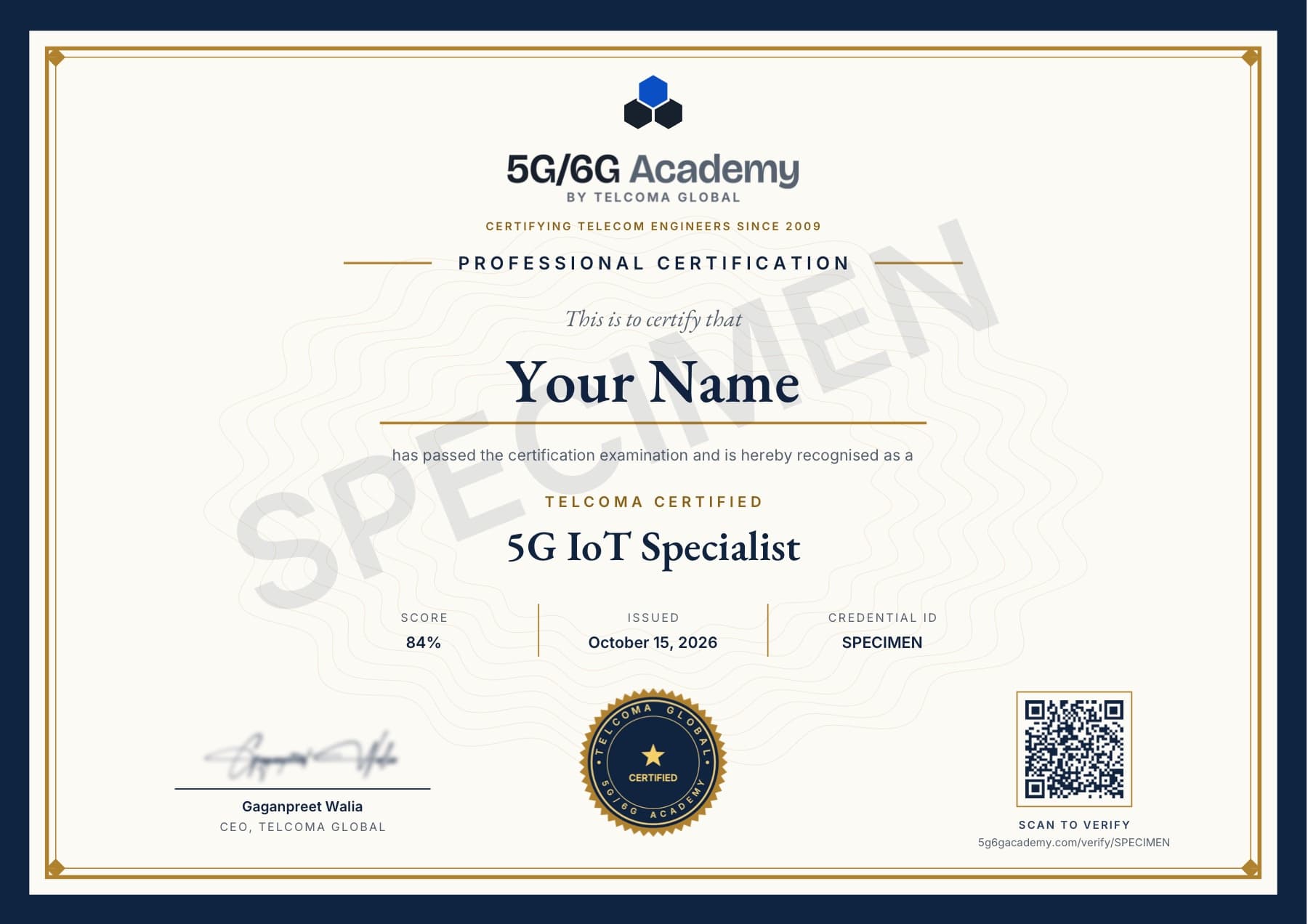
- Certification exam and a QR-verifiable certificate
Skills you'll gain
- IoT device-class selection
- RedCap & eRedCap trade-offs
- IoT link budgets
- SIB1 admission & bandwidth parts
- eDRX, PSM & MICO
- Battery-life budgeting
- Ambient IoT & backscatter
- LTE-M & NB-IoT comparison
Syllabus
6 modules · 29 lessons · certification exam
Module 1 — Device-class selection basics: rate, reach, power, cost
Place RedCap, eRedCap, Ambient IoT and the incumbents on specification and field rails, turn sleep current into battery days, read reach in decibels, and make a first-cut class choice for six reference devices.
4 lessons · 1 checkpoint · ≈25 min
- Lesson 1Standalone-core dependency: device classes on two status railsWatch free6:42
- Lesson 2Sleep current to battery days: one module’s floorFree with an account6:06
- Lesson 3Maximum coupling loss in decibels: phone to basementFree with an account5:22
- Lesson 4Device-class gates: six reference devices, first cutFree with an account6:28
- CheckpointRun the Four Gates · Checkpoint~5 min
Module 2 — RedCap Rel-17 trims and eRedCap: what each cut costs
Price each RedCap trim in cost, peak rate and coverage, read what RedCap keeps and drops, and how eRedCap caps data on a full-width radio.
5 lessons · 1 lab · 1 checkpoint · ≈28 min
- Lesson 1RedCap’s cost ledger: each trim priced separatelyFree for 7 days with a free account, then with Prime Membership6:58
- Lesson 2Peak-rate formula: one or two receive branchesFree for 7 days with a free account, then with Prime Membership4:58
- Lesson 3Half-duplex FDD type A: what RedCap keeps and dropsFree for 7 days with a free account, then with Prime Membership5:41
- Lesson 4One receive branch and a small body: the coverage billFree for 7 days with a free account, then with Prime Membership5:42
- Lesson 5eRedCap: full-width radio, ten-megabit data capFree for 7 days with a free account, then with Prime Membership4:50
- CheckpointRead the Capability Report · Checkpoint~5 min
- Interactive labWhat the Formula Gives · Interactive lab~6 min
Module 3 — RedCap cell admission: SIB1, bandwidth parts, capacity bill
Read the SIB1 flags that admit RedCap and eRedCap, place their bandwidth parts, trace early indication to the core, weigh the capacity cost and prove admission.
5 lessons · 1 lab · 1 checkpoint · ≈29 min
- Lesson 1SIB1 admission flags: barred unless toldFree for 7 days with a free account, then with Prime Membership6:32
- Lesson 2RedCap initial bandwidth part: on a wide carrierFree for 7 days with a free account, then with Prime Membership6:45
- Lesson 3Early indication: Msg1, Msg3, then the coreFree for 7 days with a free account, then with Prime Membership5:48
- Lesson 4PDCCH blocking and access load: RedCap’s capacity billFree for 7 days with a free account, then with Prime Membership5:15
- Lesson 5End-to-end admission proof: cell, core, subscriptionFree for 7 days with a free account, then with Prime Membership4:41
- Interactive labWrite the Broadcast · Interactive lab~7 min
- CheckpointWho Knows It Is RedCap · Checkpoint~6 min
Module 4 — Battery life as a computed budget: tail, eDRX, MICO and listening less
Work out where each report's energy goes, including the tail the network operator sets, and how far eDRX, MICO mode and wake-up signalling stretch a battery's derated life.
5 lessons · 1 lab · 1 checkpoint · ≈34 min
- Lesson 1Inactivity tail: where a report’s energy goesFree for 7 days with a free account, then with Prime Membership5:26
- Lesson 2eDRX in hyperframes: paging windows, locks and releasesFree for 7 days with a free account, then with Prime Membership8:00
- Lesson 3MICO mode with Active Time: PSM’s 5G counterpartFree for 7 days with a free account, then with Prime Membership6:19
- Lesson 4Wake-up signalling: paging early indication to wake-up receiversFree for 7 days with a free account, then with Prime Membership6:49
- Lesson 5Battery-life ledger: state currents to derated yearsFree for 7 days with a free account, then with Prime Membership7:01
- CheckpointWhere the Message Waits · Checkpoint~6 min
- Interactive labFill the Ledger · Interactive lab~6 min
Module 5 — Ambient IoT: backscatter, readers and the release train
Trace Ambient IoT backscatter, budget both links, walk the Rel-19 inventory, sort device names by document, and weigh the 3GPP tag against RAIN RFID.
5 lessons · 1 lab · 1 checkpoint · ≈36 min
- Lesson 1Backscatter and harvesting: the Rel-19 tag has no transmitterFree for 7 days with a free account, then with Prime Membership6:57
- Lesson 2Round-trip link budget: two path losses in seriesFree for 7 days with a free account, then with Prime Membership6:55
- Lesson 3Rel-19 inventory: base-station reader, carrier-wave node, three-step accessFree for 7 days with a free account, then with Prime Membership6:51
- Lesson 4Ambient IoT device types and topologies: Rel-19 to Rel-20Free for 7 days with a free account, then with Prime Membership7:42
- Lesson 5RAIN RFID and battery-free Bluetooth: the non-3GPP laneFree for 7 days with a free account, then with Prime Membership7:32
- Interactive labWalk the Aisle · Interactive lab~7 min
- CheckpointWho Supplies the Wave · Checkpoint~5 min
Module 6 — Device-class selection: incumbents, acceptance, a defended design
Weigh LTE-M, NB-IoT and Cat-1bis against RedCap and eRedCap, clear device acceptance, defend six classes with computed numbers, then stress-test the fleet against network exits.
5 lessons · 2 checkpoints · ≈31 min
- Lesson 1LTE-M and NB-IoT coverage: repetition and power densityFree for 7 days with a free account, then with Prime Membership6:48
- Lesson 2eRedCap energy per transfer: Cat-1bis beside itFree for 7 days with a free account, then with Prime Membership6:19
- Lesson 3RedCap device acceptance: antennas, body loss, certificationFree for 7 days with a free account, then with Prime Membership5:07
- Lesson 4Device-class selection: six reference devices, defendedFree for 7 days with a free account, then with Prime Membership7:00
- Lesson 5Network sunsets and multimode migration: stress-testing the fleetFree for 7 days with a free account, then with Prime Membership5:26
- CheckpointDefend the Class · Checkpoint~6 min
- CheckpointWhen the Network Leaves · Checkpoint~6 min
Certification exam
Earns a certificate42 questions · 60 min · 65% to pass — earns your TELCOMA Certified 5G IoT Specialist, a QR-verifiable certificate.
Look up any acronym in the telecom glossary
Certification
Earn the TELCOMA Certified 5G IoT Specialist
Pass the 42-question exam with 65% or more, and the certificate is yours to show anyone.
- Show proofEvery certificate carries a QR code and a public page that anyone can check.
- Add it to LinkedInPut it in the Licenses & certifications section of your profile in one click.
- Build a collectionEach of our 13 courses earns its own certificate.
Study materials
Download the RedCap, eRedCap & Ambient IoT question bank and slide deck — every signal check in the course, with answers, plus every figure.
- Question BankPDF40 KB
- Slide DeckPPTX17 MB
Hands-on learning
Do it, don't just watch it
Modules end with a hands-on exercise — 4 labs · 7 checkpoints in this course. You move the controls, the numbers answer back, and a wrong turn tells you why.
Try this one first:
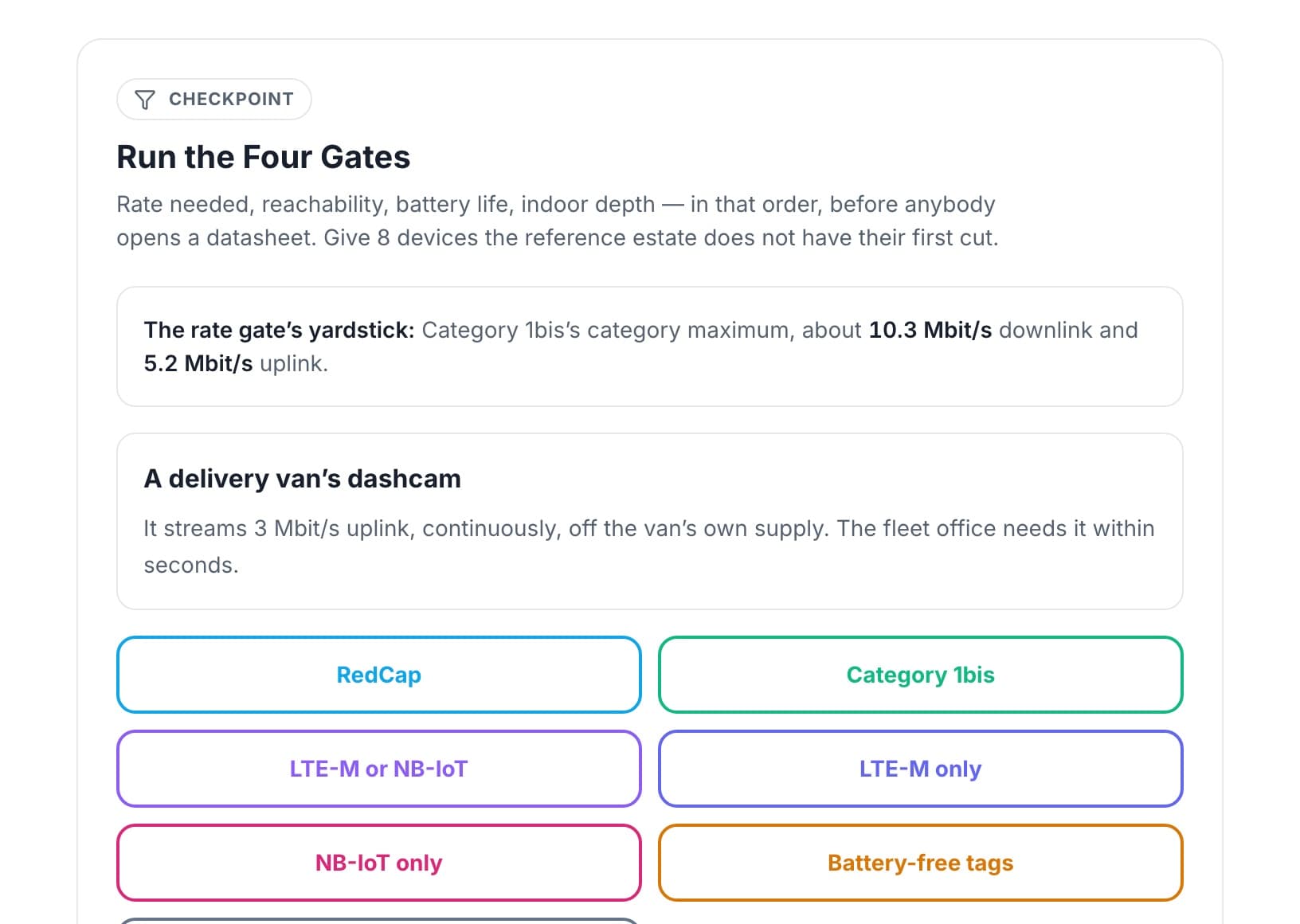
Run the Four Gates · Checkpoint · ~5 min
Try it freeFree with an account — no card.
What you'll build
3 of 11 — the rest are in the syllabus
- Lab 1What the Formula GivesOne formula turns capabilities into a peak rate. Move the receive branches, the modulation, the carrier and the frame’s share one at a time — then cap eRedCap two ways.Module 2~6 min
- Lab 2Write the BroadcastA cell phones camp on that bars every RedCap device. Write its RedCap flags and run three devices through them: who camps, who is barred at which gate, and where each may look next.Module 3~7 min
- Lab 3Fill the LedgerA current, the capacity over it, then a derating and the cell’s own self-discharge. Fill the ledger for the meter, the sensor and the wearable, and see which figures earn the word derated.Module 4~6 min
Ways to learn
Choose the way that fits you.
| Feature | This certification Price loadingonce One credential, yours for good | Recommended Prime Membership Price loading/year Every course, including new ones | Free account Free Every course for your first 7 days, then the first module of each |
|---|---|---|---|
| Lessons and labs in this course | All for your first 7 days, then the first module | ||
| Study pack — question bank and slides | For your first 7 days | ||
| Certification exam and verifiable certificate | This course | Every course | |
| Every other course | First module | All, and new ones | All for your first 7 days, then the first module |
| Full-length practice exams | For your first 7 days | ||
| TelcoMentor AI coach | For your first 7 days, at a smaller daily limit | ||
| Hands-on scenarios — traces, logs, configs | Selected traces | All for your first 7 days, then selected traces | |
One payment · no renewal | See Prime Membership Renews yearly · cancel anytime | Join for free No card needed |
This certification
Price loadingonce
One credential, yours for good
- Lessons and labs in this course
- Study pack — question bank and slides
- Certification exam and verifiable certificate — this course
- Every other course — first module
- Not included: Full-length practice exams
- Not included: TelcoMentor AI coach
- Hands-on scenarios — traces, logs, configs — selected traces
One payment · no renewal
Prime Membership
Price loading/year
Every course, including new ones
- Lessons and labs in this course
- Study pack — question bank and slides
- Certification exam and verifiable certificate — every course
- Every other course — all, and new ones
- Full-length practice exams
- TelcoMentor AI coach
- Hands-on scenarios — traces, logs, configs
Renews yearly · cancel anytime
Free account
Free
Every course for your first 7 days, then the first module of each
- Lessons and labs in this course — all for your first 7 days, then the first module
- Study pack — question bank and slides — for your first 7 days
- Not included: Certification exam and verifiable certificate
- Every other course — all for your first 7 days, then the first module
- Full-length practice exams — for your first 7 days
- TelcoMentor AI coach — for your first 7 days, at a smaller daily limit
- Hands-on scenarios — traces, logs, configs — all for your first 7 days, then selected traces
No card needed
A new free account opens every course for its first 7 days, no card needed: every lesson and lab, the study packs, the full-length practice exams and TelcoMentor. In those 7 days only the certification exam needs a paid option. After them, the first module of every course stays free. Both paid options come with a 7-day money-back guarantee.
Explore more courses
See all 13 courses → Private 5GSNPN & PNI-NPN designNetwork function placementEAP-TLS & credentials holdersIntermediate34 lessons~3.6h
 5G Foundation5G system architectureNSA vs SAService-based architectureBeginner34 lessons~3.3h
 5G RAN SpecialistNR numerology & frame structureBandwidth partsSSB & random accessIntermediate31 lessons~3.4h