 Watch free
Free preview · The optimisation loop: measure, diagnose, change, verify — opens in the course player
5G RAN Optimisation & Performance
The optimisation loop as a decision procedure run on numbers somebody else produced. Accessibility, retainability, mobility and throughput taken apart until causes that share a symptom can be told apart — and a running theme that the denominator is where the lie lives, because correcting it changes the verdict rather than the decimal place.
Every 5G & 6G course free for 7 days
- Lessons
- 31
- Video
- ≈5.1h
- Hands-on
- 5 labs · 5 checkpoints
- Before you start
- 5G RAN Planning & Design
About this course
Who it's for. RAN performance and optimisation engineers, NOC and field teams, and anyone who answers for a KPI they did not compute.
Before you start. 5G RAN Planning & Design — this course operates the cell that one designs, and inherits its reference case by reference rather than by copy. 5G RAN Specialist helps throughout.
This course includes
- 31 video lessons — the first needs no account, and all are free for your first 7 days
- Hands-on labs and checkpoints
- Study pack — question bank and slides
- A free mock exam to find your gaps
- Certification exam and a QR-verifiable certificate
Skills you'll gain
- Counters & KPIs
- Accessibility analysis
- Retainability & radio link failure
- Mobility robustness
- Throughput & interference
- Measurement campaign design
- Parameter change trials
- Vendor KPI mapping
Syllabus
6 modules · 31 lessons · certification exam
Module 1 — From a design handover to a live cell
Turn a design handover into a loop you can run: what the operations system stores, why four instruments disagree, and which half of a ratio moved.
4 lessons · 1 lab · 1 checkpoint · ≈33 min
- Lesson 1The optimisation loop: measure, diagnose, change, verifyWatch free7:25
- Lesson 2Counters, KPIs and the measurement object: what the OSS storesFree with an account8:12
- Lesson 3Cell trace, device reports and campaigns: four sources, four different answersFree with an account8:59
- Lesson 4Numerator and denominator: reading a regression before you touch anythingFree with an account8:20
- CheckpointFour Instruments, One Hour · Checkpoint~6 min
- Interactive labWhich Half Moved? · Interactive lab~7 min
Module files
- M1-worksheet.xlsx17 KB
- M1-busy-hour-ledger-day-12.csv1 KB
- M1-change-log-cell-A.csv1 KB
- M1-daily-counters-cell-A.csv1 KB
Module 2 — Accessibility: why the call does not get in
Compose accessibility from its stages, learn where each counter arms and which two stages nothing watches, then tell its causes apart on evidence that exists.
6 lessons · 1 lab · 1 checkpoint · ≈52 min
- Lesson 1The access chain: five stages, and the two no standard counter watchesFree for 7 days with a free account, then with Prime Membership9:02
- Lesson 2Setup signalling: five messages, and where each counter armsFree for 7 days with a free account, then with Prime Membership8:27
- Lesson 3Composing accessibility: three rates multiplied — and the KPI that is not that numberFree for 7 days with a free account, then with Prime Membership8:59
- Lesson 4Random access, failure by failure: two branches in the spec, four in the fieldFree for 7 days with a free account, then with Prime Membership8:29
- Lesson 5Cyclic shift and root sequences: a planner’s parameter, a field signatureFree for 7 days with a free account, then with Prime Membership9:02
- Lesson 6The evidence the device already stored: reports that name the causeFree for 7 days with a free account, then with Prime Membership8:10
- CheckpointWhere Does the Counter Arm? · Checkpoint~5 min
- Interactive labThree Rates, One Number · Interactive lab~6 min
Module files
- M2-worksheet.xlsx28 KB
- M2-connection-failure-records.csv1 KB
- M2-front-of-chain-hours.csv1 KB
- M2-per-cause-counters-reference-hour.csv1 KB
- M2-setup-counter-cases.csv1 KB
Module 3 — Retainability and mobility: why it drops, and which parameter cures it
Measure retainability per active session-second rather than per attempt, classify a handover as too early, too late or the wrong cell, and recognise what tuning cannot cure.
6 lessons · 1 lab · 1 checkpoint · ≈63 min
- Lesson 1Retainability is a rate per active second, not a drop rateFree for 7 days with a free account, then with Prime Membership10:17
- Lesson 2Radio link failure: the causes, and why the timer is only oneFree for 7 days with a free account, then with Prime Membership10:52
- Lesson 3After the failure: re-establishment, and the outcome booked as successFree for 7 days with a free account, then with Prime Membership10:58
- Lesson 4Too early, too late, or the wrong cell: two variables, and who classifiesFree for 7 days with a free account, then with Prime Membership10:25
- Lesson 5The trade-off surface: one axis, two failure modes, an asymmetric costFree for 7 days with a free account, then with Prime Membership10:08
- Lesson 6When tuning is the wrong answer: reading the failure’s own measurementsFree for 7 days with a free account, then with Prime Membership10:09
- CheckpointToo Early, Too Late, or the Wrong Cell · Checkpoint~6 min
- Interactive labWhere On the Curve? · Interactive lab~7 min
Module files
- M3-worksheet.xlsx41 KB
- M3-rlf-reports-week.csv2 KB
- M3-session-ledger.csv1 KB
- M3-trigger-knob-values.csv1 KB
Module 4 — Throughput, interference and the faults that imitate them
Work out why it is slow: the throughput ladder, reported quality against scheduled rate, five causes of a raised uplink interference floor, and the faults that only imitate one.
6 lessons · 1 lab · 1 checkpoint · ≈66 min
- Lesson 1The throughput ladder: five rungs, and the KPI that is not application speedFree for 7 days with a free account, then with Prime Membership11:07
- Lesson 2Reported quality against scheduled rate: reading the gapFree for 7 days with a free account, then with Prime Membership10:45
- Lesson 3Rank, layers and resource utilisation: three ways to mis-state a cellFree for 7 days with a free account, then with Prime Membership11:25
- Lesson 4Uplink noise rise: five interference classes, named by their discriminatorFree for 7 days with a free account, then with Prime Membership10:21
- Lesson 5Overshoot, identity conflicts and the faults that imitate a performance problemFree for 7 days with a free account, then with Prime Membership11:00
- Lesson 6The densification trigger, and the change a new carrier cannot makeFree for 7 days with a free account, then with Prime Membership11:28
- CheckpointFour Tests, Five Causes · Checkpoint~6 min
- Interactive labOne Hour, Three Answers · Interactive lab~6 min
Module files
- M4-worksheet.xlsx32 KB
- M4-cell-hour-occasions.csv1 KB
- M4-neighbour-relations.csv1 KB
- M4-uplink-symbol-profile.csv1 KB
Module 5 — From a measurement to a change that ships
Design a campaign around one question, reduce its samples honestly, and ship a parameter change against a control with the criterion agreed beforehand.
6 lessons · 1 lab · 1 checkpoint · ≈68 min
- Lesson 1Campaign design: one campaign, one objectiveFree for 7 days with a free account, then with Prime Membership10:23
- Lesson 2Binning and percentiles: two rules, and the exceptionFree for 7 days with a free account, then with Prime Membership10:14
- Lesson 3What the network collects for you: device measurement, and what it cannot reachFree for 7 days with a free account, then with Prime Membership11:26
- Lesson 4How a parameter change ships: baseline, one variable, trial and controlFree for 7 days with a free account, then with Prime Membership11:48
- Lesson 5Verification and rollback: the criterion you set before you changeFree for 7 days with a free account, then with Prime Membership11:19
- Lesson 6What the automated loop already does, and the seat the human keepsFree for 7 days with a free account, then with Prime Membership12:55
- Interactive labBin Before You Reduce · Interactive lab~7 min
- CheckpointDid It Work? · Checkpoint~6 min
Module files
- M5-change-ticket-template.xlsx13 KB
- M5-worksheet.xlsx51 KB
- M5-area-squares.csv1 KB
- M5-campaign-road.csv1 KB
- M5-drive-log-raw.csv11 KB
- M5-trial-population.csv1 KB
Module 6 — Vendor names for KPIs and counters
Optional appendix · not examinedMatch the course's KPIs, counters and parameters to Ericsson and Huawei names — and see why their counts need not agree.
3 lessons · ≈24 min
Vendor names unreviewed. Confirm in the counter reference for your release.
- Lesson 1One KPI, three attempt counts: why the setup success rates disagreeFree for 7 days with a free account, then with Prime Membership8:04
- Lesson 2Accessibility composed two ways: the same product, a different third stepFree for 7 days with a free account, then with Prime Membership7:47
- Lesson 3From a 3GPP parameter to your vendor’s managed object: and the counts that do not line upFree for 7 days with a free account, then with Prime Membership7:57
Module files
- vendor-mapping-M1-M2.xlsx13 KB
Vendor names unreviewed. Confirm in the counter reference for your release.
Certification exam
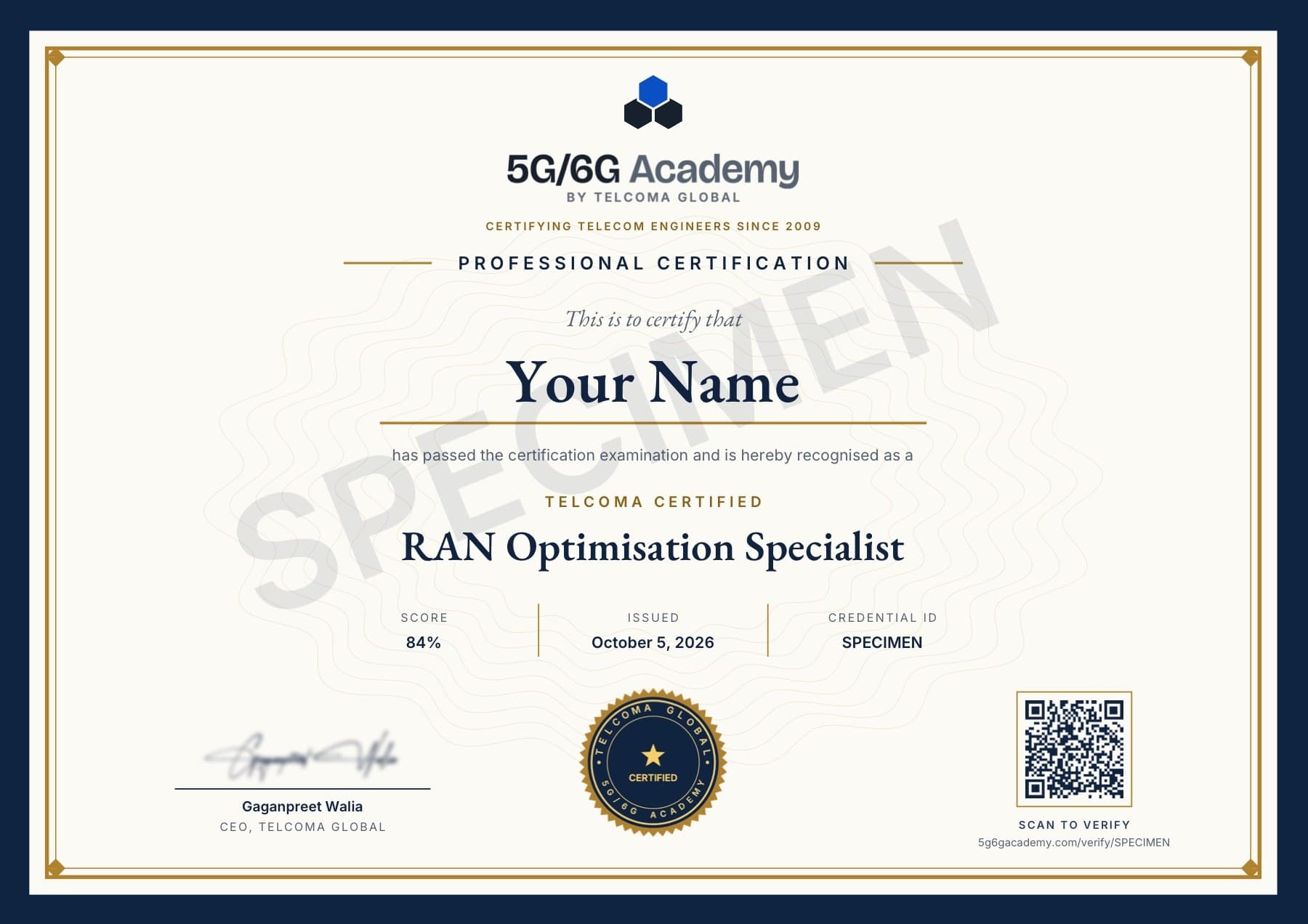
Earns a certificate35 questions · 60 min · 65% to pass — earns your TELCOMA Certified RAN Optimisation Specialist, a QR-verifiable certificate.
Not ready yet? Take a free 20-question mock exam first.
Look up any acronym in the telecom glossary
Certification
Earn the TELCOMA Certified RAN Optimisation Specialist
Pass the 35-question exam with 65% or more, and the certificate is yours to show anyone.
- Show proofEvery certificate carries a QR code and a public page that anyone can check.
- Add it to LinkedInPut it in the Licenses & certifications section of your profile in one click.
- Build a collectionEach of our 11 courses earns its own certificate.
Study materials
Download the 5G RAN Optimisation & Performance question bank and slide deck — every signal check in the course, with answers, plus every figure — and the companion pack, with every module’s worksheets and datasets in one file.
- Question BankPDF39 KB
- Slide DeckPPTX15 MB
- Companion pack — download everythingZIP193 KB
Hands-on learning
Do it, don't just watch it
Modules end with a hands-on exercise — 5 labs · 5 checkpoints in this course. You move the controls, the numbers answer back, and a wrong turn tells you why.
Try this one first:
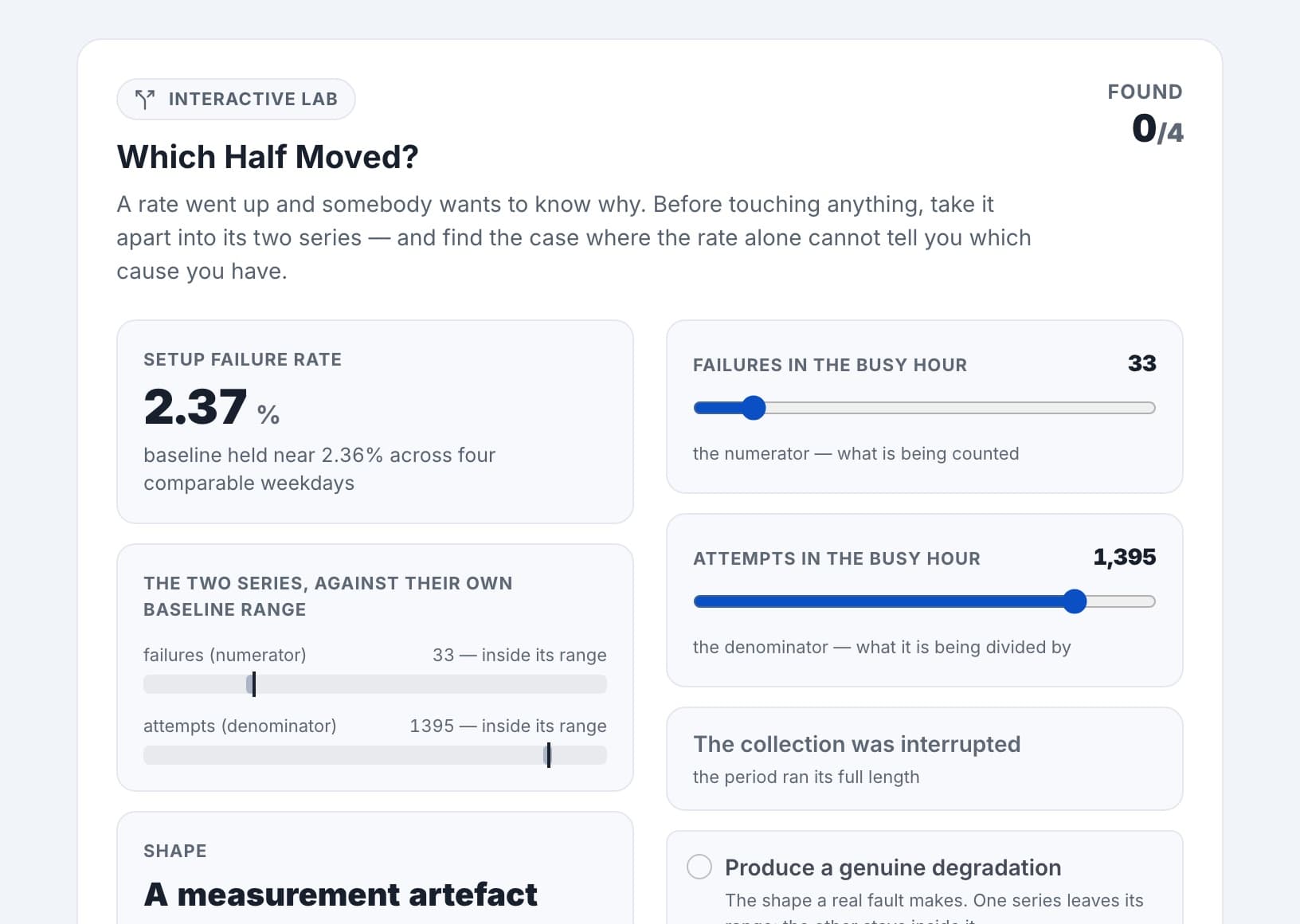
Which Half Moved? · Interactive lab · ~7 min
Try it freeFree with an account — no card.
What you'll build
3 of 10 — the rest are in the syllabus
- Lab 1FreeWhich Half Moved?A rate went up and somebody wants to know why. Take it apart into its two series, and find the case where the rate alone cannot tell you which cause you have.Module 1~7 min
- Lab 2Three Rates, One NumberThe published accessibility figure is composed, not measured. Move the three factors and find two very different cells that publish the same headline.Module 2~6 min
- Lab 3Where On the Curve?Two failure classes moving in opposition on one axis, with unequal costs. Sweep the margin, then price the outcome that is counted among the successes.Module 3~7 min
Ways to learn
Choose the way that fits you.
| Feature | This certification Price loadingonce One credential, yours for good | Recommended Prime Membership Price loading/year Every course, including new ones | Free account Free Every course for your first 7 days, then the first module of each |
|---|---|---|---|
| Lessons and labs in this course | All for your first 7 days, then the first module | ||
| Study pack — question bank and slides | For your first 7 days | ||
| Certification exam and verifiable certificate | This course | Every course | |
| Every other course | First module | All, and new ones | All for your first 7 days, then the first module |
| Full-length practice exams | For your first 7 days | ||
| TelcoMentor AI coach | For your first 7 days, at a smaller daily limit | ||
| Hands-on scenarios — traces, logs, configs | Selected traces | All for your first 7 days, then selected traces | |
One payment · no renewal | See Prime Membership Renews yearly · cancel anytime | Join for free No card needed |
This certification
Price loadingonce
One credential, yours for good
- Lessons and labs in this course
- Study pack — question bank and slides
- Certification exam and verifiable certificate — this course
- Every other course — first module
- Not included: Full-length practice exams
- Not included: TelcoMentor AI coach
- Hands-on scenarios — traces, logs, configs — selected traces
One payment · no renewal
Prime Membership
Price loading/year
Every course, including new ones
- Lessons and labs in this course
- Study pack — question bank and slides
- Certification exam and verifiable certificate — every course
- Every other course — all, and new ones
- Full-length practice exams
- TelcoMentor AI coach
- Hands-on scenarios — traces, logs, configs
Renews yearly · cancel anytime
Free account
Free
Every course for your first 7 days, then the first module of each
- Lessons and labs in this course — all for your first 7 days, then the first module
- Study pack — question bank and slides — for your first 7 days
- Not included: Certification exam and verifiable certificate
- Every other course — all for your first 7 days, then the first module
- Full-length practice exams — for your first 7 days
- TelcoMentor AI coach — for your first 7 days, at a smaller daily limit
- Hands-on scenarios — traces, logs, configs — all for your first 7 days, then selected traces
No card needed
A new free account opens every course for its first 7 days, no card needed: every lesson and lab, the study packs, the full-length practice exams and TelcoMentor. In those 7 days only the certification exam needs a paid option. After them, the first module of every course stays free. Both paid options come with a 7-day money-back guarantee.
Explore more courses
See all 11 courses → 5G RAN Planning & DesignPropagation modelsShadow fading marginsLink budgets & cell radiusIntermediate28 lessons~4.5h
 5G SecuritySUCI & ECIES5G-AKA & EAP-AKA′SBI mutual TLS & OAuth tokensAdvanced32 lessons~4.6h
 Telco CloudKubernetes for CNFsStatefulSets & probesCPU pinning & HugePagesAdvanced36 lessons~4.7h