Teach 5G the way the industry actually builds it.
Most telecom syllabi run a release or two behind the network your graduates will walk into. Give your students the same hands-on 5G, 6G and O-RAN training that working engineers use — with a certificate an employer can actually check.
See the material yourself: watch a free lesson · see a sample certificate
Where our learners work · engineers in 150+ countries
- AT&T
- Verizon
- T-Mobile
- Orange
- Rakuten
- MTN Group
- Telenor
- Ericsson
- Nokia
- NEC
- Intel
- Accenture
- Capgemini
- TCS
- Amazon
- IEEE
- University of Edinburgh
- University of Illinois
- McGill
- IIT Madras
- IIT Bombay
- IIT Hyderabad
- C-DOT
A selection of the operators, vendors, integrators, governments and institutes where our learners work.
The honest problem with telecom teaching
Telecom moves faster than a curriculum committee can. By the time an edition is printed, 3GPP has frozen another release. Students learn LTE theory and a little “5G is faster,” then graduate and find they've never seen a real 5G core, a call flow, or an O-RAN split — the things the work itself is made of.
We keep the material current because it's the same platform we run for engineers already working at operators and vendors. It isn't a student edition of the real thing — it is the real thing.
What your students walk away with
Current, not cached
The courses follow 3GPP releases, not a five-year-old edition — 5G NR, cloud-native core, O-RAN, RF, security, and where 6G is actually heading. When the standard moves, the lessons move.
They build, not just watch
Hands-on labs throughout: 3GPP-accurate packet captures, a simulated 5G core they can break and fix, KPIs to read. A few minutes of theory, then hands on the work itself — which is the part students never get from a textbook.
A credential that holds up
Finish a course, pass the exam, and the student earns a TELCOMA certificate with a QR code any employer can verify. It goes on the CV and it checks out — no self-declared badge.
Co-branding, per contract
Certificates that carry your institution's name next to ours are scoped per contract. The achievement reads as your students', and the standard behind it stays external and independent.
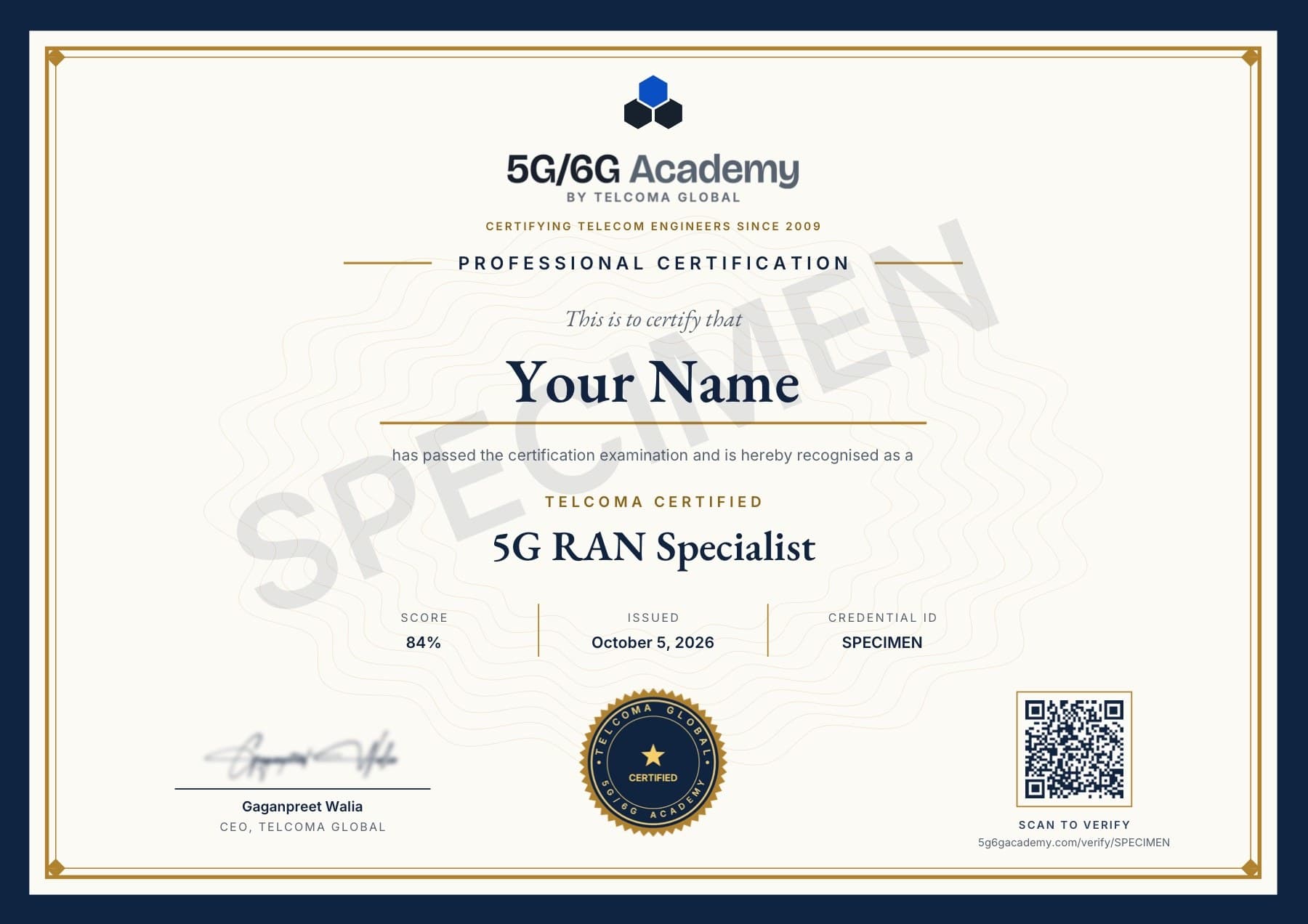
The credential
The certificate a student puts on their CV
Every engineer who passes a course’s graded exam gets a numbered TELCOMA certificate with a QR code. Scanning it opens a public page with the holder, the certification, the score and the date, read from our records rather than from the PDF in your inbox. Nobody needs an account to check one.
See what an employer sees (sample)You don't have to build or grade any of it
- One workspace per class. Invite the class by email, set roles, and free a seat when a student leaves.
- Into your LMS, per contract. SCORM 1.2/2004 or xAPI export into Moodle, Canvas, Blackboard or whatever you run, and SSO, are scoped per contract.
- Faculty visibility, per contract. Progress reporting — who's stuck, who's ahead, who hasn't logged in — is scoped per contract.
- Fits the shape you need. A semester elective, a short bootcamp, a continuing-education track, or a final-year bridge into industry practice.
- An instructor too, if you want one. Live sessions on campus or online, and train-the-trainer programmes for your own faculty, scoped with the cohort.
Engineering colleges and polytechnics, ECE and telecom departments, continuing-education and executive programs, and corporate universities that want an outside, standards-based benchmark for their people.
TELCOMA Global has been certifying telecom engineers since 2009, in 150+ countries, and is trusted by 200,000+ telecom professionals. The academy is where that curriculum lives now.
Tell us about your program
A rough class size and what you're trying to teach is enough to start. We'll come back with a cohort plan and pricing — no obligation. Prefer email? Reach us at support@telcomaglobal.com. Looking at a partnership angle (co-branding, curriculum embedding)? Our partnerships page covers that.