 Watch free
Free preview · Slant range, delay, Doppler and moving cells: what "high and fast" actually costs — opens in the course player
NTN & Direct-to-Device: 5G from Orbit
The satellite link taught as arithmetic, not architecture — slant range and delay you can compute, a link budget that closes in both directions, the pre-compensation a handset owes before it may transmit, and the mobility a moving cell forces on a network built for stationary ones.
Every 5G & 6G course free for 7 days
Engineers in 150+ countries learn with TELCOMA — training telecom engineers since 2009
- Lessons
- 27
- Video
- ≈3.7h
- Hands-on
- 10 exercises
- Before you start
- 5G Foundation
About this course
Who it's for. RAN and core engineers, architects and technical leads evaluating or deploying non-terrestrial access.
Before you start. 5G Foundation. 5G RAN Specialist helps for modules 3 and 4 — timing advance, HARQ and handover are the terrestrial frames this course stretches.
This course includes
- 27 video lessons — the first needs no account, and all are free for your first 7 days
- 10 hands-on exercises — interactive labs and checkpoints
- Study pack — question bank and slides
- A free mock exam to find your gaps
- Certification exam and a QR-verifiable certificate — with Prime Membership or this certification
Skills you'll gain
- LEO, MEO & GEO geometry
- Satellite link budgets
- Transparent vs regenerative payloads
- Doppler & timing pre-compensation
- Random access over satellite
- Moving cells & NTN handover
- NB-IoT over NTN
Syllabus
5 modules · 27 lessons · certification exam
Module 1 — From 'high and fast' to a number you can compute
Turn “high and fast” into quantities: the three frames NTN stretches, and slant range and delay computed from an elevation angle.
4 lessons · 1 lab · 1 checkpoint · ≈29 min
- Lesson 1Slant range, delay, Doppler and moving cells: what "high and fast" actually costsWatch free7:06
- Lesson 2The standards lane and the product lane: one ladder, two railsFree with an account7:30
- Lesson 3Timing advance, HARQ and Doppler: the three frames this course stretchesFree with an account7:00
- Lesson 4Slant range from elevation angle: the first number you can computeFree with an account7:03
- CheckpointHigh, or Fast? · Checkpoint~5 min
- Interactive labHow Far Is It Really? · Interactive lab~6 min
Module 2 — Geometry, payloads and the budget that decides the service
Weigh what an orbit buys and charges, place the gNB in a transparent or regenerative payload, and close a link budget in both directions.
5 lessons · 1 lab · 1 checkpoint · ≈40 min
- Lesson 1LEO, MEO and GEO: what altitude buys and what it chargesFree for 7 days with a free account, then with Prime Membership8:22
- Lesson 2Transparent and regenerative payloads: where the gNB sitsFree for 7 days with a free account, then with Prime Membership8:13
- Lesson 3EIRP, G/T and path loss: the downlink budget that closesFree for 7 days with a free account, then with Prime Membership8:43
- Lesson 4The uplink budget: why the handset is the weak endFree for 7 days with a free account, then with Prime Membership7:21
- Lesson 5From carrier-to-noise to service class: what the budget lets you promiseFree for 7 days with a free account, then with Prime Membership7:40
- CheckpointWhich Legs Did You Measure? · Checkpoint~6 min
- Interactive labWhich Direction Binds? · Interactive lab~7 min
Module 3 — Making the radio work at 600 km
Work out what a UE must hold before it may transmit, what it pre-compensates itself, and what breaks when timing advance and HARQ stretch.
6 lessons · 2 checkpoints · ≈51 min
- Lesson 1GNSS, ephemeris and epoch time: what a UE must hold before it may transmitFree for 7 days with a free account, then with Prime Membership8:14
- Lesson 2Doppler pre-compensation: the UE owns the service linkFree for 7 days with a free account, then with Prime Membership8:54
- Lesson 3Timing advance in four terms: open-loop pre-compensationFree for 7 days with a free account, then with Prime Membership8:34
- Lesson 4Random access over a satellite link: the first thing that breaksFree for 7 days with a free account, then with Prime Membership8:30
- Lesson 5HARQ and every closed loop at one round tripFree for 7 days with a free account, then with Prime Membership8:42
- Lesson 6Repetition and coverage: buying margin without feedbackFree for 7 days with a free account, then with Prime Membership8:14
- CheckpointWho Supplies This? · Checkpoint~7 min
- CheckpointPick the Repair · Checkpoint~7 min
Module 4 — Cells that move, and the network that follows them
Hold the earth-fixed and earth-moving cell taxonomy exactly, and account for what a moving cell does to mobility, identity and signalling load.
6 lessons · 2 checkpoints · ≈48 min
- Lesson 1Earth-fixed, quasi-earth-fixed and earth-moving cellsFree for 7 days with a free account, then with Prime Membership7:50
- Lesson 2Service link switch, feeder link switchover and satellite switchFree for 7 days with a free account, then with Prime Membership8:17
- Lesson 3Conditional handover on distance and time: the NTN trigger eventsFree for 7 days with a free account, then with Prime Membership8:21
- Lesson 4NTN-to-TN handover: coverage broadcast, ephemeris on the ground, entry without random accessFree for 7 days with a free account, then with Prime Membership8:31
- Lesson 5Mapped Cell ID and core selection: a cell that crosses a borderFree for 7 days with a free account, then with Prime Membership7:40
- Lesson 6Regenerative operations: gNB on board and inter-satellite linksFree for 7 days with a free account, then with Prime Membership7:11
- CheckpointWhat Does the Trace Show? · Checkpoint~6 min
- CheckpointJudge the Claim · Checkpoint~6 min
Module 5 — What is flying, what is specified, and what to track
Separate the spectrum routes to orbit, size what one beam honestly carries, and read the release train for which capability is actually specified.
6 lessons · 1 lab · 1 checkpoint · ≈52 min
- Lesson 1MSS allocations and leased terrestrial spectrum: two routes to orbitFree for 7 days with a free account, then with Prime Membership8:10
- Lesson 2UE pre-compensation and payload compensation: who does the workFree for 7 days with a free account, then with Prime Membership8:44
- Lesson 3Per-beam capacity: what one footprint can actually carryFree for 7 days with a free account, then with Prime Membership8:57
- Lesson 4NB-IoT and eMTC over NTN: the standards-native business already shippingFree for 7 days with a free account, then with Prime Membership8:39
- Lesson 5PLMN selection, roaming and emergency routing: what an operator actually signsFree for 7 days with a free account, then with Prime Membership9:06
- Lesson 6Rel-17 to Rel-20: reading the NTN release trainFree for 7 days with a free account, then with Prime Membership8:46
- Interactive labOne Beam, Everybody Under It · Interactive lab~6 min
- CheckpointWhich Track Owns It? · Checkpoint~6 min
Certification exam
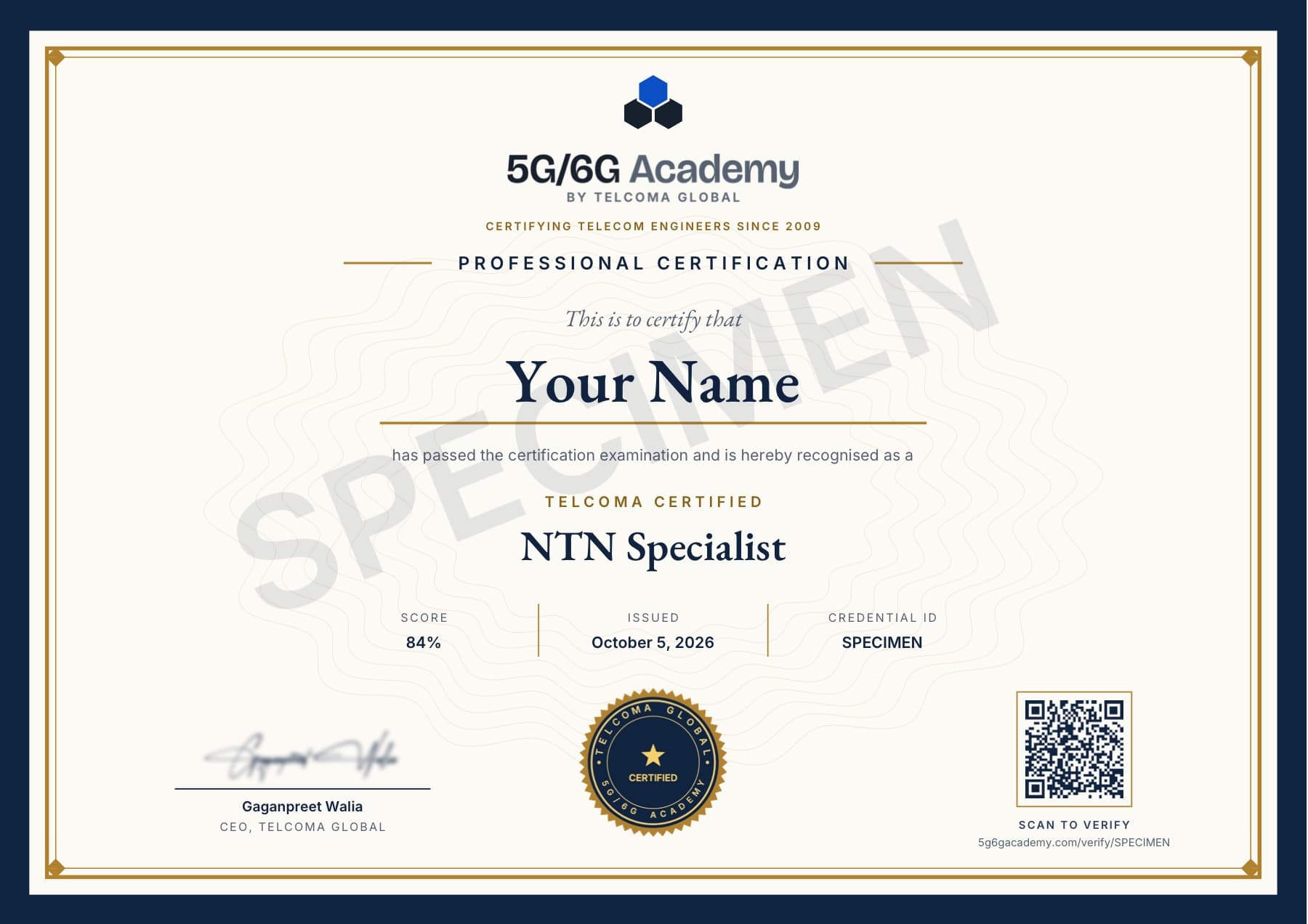
Earns a certificate35 questions · 60 min · 65% to pass — earns your TELCOMA Certified NTN Specialist, a QR-verifiable certificate.
Not ready yet? Take a free 20-question mock exam first.
Look up any acronym in the telecom glossary
Certification
Earn the TELCOMA Certified NTN Specialist
Pass the 35-question exam with 65% or more, and the certificate is yours to show anyone.
- Show proofEvery certificate carries a QR code and a public page that anyone can check.
- Add it to LinkedInPut it in the Licenses & certifications section of your profile in one click.
- Build a collectionEach of our 13 courses earns its own certificate.
Every lesson free for 7 days, no card. The exam comes with Prime Membership or this certification.
Study materials
Free for 7 daysDownload the NTN & Direct-to-Device: 5G from Orbit question bank and slide deck — every signal check in the course, with answers, plus every figure.
- Question BankPDF37 KB
- Slide DeckPPTX15 MB
Free with a new account for your first 7 days — no card. After that, the question bank and slides come with Prime Membership or this certification.
Hands-on learning
Do it, don't just watch it
Modules end with a hands-on exercise — 10 in this course. You move the controls, the numbers answer back, and a wrong turn tells you why.
Try this one first:
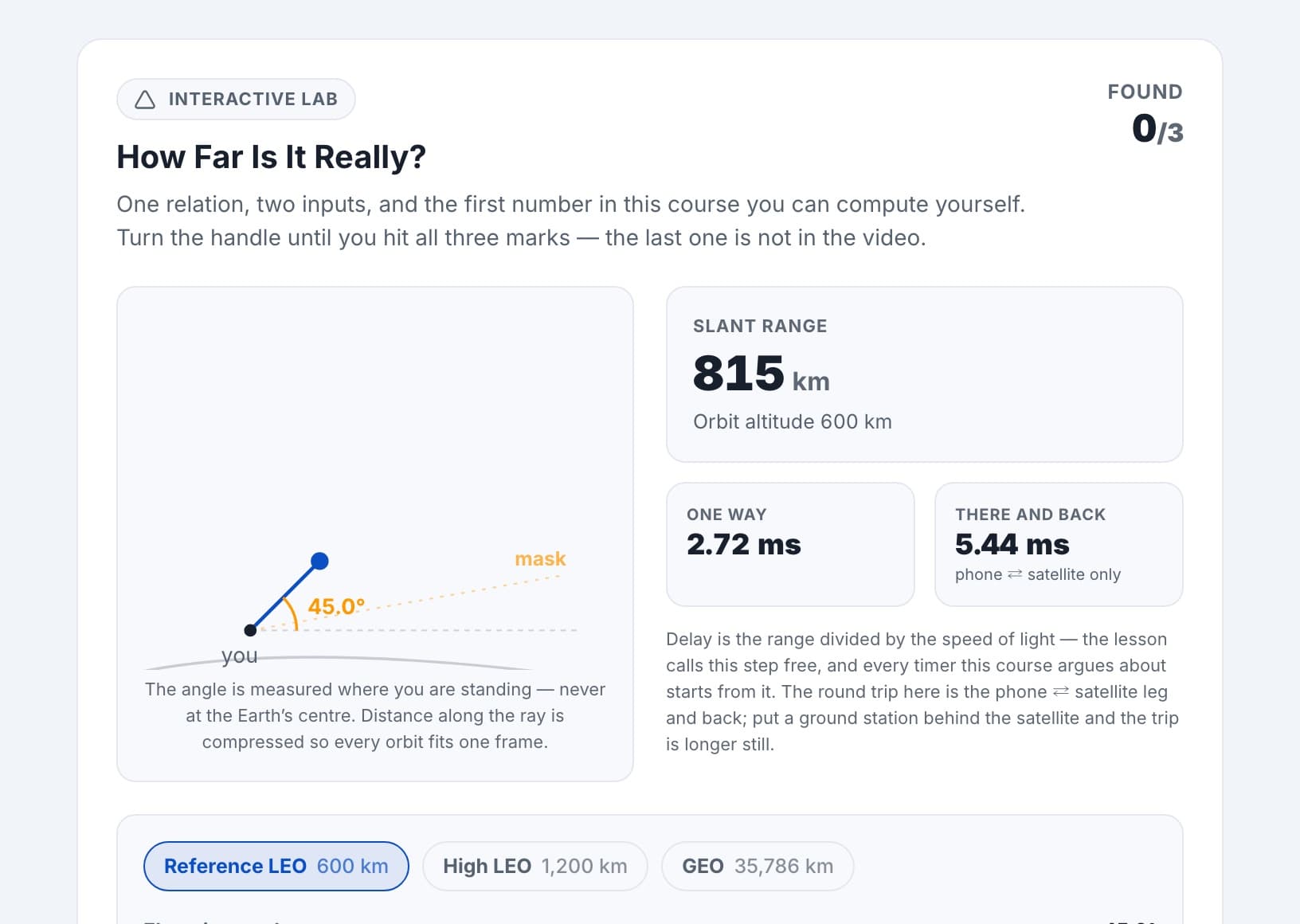
How Far Is It Really? · Interactive lab · ~6 min
Try it freeFree with an account — no card.
What you'll build
3 of 10 — the rest are in the syllabus
- Lab 1FreeHow Far Is It Really?Turn the handle on the geometry lesson's triangle. Find the overhead sanity check, stop at the mask to reproduce the published maximum to the kilometre, then work out from range and altitude alone the angle where the path doubles — which the video never states.Module 1~6 min
- Lab 2Which Direction Binds?Two budget columns from the same geometry, and one term on the ledger that is not fixed. Find the binding direction, the lever that rescues it, and the wall the lever cannot get through.Module 2~7 min
- Lab 3One Beam, Everybody Under ItDivide one beam's illustrative 8 Mbit/s across a declared crowd of handsets, then switch to sensors on the uplink slice. Find where a share falls to a tenth, where sensors ask for what one handset takes — and where airtime would run out, and why it doesn't.Module 5~6 min
Ways to learn
Choose the way that fits you.
| Feature | This certification Price loadingonce One credential, yours for good | Recommended Prime Membership Price loading/year 13 courses · 404 lessons · ~52 h · 121 hands-on exercises | Free account Free Every course for your first 7 days, then the first module of each |
|---|---|---|---|
| Lessons and labs in this course | All for your first 7 days, then the first module | ||
| Study pack — question bank and slides | For your first 7 days | ||
| Certification exams and verifiable certificates | 1, for this course | All 13 | |
| Every other course | First module | All, and new ones | All for your first 7 days, then the first module |
| Full-length practice exams | For your first 7 days | ||
| TelcoMentor AI coach | For your first 7 days, at a smaller daily limit | ||
| Hands-on scenarios — traces, logs, configs | Selected traces | All for your first 7 days, then selected traces | |
One payment · no renewal | Get Prime Membership You create a free account first, then go straight to the plans. Renews yearly · cancel anytime | Join for free No card needed |
Prime Membership
Price loading/year
13 courses · 404 lessons · ~52 h · 121 hands-on exercises
- Lessons and labs in this course
- Study pack — question bank and slides
- Certification exams and verifiable certificates — all 13
- Every other course — all, and new ones
- Full-length practice exams
- TelcoMentor AI coach
- Hands-on scenarios — traces, logs, configs
You create a free account first, then go straight to the plans.
Renews yearly · cancel anytime
This certification
Price loadingonce
One credential, yours for good
- Lessons and labs in this course
- Study pack — question bank and slides
- Certification exams and verifiable certificates — 1, for this course
- Every other course — first module
- Not included: Full-length practice exams
- Not included: TelcoMentor AI coach
- Hands-on scenarios — traces, logs, configs — selected traces
One payment · no renewal
Free account
Free
Every course for your first 7 days, then the first module of each
- Lessons and labs in this course — all for your first 7 days, then the first module
- Study pack — question bank and slides — for your first 7 days
- Not included: Certification exams and verifiable certificates
- Every other course — all for your first 7 days, then the first module
- Full-length practice exams — for your first 7 days
- TelcoMentor AI coach — for your first 7 days, at a smaller daily limit
- Hands-on scenarios — traces, logs, configs — all for your first 7 days, then selected traces
No card needed
A new free account opens every course for its first 7 days, no card needed: every lesson and lab, the study packs, the full-length practice exams and TelcoMentor. In those 7 days only the certification exam needs a paid option. After them, the first module of every course stays free. Both paid options come with a 7-day money-back guarantee.
Explore more courses
See all 13 courses → Road to 6GIMT-2030 usage scenariosRel-18 to Rel-21 roadmap6G waveform & bandwidthIntermediate27 lessons~3.5h
 5G RAN Planning & DesignPropagation modelsShadow fading marginsLink budgets & cell radiusIntermediate28 lessons~4.5h
 5G RAN Optimisation & PerformanceCounters & KPIsAccessibility analysisRetainability & radio link failureIntermediate31 lessons~5.1h