 Watch free
Free preview · Where AI already lives in your network — opens in the course player
AI for Telecom Networks
GenAI and machine learning for network operations — where AI already runs in your network, the methods that actually work on telecom data, the 5G core's own analytics function, and how to choose a first deployment that cannot hurt you.
Every 5G & 6G course free for 7 days
- Lessons
- 26
- Video
- ≈3.8h
- Hands-on
- 1 lab · 5 checkpoints
- Before you start
- 5G Foundation
About this course
Who it's for. Working telecom engineers — operations, core, RAN, NOC and planning.
Before you start. 5G Foundation — or the free placement check
This course includes
- 26 video lessons — the first needs no account, and all are free for your first 7 days
- Hands-on labs and checkpoints
- Study pack — question bank and slides
- A free mock exam to find your gaps
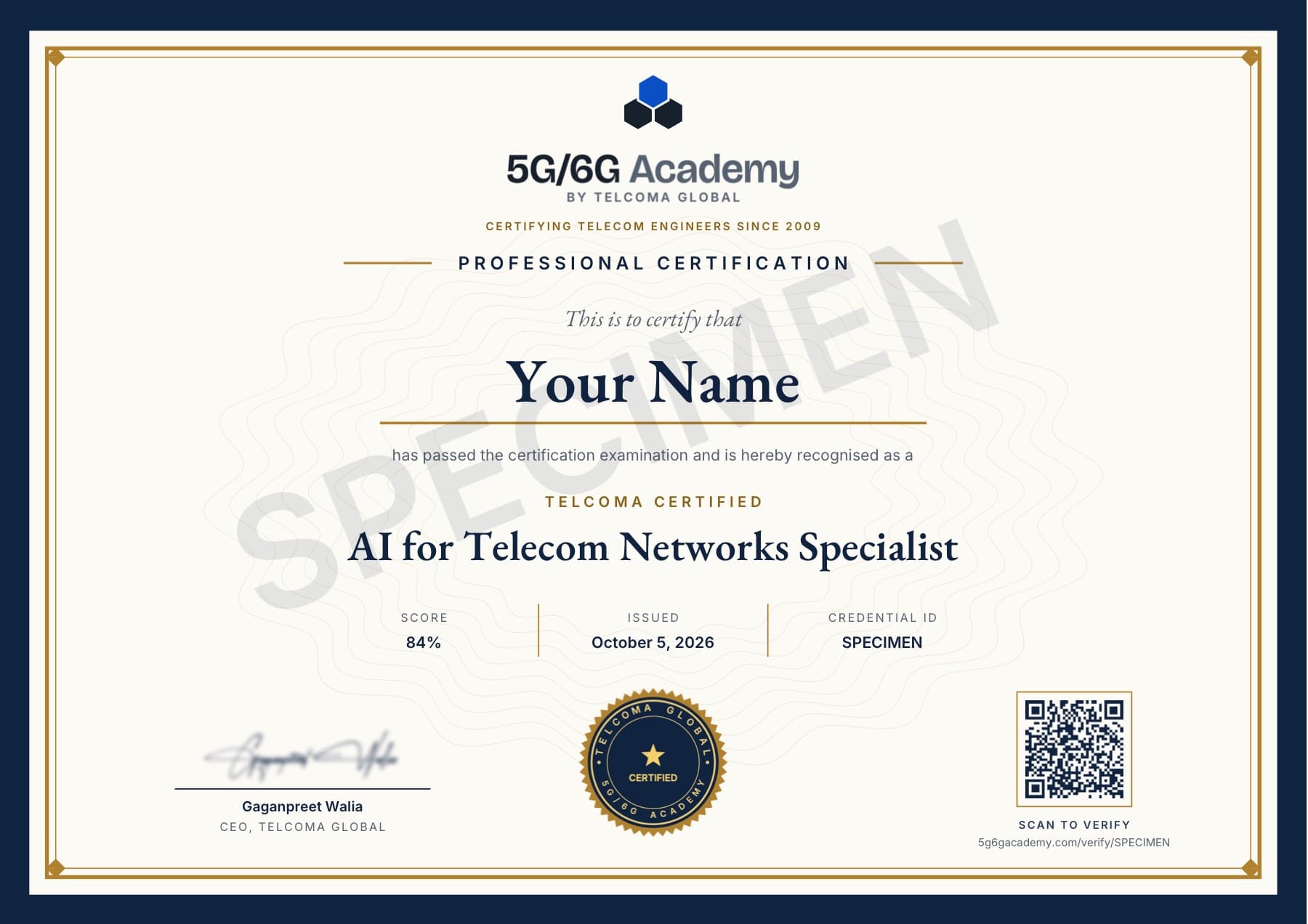
- Certification exam and a QR-verifiable certificate
Skills you'll gain
- Supervised & unsupervised ML
- Model evaluation & drift
- LLMs & RAG for operations
- AI agents
- NWDAF
- SON & closed-loop automation
- AI governance & model security
Syllabus
6 modules · 26 lessons · certification exam
Module 1 — The AI toolbox, in network terms
Place AI in the network you already know — what it does today, the three words that carry the course, and why data quality decides everything.
4 lessons · 1 checkpoint · ≈28 min
- Lesson 1Where AI already lives in your networkWatch free7:05
- Lesson 2Model, training, inference — the three words that carry the courseFree with an account6:54
- Lesson 3What networks actually log: counters, KPIs and tracesFree with an account6:51
- Lesson 4Rules vs learning: when a threshold beats a modelFree with an account7:09
- CheckpointRule or Model? · Checkpoint~5 min
Module 2 — Machine learning through telecom cases
Command the core ML method families — supervised, unsupervised, evaluation, drift, deep learning — each taught through a real network problem, never as abstract math.
5 lessons · 1 lab · ≈41 min
- Lesson 1Supervised learning: predicting tomorrow's trafficFree for 7 days with a free account, then with Prime Membership6:57
- Lesson 2Unsupervised learning: finding the anomaly you didn't nameFree for 7 days with a free account, then with Prime Membership7:38
- Lesson 3Judging a model: precision, recall and the cost of a false alarmFree for 7 days with a free account, then with Prime Membership8:05
- Lesson 4Drift: when yesterday's model meets today's networkFree for 7 days with a free account, then with Prime Membership9:34
- Lesson 5Deep learning — and when you actually need itFree for 7 days with a free account, then with Prime Membership8:40
- Interactive labWhere Do You Set the Bar? · Interactive lab~7 min
Module 3 — GenAI and LLMs in operations
Understand what large language models genuinely do, where they help a network operations team today, and how their failure modes are contained.
5 lessons · 1 checkpoint · ≈47 min
- Lesson 1What an LLM is — and what it is notFree for 7 days with a free account, then with Prime Membership7:42
- Lesson 2The ops copilot: tickets, runbooks and summariesFree for 7 days with a free account, then with Prime Membership10:10
- Lesson 3RAG: grounding the copilot in your network's truthFree for 7 days with a free account, then with Prime Membership9:17
- Lesson 4Agents: from answering to actingFree for 7 days with a free account, then with Prime Membership10:09
- Lesson 5Where GenAI fails in a network — and how to contain itFree for 7 days with a free account, then with Prime Membership9:40
- CheckpointContain the Failure · Checkpoint~5 min
Module 4 — NWDAF and the network's own data pipeline
Know the 5G core's built-in analytics machinery — what the Network Data Analytics Function is, how one analytics round-trip flows, how it splits training from serving, and where analytics live beyond the core.
4 lessons · 1 checkpoint · ≈32 min
- Lesson 1NWDAF: the network's own analytics functionFree for 7 days with a free account, then with Prime Membership9:30
- Lesson 2The NWDAF round-trip: subscribe, collect, deliverFree for 7 days with a free account, then with Prime Membership8:05
- Lesson 3Inside NWDAF: training vs serving (MTLF and AnLF)Free for 7 days with a free account, then with Prime Membership7:36
- Lesson 4Analytics beyond the core: MDAF and where RAN intelligence livesFree for 7 days with a free account, then with Prime Membership7:17
- CheckpointTrace the Round Trip · Checkpoint~4 min
Module 5 — From SON to closed-loop automation
Connect the automation the industry already runs to the closed-loop, intent-driven automation AI enables — and fix who approves what.
4 lessons · 1 checkpoint · ≈41 min
- Lesson 1SON: the automation you already ownFree for 7 days with a free account, then with Prime Membership10:00
- Lesson 2The closed loop: observe, decide, act — and who approvesFree for 7 days with a free account, then with Prime Membership9:58
- Lesson 3Explainability and rollback: automation that explains itselfFree for 7 days with a free account, then with Prime Membership10:12
- Lesson 4"AI-native": what changes when the loop is the designFree for 7 days with a free account, then with Prime Membership11:06
- CheckpointWhere Does the Person Stand? · Checkpoint~5 min
Module 6 — Trust, governance and your first deployment
Close with the judgment layer — accountable AI, securing the models themselves, the build-vs-buy call, and choosing a first deployment that cannot hurt you.
4 lessons · 1 checkpoint · ≈39 min
- Lesson 1Accountable AI: explainability, bias and the audit trailFree for 7 days with a free account, then with Prime Membership8:31
- Lesson 2Model security: poisoning, theft and adversarial inputsFree for 7 days with a free account, then with Prime Membership10:04
- Lesson 3Build vs buy — and the team's skills mapFree for 7 days with a free account, then with Prime Membership9:40
- Lesson 4Your first deployment: pick the use case that cannot hurt youFree for 7 days with a free account, then with Prime Membership10:25
- CheckpointPick the First Deployment · Checkpoint~5 min
Certification exam
Earns a certificate42 questions · 60 min · 65% to pass — earns your TELCOMA Certified AI for Telecom Networks Specialist, a QR-verifiable certificate.
Not ready yet? Take a free 20-question mock exam first.
Look up any acronym in the telecom glossary
Certification
Earn the TELCOMA Certified AI for Telecom Networks Specialist
Pass the 42-question exam with 65% or more, and the certificate is yours to show anyone.
- Show proofEvery certificate carries a QR code and a public page that anyone can check.
- Add it to LinkedInPut it in the Licenses & certifications section of your profile in one click.
- Build a collectionEach of our 13 courses earns its own certificate.
Study materials
Download the AI for Telecom Networks question bank and slide deck — every signal check in the course, with answers, plus every figure.
- Question BankPDF40 KB
- Slide DeckPPTX16 MB
Hands-on learning
Do it, don't just watch it
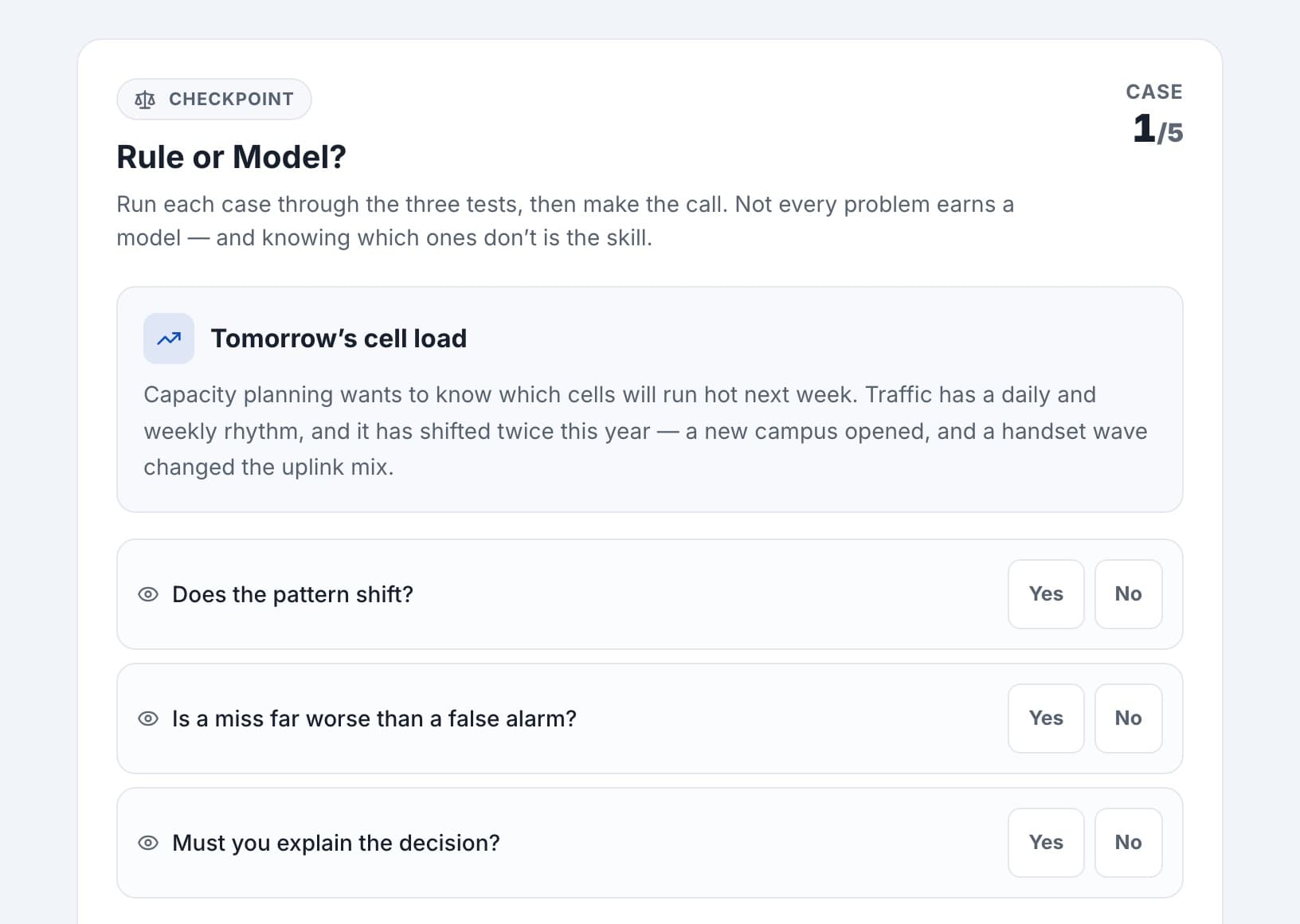
Modules end with a hands-on exercise — 1 lab · 5 checkpoints in this course. You move the controls, the numbers answer back, and a wrong turn tells you why.
Try this one first:
Rule or Model? · Checkpoint · ~5 min
Try it freeFree with an account — no card.
What you'll build
3 of 6 — the rest are in the syllabus
- Lab 1Where Do You Set the Bar?Move the alarm threshold on 800 scored cells and watch precision, recall and the operating BILL move against each other — the cheapest setting is not the one with the best F1.Module 2~7 min
- CheckpointFreeRule or Model?Run five network cases through the three tests — does the pattern shift, is a miss lopsided, must you explain it — and decide honestly which earn a model.Module 1~5 min
- CheckpointContain the FailureMatch five ways an assistant goes wrong to the control that actually holds each — including the one grounding cannot touch.Module 3~5 min
Ways to learn
Choose the way that fits you.
| Feature | This certification Price loadingonce One credential, yours for good | Recommended Prime Membership Price loading/year Every course, including new ones | Free account Free Every course for your first 7 days, then the first module of each |
|---|---|---|---|
| Lessons and labs in this course | All for your first 7 days, then the first module | ||
| Study pack — question bank and slides | For your first 7 days | ||
| Certification exam and verifiable certificate | This course | Every course | |
| Every other course | First module | All, and new ones | All for your first 7 days, then the first module |
| Full-length practice exams | For your first 7 days | ||
| TelcoMentor AI coach | For your first 7 days, at a smaller daily limit | ||
| Hands-on scenarios — traces, logs, configs | Selected traces | All for your first 7 days, then selected traces | |
One payment · no renewal | See Prime Membership Renews yearly · cancel anytime | Join for free No card needed |
This certification
Price loadingonce
One credential, yours for good
- Lessons and labs in this course
- Study pack — question bank and slides
- Certification exam and verifiable certificate — this course
- Every other course — first module
- Not included: Full-length practice exams
- Not included: TelcoMentor AI coach
- Hands-on scenarios — traces, logs, configs — selected traces
One payment · no renewal
Prime Membership
Price loading/year
Every course, including new ones
- Lessons and labs in this course
- Study pack — question bank and slides
- Certification exam and verifiable certificate — every course
- Every other course — all, and new ones
- Full-length practice exams
- TelcoMentor AI coach
- Hands-on scenarios — traces, logs, configs
Renews yearly · cancel anytime
Free account
Free
Every course for your first 7 days, then the first module of each
- Lessons and labs in this course — all for your first 7 days, then the first module
- Study pack — question bank and slides — for your first 7 days
- Not included: Certification exam and verifiable certificate
- Every other course — all for your first 7 days, then the first module
- Full-length practice exams — for your first 7 days
- TelcoMentor AI coach — for your first 7 days, at a smaller daily limit
- Hands-on scenarios — traces, logs, configs — all for your first 7 days, then selected traces
No card needed
A new free account opens every course for its first 7 days, no card needed: every lesson and lab, the study packs, the full-length practice exams and TelcoMentor. In those 7 days only the certification exam needs a paid option. After them, the first module of every course stays free. Both paid options come with a 7-day money-back guarantee.
Explore more courses
See all 13 courses → AI-RAN & the AI-Native NetworkTraining vs inferenceBeam & CSI predictionAI positioningAdvanced31 lessons~3.6h
 Road to 6GIMT-2030 usage scenariosRel-18 to Rel-21 roadmap6G waveform & bandwidthIntermediate27 lessons~3.5h
 NTN & Direct-to-DeviceLEO, MEO & GEO geometrySatellite link budgetsTransparent vs regenerative payloadsIntermediate27 lessons~3.7h