 Watch free
Free preview · From the radio picture to the radio grid — a bridge — opens in the course player
5G RAN Specialist
Decode the NR air interface, run a handover in your head, and dimension a real 5G RAN — from the resource grid and massive MIMO to CU/DU/RU splits, Open RAN, and KPIs.
Every 5G & 6G course free for 7 days
Engineers in 150+ countries learn with TELCOMA — training telecom engineers since 2009
- Lessons
- 31
- Video
- ≈3.4h
- Hands-on
- 7 exercises
- Before you start
- 5G Foundation
About this course
Who it's for. Engineers moving into the radio access network.
Before you start. 5G Foundation, or equivalent working knowledge of 5G architecture
This course includes
- 31 video lessons — the first needs no account, and all are free for your first 7 days
- 7 hands-on exercises — interactive labs and checkpoints
- Study pack — question bank and slides
- A free mock exam to find your gaps
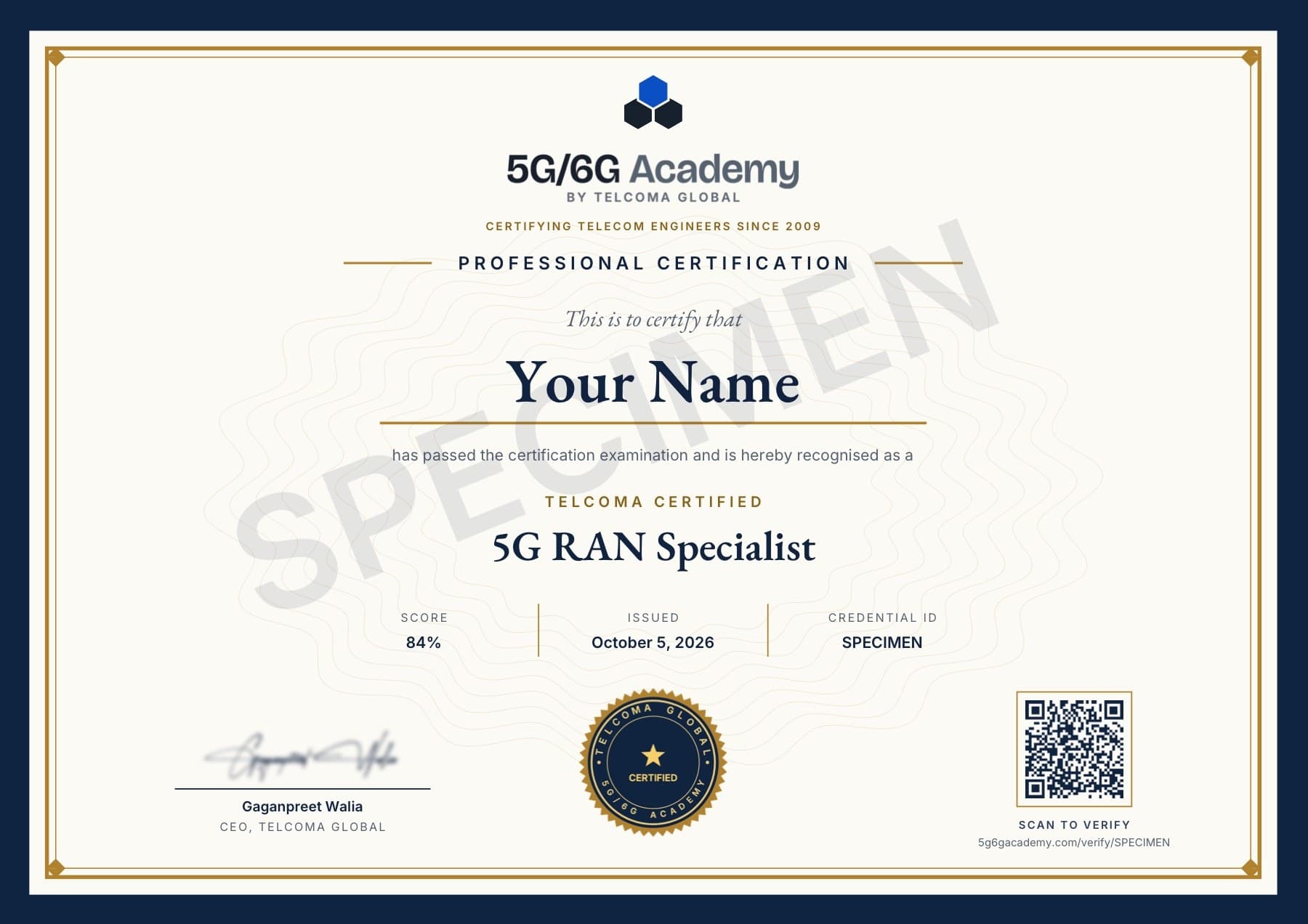
- Certification exam and a QR-verifiable certificate — with Prime Membership or this certification
Skills you'll gain
- NR numerology & frame structure
- Bandwidth parts
- SSB & random access
- Massive MIMO & beamforming
- CU/DU/RU splits & fronthaul
- Open RAN & RIC
- Handover & mobility events
- Link budgets & RAN KPIs
Syllabus
7 modules · 31 lessons · certification exam
Module 8 — NR Air Interface I: Structure
Read the NR resource grid — from the radio picture you know to the time-frequency grid and how TDD shares it.
5 lessons · 1 lab · ≈37 min
- Lesson 1From the radio picture to the radio grid — a bridgeWatch free7:42
- Lesson 2Numerologies & subcarrier spacing — why flexibility winsFree with an account8:09
- Lesson 3Frames, slots and the resource gridFree with an account7:38
- Lesson 4Bandwidth parts — the radio's gearboxFree with an account6:28
- Lesson 5TDD patterns in the real worldFree with an account6:55
- Interactive labThe Numerology Dial · Interactive lab~5 min
- Try it5G Numerology Planner
Module 9 — NR Air Interface II: Access, Channels & the Stack
Follow a UE from cell search through the access handshake and channels to a packet down the stack.
6 lessons · 1 lab · ≈42 min
- Lesson 1SSB: how a phone finds a cellFree for 7 days with a free account, then with Prime Membership6:46
- Lesson 2Random access: the four-step RACH handshakeFree for 7 days with a free account, then with Prime Membership6:50
- Lesson 3The channel map: PDCCH, PDSCH, PUCCH, PUSCH — where control and data rideFree for 7 days with a free account, then with Prime Membership6:50
- Lesson 4Link adaptation & HARQ in actionFree for 7 days with a free account, then with Prime Membership7:18
- Lesson 5Reference signals: DMRS, CSI-RS, SRSFree for 7 days with a free account, then with Prime Membership7:02
- Lesson 6The NR protocol stack: MAC, RLC, PDCP, SDAP — one packet's journeyFree for 7 days with a free account, then with Prime Membership6:59
- Interactive labDimension the RACH · Interactive lab~4 min
Module 10 — Massive MIMO & Beamforming
Explain how antennas became 5G's biggest lever.
4 lessons · 1 checkpoint · ≈25 min
- Lesson 1Antenna arrays — where the gain comes fromFree for 7 days with a free account, then with Prime Membership5:48
- Lesson 2Digital, analog, hybrid beamformingFree for 7 days with a free account, then with Prime Membership6:51
- Lesson 3Beam management: sweep, refine, trackFree for 7 days with a free account, then with Prime Membership5:55
- Lesson 4MU-MIMO: many users, same resourcesFree for 7 days with a free account, then with Prime Membership6:36
- CheckpointLock the Beam · Checkpoint~5 min
- Try itSSB Beam Planner
Module 11 — RAN Architecture & Splits
Justify a CU/DU/RU design and its transport budget.
4 lessons · 1 lab · ≈25 min
- Lesson 1The disaggregated gNB: CU, DU and RU — and where the split sitsFree for 7 days with a free account, then with Prime Membership6:50
- Lesson 2F1, E1 and Xn — wiring the split gNB togetherFree for 7 days with a free account, then with Prime Membership5:29
- Lesson 3Fronthaul: eCPRI and the latency budgetFree for 7 days with a free account, then with Prime Membership6:03
- Lesson 4vRAN: the RAN becomes softwareFree for 7 days with a free account, then with Prime Membership6:32
- Interactive labSize the Fronthaul · Interactive lab~6 min
Module 12 — Open RAN
Map the O-RAN architecture and assess it like an operator.
4 lessons · 1 checkpoint · ≈24 min
- Lesson 1The case for open interfacesFree for 7 days with a free account, then with Prime Membership5:07
- Lesson 2The O-RAN architecture mapFree for 7 days with a free account, then with Prime Membership6:12
- Lesson 3The RIC, xApps and rApps — the two control loops behind RAN intelligenceFree for 7 days with a free account, then with Prime Membership6:10
- Lesson 4Open RAN in the field: open fronthaul and the deployment scorecardFree for 7 days with a free account, then with Prime Membership6:09
- CheckpointWire the O-RAN Fabric · Checkpoint~5 min
Module 13 — Mobility & Radio Procedures
Run a handover in your head, and know how 5G keeps a moving phone connected and reachable.
4 lessons · 1 lab · ≈25 min
- Lesson 1Measurements & events: A3, hysteresis, time-to-triggerFree for 7 days with a free account, then with Prime Membership6:20
- Lesson 2Handover, step by step: Xn and the N2 variantFree for 7 days with a free account, then with Prime Membership6:21
- Lesson 3Carrier aggregation & dual connectivity — and EN-DC with 4GFree for 7 days with a free account, then with Prime Membership6:06
- Lesson 4Paging, DRX and battery lifeFree for 7 days with a free account, then with Prime Membership6:21
- Interactive labTune the A3 Handover · Interactive lab~5 min
Module 14 — RAN Planning & Performance
Dimension and judge a real 5G RAN — turn coverage, capacity and quality into numbers.
4 lessons · 1 checkpoint · ≈27 min
- Lesson 1KPIs that matter: RSRP, RSRQ, SINR — accessibility, retainability, energyFree for 7 days with a free account, then with Prime Membership5:43
- Lesson 2Link budgets & coverage planningFree for 7 days with a free account, then with Prime Membership7:11
- Lesson 3Capacity dimensioningFree for 7 days with a free account, then with Prime Membership7:04
- Lesson 4Private 5G RAN — spectrum, architecture and planningFree for 7 days with a free account, then with Prime Membership7:02
- CheckpointRead the Cell · Checkpoint~4 min
Certification exam
Earns a certificate49 questions · 60 min · 65% to pass — earns your TELCOMA Certified 5G RAN Specialist, a QR-verifiable certificate.
Not ready yet? Take a free 20-question mock exam first.
Prefer to read? 5G Radio Access Network (Level 3) · Look up any acronym in the telecom glossary
Certification
Earn the TELCOMA Certified 5G RAN Specialist
Pass the 49-question exam with 65% or more, and the certificate is yours to show anyone.
- Show proofEvery certificate carries a QR code and a public page that anyone can check.
- Add it to LinkedInPut it in the Licenses & certifications section of your profile in one click.
- Build a collectionEach of our 13 courses earns its own certificate.
Every lesson free for 7 days, no card. The exam comes with Prime Membership or this certification.
Study materials
Free for 7 daysDownload the 5G RAN Specialist question bank and slide deck — every signal check in the course, with answers, plus every figure.
- Question BankPDF49 KB
- Slide DeckPPTX15 MB
Free with a new account for your first 7 days — no card. After that, the question bank and slides come with Prime Membership or this certification.
Hands-on learning
Do it, don't just watch it
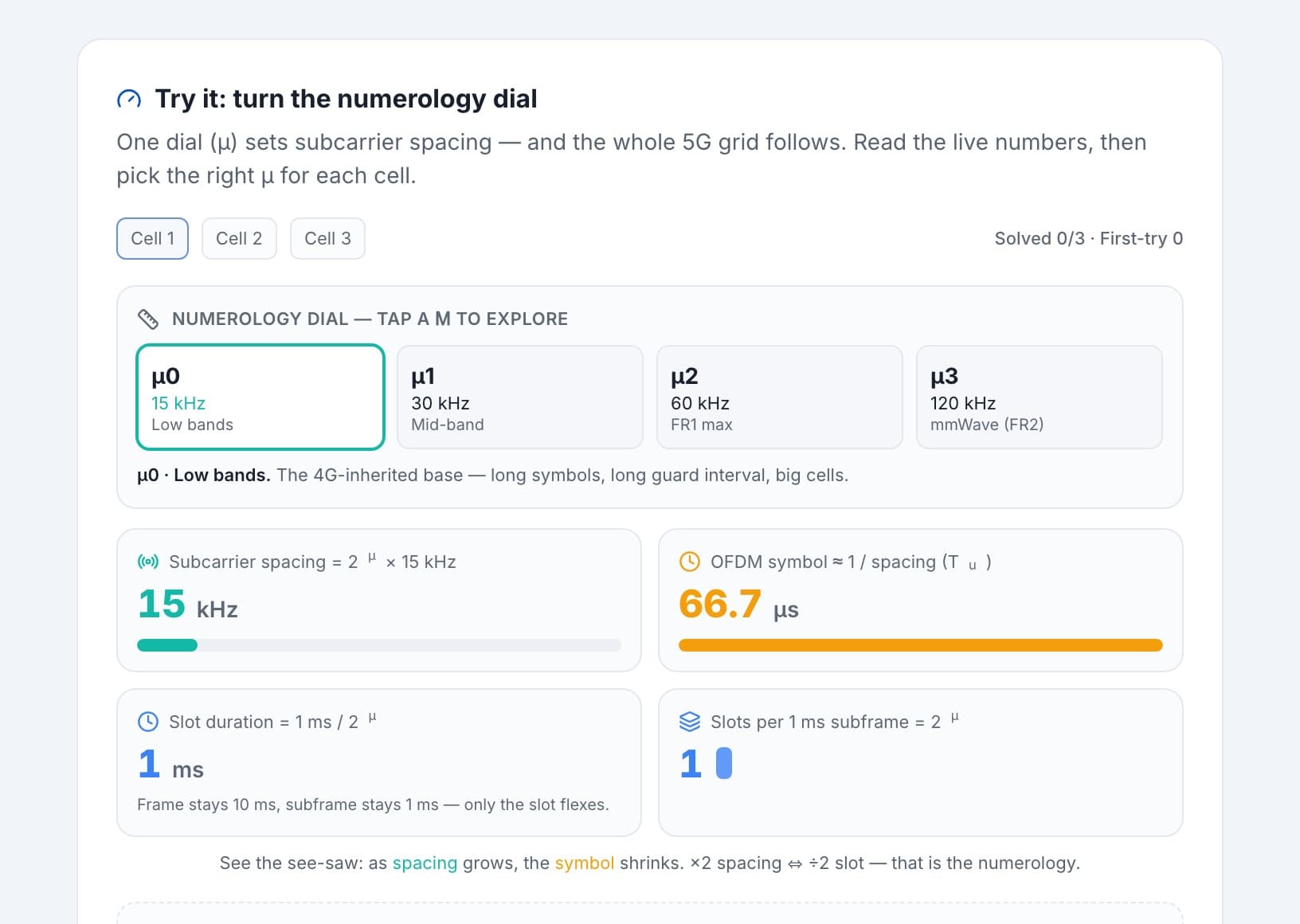
Modules end with a hands-on exercise — 7 in this course. You move the controls, the numbers answer back, and a wrong turn tells you why.
Try this one first:
The Numerology Dial · Interactive lab · ~5 min
Try it freeFree with an account — no card.
What you'll build
3 of 7 — the rest are in the syllabus
- Lab 1FreeThe Numerology DialTurn one dial (µ) to watch NR subcarrier spacing, slot length, and symbol duration flex, then pick the right numerology for three real cells.Module 8~5 min
- Lab 2Dimension the RACHRandom access is a contention protocol, so it has a ceiling — and past it, throughput FALLS. Configure the cell and throw a ten-thousand-meter wake-up at it.Module 9~4 min
- Lab 3Size the FronthaulConfigure the site and compute what each functional split demands of the fibre — then find the configuration where only one of them is physically possible.Module 11~6 min
More practice: scenario labs
Go further than the course's own exercises — inspect real traces, debug configs and logs, and run a simulated 5G core.
Ways to learn
Choose the way that fits you.
| Feature | This certification Price loadingonce One credential, yours for good | Recommended Prime Membership Price loading/year 13 courses · 404 lessons · ~52 h · 121 hands-on exercises | Free account Free Every course for your first 7 days, then the first module of each |
|---|---|---|---|
| Lessons and labs in this course | All for your first 7 days, then the first module | ||
| Study pack — question bank and slides | For your first 7 days | ||
| Certification exams and verifiable certificates | 1, for this course | All 13 | |
| Every other course | First module | All, and new ones | All for your first 7 days, then the first module |
| Full-length practice exams | For your first 7 days | ||
| TelcoMentor AI coach | For your first 7 days, at a smaller daily limit | ||
| Hands-on scenarios — traces, logs, configs | Selected traces | All for your first 7 days, then selected traces | |
One payment · no renewal | Get Prime Membership You create a free account first, then go straight to the plans. Renews yearly · cancel anytime | Join for free No card needed |
Prime Membership
Price loading/year
13 courses · 404 lessons · ~52 h · 121 hands-on exercises
- Lessons and labs in this course
- Study pack — question bank and slides
- Certification exams and verifiable certificates — all 13
- Every other course — all, and new ones
- Full-length practice exams
- TelcoMentor AI coach
- Hands-on scenarios — traces, logs, configs
You create a free account first, then go straight to the plans.
Renews yearly · cancel anytime
This certification
Price loadingonce
One credential, yours for good
- Lessons and labs in this course
- Study pack — question bank and slides
- Certification exams and verifiable certificates — 1, for this course
- Every other course — first module
- Not included: Full-length practice exams
- Not included: TelcoMentor AI coach
- Hands-on scenarios — traces, logs, configs — selected traces
One payment · no renewal
Free account
Free
Every course for your first 7 days, then the first module of each
- Lessons and labs in this course — all for your first 7 days, then the first module
- Study pack — question bank and slides — for your first 7 days
- Not included: Certification exams and verifiable certificates
- Every other course — all for your first 7 days, then the first module
- Full-length practice exams — for your first 7 days
- TelcoMentor AI coach — for your first 7 days, at a smaller daily limit
- Hands-on scenarios — traces, logs, configs — all for your first 7 days, then selected traces
No card needed
A new free account opens every course for its first 7 days, no card needed: every lesson and lab, the study packs, the full-length practice exams and TelcoMentor. In those 7 days only the certification exam needs a paid option. After them, the first module of every course stays free. Both paid options come with a 7-day money-back guarantee.
Explore more courses
See all 13 courses → 5G Foundation5G system architectureNSA vs SAService-based architectureBeginner34 lessons~3.3h
 5G Core & E2E SpecialistCore call flowsPFCP & the UPF5QI, PCF & chargingAdvanced38 lessons~5.1h
 AI for Telecom NetworksSupervised & unsupervised MLModel evaluation & driftLLMs & RAG for operationsIntermediate26 lessons~3.8h