 Watch free
Free preview · Search ring to parameter sheet: who decides what — opens in the course player
5G RAN Planning & Design
Radio planning taught as arithmetic you can reproduce and defend in a design review — a link budget that ends in a cell radius, a capacity chain that ends in a site count, and the parameter sheet that leaves your desk. Every number is computed from stated inputs against two 3GPP reference cases, urban and rural, lifted from a single published evaluation table so no two lessons can disagree.
Every 5G & 6G course free for 7 days
Engineers in 150+ countries learn with TELCOMA — training telecom engineers since 2009
- Lessons
- 28
- Video
- ≈4.5h
- Hands-on
- 10 exercises
- Before you start
- 5G Foundation
About this course
Who it's for. RF and RAN planning engineers, design consultants and technical leads who own or review a radio design.
Before you start. 5G Foundation. 5G RAN Specialist helps throughout — this course plans the air interface that one explains.
This course includes
- 28 video lessons — the first needs no account, and all are free for your first 7 days
- 10 hands-on exercises — interactive labs and checkpoints
- Study pack — question bank and slides
- A free mock exam to find your gaps
- Certification exam and a QR-verifiable certificate — with Prime Membership or this certification
Skills you'll gain
- Propagation models
- Shadow fading margins
- Link budgets & cell radius
- Capacity dimensioning
- SINR prediction
- PCI planning
- PRACH root sequences
- Neighbour planning
Syllabus
5 modules · 28 lessons · certification exam
Module 1 — The planner's frame: from a live cell to a document set
Install the role frame: what a plan actually promises, which constraint binds it, and a receiver noise floor you derive rather than look up.
4 lessons · 1 lab · 1 checkpoint · ≈33 min
- Lesson 1Search ring to parameter sheet: who decides whatWatch free8:34
- Lesson 2Edge rate at an edge probability: what a plan promisesFree with an account6:56
- Lesson 3Coverage-limited or capacity-limited: the question that orders the designFree with an account7:56
- Lesson 4The noise floor and receiver sensitivity: the ledger's bottom row, derivedFree with an account9:13
- CheckpointWhose Signature Is On It? · Checkpoint~5 min
- Interactive labDerive the Floor · Interactive lab~7 min
Module 2 — Propagation and prediction: the loss side, and how far to trust it
Match a propagation model to the question, respect the range it was fitted over, and turn a coverage target into a margin you can spend.
6 lessons · 1 lab · 1 checkpoint · ≈52 min
- Lesson 1Empirical, scenario-stochastic and deterministic models: three kindsFree for 7 days with a free account, then with Prime Membership8:47
- Lesson 2Distance, frequency, height and clutter: the four termsFree for 7 days with a free account, then with Prime Membership8:55
- Lesson 3Urban macro, street canyon and rural macro: the scenario models and their limitsFree for 7 days with a free account, then with Prime Membership8:49
- Lesson 4Shadow fading: from a standard deviation to a margin you can spendFree for 7 days with a free account, then with Prime Membership8:11
- Lesson 5Outdoor-to-indoor loss: the wall that decides where the cell endsFree for 7 days with a free account, then with Prime Membership8:47
- Lesson 6Prediction versus measurement: tuning a model, and what a plot never showsFree for 7 days with a free account, then with Prime Membership8:15
- CheckpointCan This Model Answer That? · Checkpoint~6 min
- Interactive labBuy the Probability · Interactive lab~6 min
Module 3 — The budget that ends in a cell radius
Build the link budget row by row, find the channel that actually sets the cell edge, and turn decibels into a cell radius and a site count.
6 lessons · 1 lab · 1 checkpoint · ≈59 min
- Lesson 1Coupling loss, hardware budget and allowable path loss: three metricsFree for 7 days with a free account, then with Prime Membership9:05
- Lesson 2Radiated power and array gain: four components, and the rules that zero themFree for 7 days with a free account, then with Prime Membership10:37
- Lesson 3From transmit power to allowable path loss: the ledger, row by rowFree for 7 days with a free account, then with Prime Membership10:16
- Lesson 4Which channel sets the cell edge: ranking every link by its budgetFree for 7 days with a free account, then with Prime Membership8:57
- Lesson 5From allowable path loss to cell radius, site spacing and site countFree for 7 days with a free account, then with Prime Membership9:19
- Lesson 6Height, downtilt, azimuth and sector count: aiming the cell you just sizedFree for 7 days with a free account, then with Prime Membership10:22
- CheckpointWhich Bracket Is It? · Checkpoint~6 min
- Interactive labWhich Link Runs Out First · Interactive lab~7 min
Module 4 — Capacity, quality, and the grid you actually inherit
Turn a distance into a rate: three capacity numbers, an offered load you can defend, and the grid you actually inherit rather than the one you drew.
6 lessons · 1 lab · 1 checkpoint · ≈74 min
- Lesson 1Peak, average and cell-edge: three capacity numbers, one commitmentFree for 7 days with a free account, then with Prime Membership11:26
- Lesson 2Best server and the SINR surface: from a plan to a quality predictionFree for 7 days with a free account, then with Prime Membership12:23
- Lesson 3Subscribers, busy hour and offered load: what the area demandsFree for 7 days with a free account, then with Prime Membership11:59
- Lesson 4What one cell carries: resource blocks, overhead, duty cycle and efficiencyFree for 7 days with a free account, then with Prime Membership12:08
- Lesson 5Overlay on an inherited grid: subset, holes, anchor bound, refarm or shareFree for 7 days with a free account, then with Prime Membership12:19
- Lesson 6The capacity site count, the verdict, and the headroom you must not sellFree for 7 days with a free account, then with Prime Membership13:28
- CheckpointThree Numbers, One Cell · Checkpoint~5 min
- Interactive labBuild the Demand, Then the Verdict · Interactive lab~7 min
Module 5 — Parameter planning and the design handover
Give identities, sequences, neighbour lists and tracking areas a defended value each, then hand the package over with an honest account of what is verified.
6 lessons · 1 lab · 1 checkpoint · ≈53 min
- Lesson 1Reuse one: what is actually reuse-planned in a 5G networkFree for 7 days with a free account, then with Prime Membership7:52
- Lesson 2Physical cell identity: collision, confusion and the modulo structureFree for 7 days with a free account, then with Prime Membership9:09
- Lesson 3Root sequences and cyclic shift: the door-knock channel encodes your cell radiusFree for 7 days with a free account, then with Prime Membership9:19
- Lesson 4Neighbour relations: the list you ship and the list that maintains itselfFree for 7 days with a free account, then with Prime Membership8:50
- Lesson 5Tracking areas and notification areas: sizing paging against signallingFree for 7 days with a free account, then with Prime Membership9:06
- Lesson 6The design handover: the package, its acceptance state, and what belongs to optimisationFree for 7 days with a free account, then with Prime Membership8:44
- CheckpointRead the Assignment · Checkpoint~6 min
- Interactive labCut the Door Open · Interactive lab~6 min
Certification exam
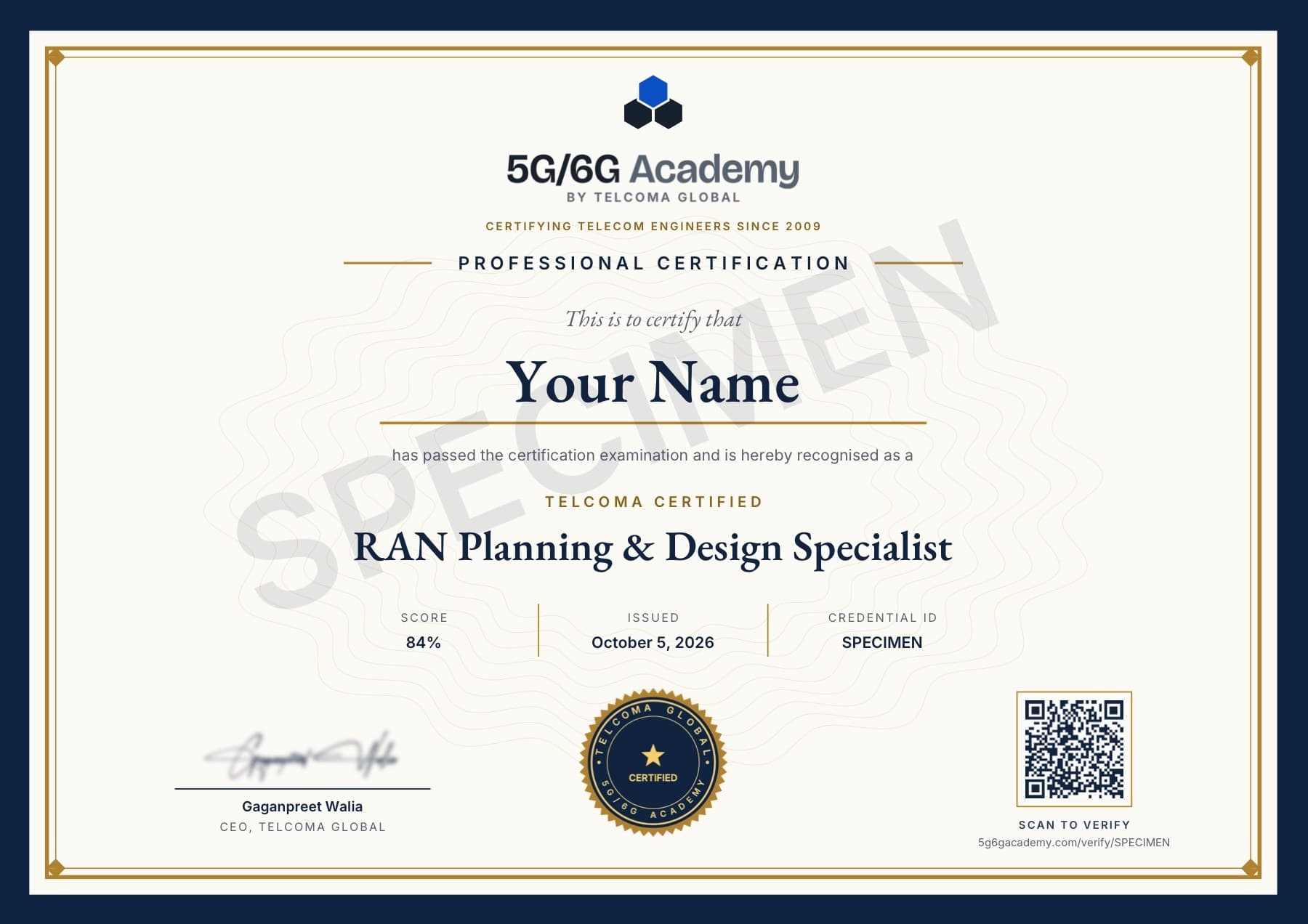
Earns a certificate35 questions · 60 min · 65% to pass — earns your TELCOMA Certified RAN Planning & Design Specialist, a QR-verifiable certificate.
Not ready yet? Take a free 20-question mock exam first.
Look up any acronym in the telecom glossary
Certification
Earn the TELCOMA Certified RAN Planning & Design Specialist
Pass the 35-question exam with 65% or more, and the certificate is yours to show anyone.
- Show proofEvery certificate carries a QR code and a public page that anyone can check.
- Add it to LinkedInPut it in the Licenses & certifications section of your profile in one click.
- Build a collectionEach of our 13 courses earns its own certificate.
Every lesson free for 7 days, no card. The exam comes with Prime Membership or this certification.
Study materials
Free for 7 daysDownload the 5G RAN Planning & Design question bank and slide deck — every signal check in the course, with answers, plus every figure.
- Question BankPDF37 KB
- Slide DeckPPTX15 MB
Free with a new account for your first 7 days — no card. After that, the question bank and slides come with Prime Membership or this certification.
Hands-on learning
Do it, don't just watch it
Modules end with a hands-on exercise — 10 in this course. You move the controls, the numbers answer back, and a wrong turn tells you why.
Try this one first:
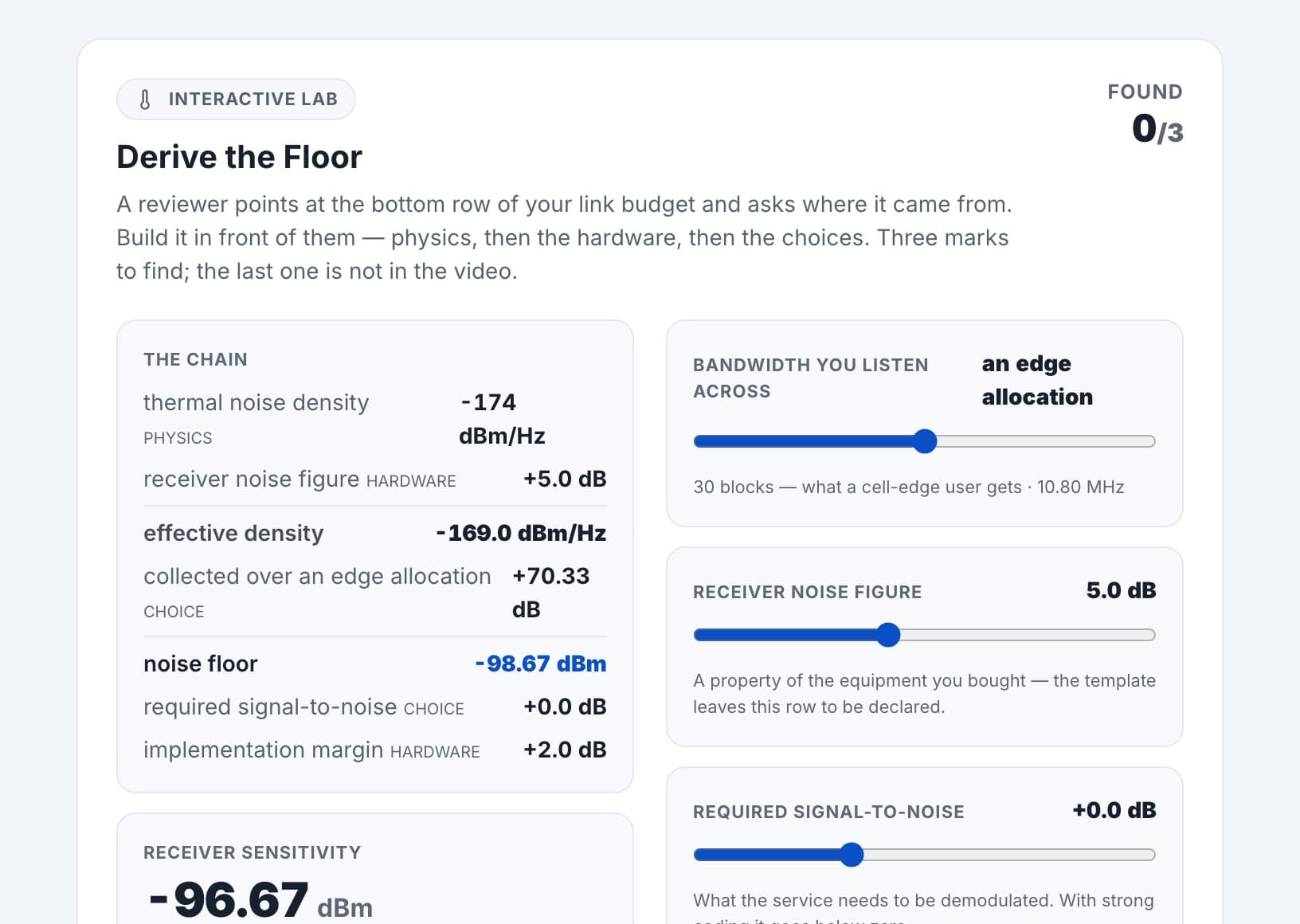
Derive the Floor · Interactive lab · ~7 min
Try it freeFree with an account — no card.
What you'll build
3 of 10 — the rest are in the syllabus
- Lab 1FreeDerive the FloorA reviewer points at the bottom row of your link budget and asks where it came from. Build it in front of them — physics, hardware, then the choices.Module 1~7 min
- Lab 2Buy the ProbabilityTurn a coverage promise into the decibels it costs, read off the width the scenario publishes, and watch what the last few points are worth.Module 2~6 min
- Lab 3Which Link Runs Out FirstOne handle — how much of the carrier a cell-edge user gets — and every channel budget is recomputed. Find the crossing, then find the floor where the site count stops falling.Module 3~7 min
Ways to learn
Choose the way that fits you.
| Feature | This certification Price loadingonce One credential, yours for good | Recommended Prime Membership Price loading/year 13 courses · 404 lessons · ~52 h · 121 hands-on exercises | Free account Free Every course for your first 7 days, then the first module of each |
|---|---|---|---|
| Lessons and labs in this course | All for your first 7 days, then the first module | ||
| Study pack — question bank and slides | For your first 7 days | ||
| Certification exams and verifiable certificates | 1, for this course | All 13 | |
| Every other course | First module | All, and new ones | All for your first 7 days, then the first module |
| Full-length practice exams | For your first 7 days | ||
| TelcoMentor AI coach | For your first 7 days, at a smaller daily limit | ||
| Hands-on scenarios — traces, logs, configs | Selected traces | All for your first 7 days, then selected traces | |
One payment · no renewal | Get Prime Membership You create a free account first, then go straight to the plans. Renews yearly · cancel anytime | Join for free No card needed |
Prime Membership
Price loading/year
13 courses · 404 lessons · ~52 h · 121 hands-on exercises
- Lessons and labs in this course
- Study pack — question bank and slides
- Certification exams and verifiable certificates — all 13
- Every other course — all, and new ones
- Full-length practice exams
- TelcoMentor AI coach
- Hands-on scenarios — traces, logs, configs
You create a free account first, then go straight to the plans.
Renews yearly · cancel anytime
This certification
Price loadingonce
One credential, yours for good
- Lessons and labs in this course
- Study pack — question bank and slides
- Certification exams and verifiable certificates — 1, for this course
- Every other course — first module
- Not included: Full-length practice exams
- Not included: TelcoMentor AI coach
- Hands-on scenarios — traces, logs, configs — selected traces
One payment · no renewal
Free account
Free
Every course for your first 7 days, then the first module of each
- Lessons and labs in this course — all for your first 7 days, then the first module
- Study pack — question bank and slides — for your first 7 days
- Not included: Certification exams and verifiable certificates
- Every other course — all for your first 7 days, then the first module
- Full-length practice exams — for your first 7 days
- TelcoMentor AI coach — for your first 7 days, at a smaller daily limit
- Hands-on scenarios — traces, logs, configs — all for your first 7 days, then selected traces
No card needed
A new free account opens every course for its first 7 days, no card needed: every lesson and lab, the study packs, the full-length practice exams and TelcoMentor. In those 7 days only the certification exam needs a paid option. After them, the first module of every course stays free. Both paid options come with a 7-day money-back guarantee.
Explore more courses
See all 13 courses → 5G RAN Optimisation & PerformanceCounters & KPIsAccessibility analysisRetainability & radio link failureIntermediate31 lessons~5.1h
 5G SecuritySUCI & ECIES5G-AKA & EAP-AKA′SBI mutual TLS & OAuth tokensAdvanced32 lessons~4.6h
 Telco CloudKubernetes for CNFsStatefulSets & probesCPU pinning & HugePagesAdvanced36 lessons~4.7h