 Watch free
Free preview · Where AI meets the radio — the network's hardest case — opens in the course player
AI-RAN & the AI-Native Network
AI inside the radio itself — the 3GPP hooks that went normative, RIC-hosted apps running on live networks, the shared-compute argument, and honest energy numbers with their denominators.
Every 5G & 6G course free for 7 days
- Lessons
- 31
- Video
- ≈3.6h
- Hands-on
- 3 labs · 3 checkpoints
- Before you start
- 5G Foundation
About this course
Who it's for. Working RAN engineers.
Before you start. 5G Foundation — or the free placement check. AI for Telecom Networks is NOT required.
This course includes
- 31 video lessons — the first needs no account, and all are free for your first 7 days
- Hands-on labs and checkpoints
- Study pack — question bank and slides
- A free mock exam to find your gaps
- Certification exam and a QR-verifiable certificate
Skills you'll gain
- Training vs inference
- Beam & CSI prediction
- AI positioning
- Model life-cycle management
- Near-RT & non-RT RIC
- xApps & rApps
- GPU-based AI-RAN
- RAN energy savings
Syllabus
6 modules · 31 lessons · certification exam
Module 1 — Why AI in the RAN
Open with the radio's real tension, re-teach the air-interface and RAN-compute frames a Foundation-only learner needs, and lock the three-strand discipline.
4 lessons · 1 checkpoint · ≈26 min
- Lesson 1Where AI meets the radio — the network's hardest caseWatch free5:29
- Lesson 2The air interface in four frames: beams, channel, scheduling, positionFree with an account6:21
- Lesson 3RU, DU, CU: where the RAN computesFree with an account7:15
- Lesson 4AI-RAN, defined — three strands, one disciplineFree with an account7:18
- CheckpointName the Strand · Checkpoint~5 min
Module 2 — ML mechanics for RAN engineers
Exactly the ML mechanics the rest of the course spends — fitted functions, time-series prediction, one-sided vs two-sided models, life-cycle management and fallback discipline — all through radio data.
5 lessons · 1 lab · ≈32 min
- Lesson 1Training vs inference: a model is a fitted functionFree for 7 days with a free account, then with Prime Membership5:59
- Lesson 2The channel is a time-seriesFree for 7 days with a free account, then with Prime Membership6:07
- Lesson 3One-sided or two-sided: where the model standsFree for 7 days with a free account, then with Prime Membership6:43
- Lesson 4Life-cycle management: a model in serviceFree for 7 days with a free account, then with Prime Membership6:44
- Lesson 5Fallback: the floor the network never losesFree for 7 days with a free account, then with Prime Membership6:30
- Interactive labWill the Decision Still Be True? · Interactive lab~5 min
Module 3 — AI on the air interface — the 3GPP strand
The 3GPP strand with exact provenance — the frozen one-sided framework and its three use cases, the life-cycle signalling, and the two-sided story told at its true status.
6 lessons · 1 lab · ≈42 min
- Lesson 1Rel-19: one-sided models go normativeFree for 7 days with a free account, then with Prime Membership7:23
- Lesson 2Beam prediction: measure a few, know them allFree for 7 days with a free account, then with Prime Membership6:52
- Lesson 3CSI prediction & AI positioning: the other two hooksFree for 7 days with a free account, then with Prime Membership7:15
- Lesson 4Life-cycle signalling: activate, monitor, fall backFree for 7 days with a free account, then with Prime Membership6:56
- Lesson 5Two-sided CSI compression: why it had to waitFree for 7 days with a free account, then with Prime Membership7:34
- Lesson 6The two-sided exchange: encoder, air gap, decoderFree for 7 days with a free account, then with Prime Membership5:58
- Interactive labPredict the Beam · Interactive lab~6 min
Module 4 — RIC-hosted intelligence — the O-RAN strand
Deepen the two-clock picture into working knowledge — loop budgets, the named wires, where models are trained and shipped, and a scorecard moved honestly forward.
5 lessons · 1 checkpoint · ≈29 min
- Lesson 1Near-RT and non-RT: two clocks, now with numbersFree for 7 days with a free account, then with Prime Membership5:06
- Lesson 2E2 and A1: the wires get namesFree for 7 days with a free account, then with Prime Membership5:38
- Lesson 3The O-RAN AI/ML loop: where the models liveFree for 7 days with a free account, then with Prime Membership6:16
- Lesson 4rApps in production: the scorecard movesFree for 7 days with a free account, then with Prime Membership6:01
- Lesson 5An energy rApp, end to end: one full circuitFree for 7 days with a free account, then with Prime Membership6:05
- CheckpointRoute It on the Right Wire · Checkpoint~5 min
Module 5 — AI-RAN infrastructure — the shared-compute strand
Cash the shared-compute promise honestly — the three prepositions, what running the physical layer on accelerated compute takes, what has genuinely run versus been announced, the open silicon debate, and the economics.
6 lessons · 1 lab · ≈48 min
- Lesson 1AI-for-RAN, AI-on-RAN, AI-and-RAN: three prepositions, kept honestFree for 7 days with a free account, then with Prime Membership7:08
- Lesson 2L1 on GPUs: the physical layer on a general-purpose machineFree for 7 days with a free account, then with Prime Membership7:48
- Lesson 3GPU AI-RAN today: what has actually runFree for 7 days with a free account, then with Prime Membership8:00
- Lesson 4AI without GPUs: the purpose-built counter-argumentFree for 7 days with a free account, then with Prime Membership8:30
- Lesson 5AI-and-RAN economics: does sharing the machine pay?Free for 7 days with a free account, then with Prime Membership8:32
- Lesson 6Research vs shipping: the AI-RAN scorecardFree for 7 days with a free account, then with Prime Membership8:07
- Interactive labShare the Machine · Interactive lab~6 min
Module 6 — Energy savings & operating models in production
The network-side 3GPP track that went normative a release earlier, sleep mechanics and honest per-denominator savings, the three operating models that run production RAN AI, and a truthful cash-out of "AI-native".
5 lessons · 1 checkpoint · ≈39 min
- Lesson 1AI/ML for NG-RAN: the oldest AI in the RANFree for 7 days with a free account, then with Prime Membership7:39
- Lesson 2Cell sleep, by levels: DTX, DRX and deeperFree for 7 days with a free account, then with Prime Membership7:33
- Lesson 3Energy savings: the numbers, with their denominatorsFree for 7 days with a free account, then with Prime Membership7:08
- Lesson 4Embedded, rApp, or GPU: who runs the loopFree for 7 days with a free account, then with Prime Membership8:29
- Lesson 5AI-native, honestlyFree for 7 days with a free account, then with Prime Membership7:49
- CheckpointRead the Energy Claim · Checkpoint~5 min
Certification exam
Earns a certificate42 questions · 60 min · 65% to pass — earns your TELCOMA Certified AI-RAN Specialist, a QR-verifiable certificate.
Not ready yet? Take a free 20-question mock exam first.
Look up any acronym in the telecom glossary
Certification
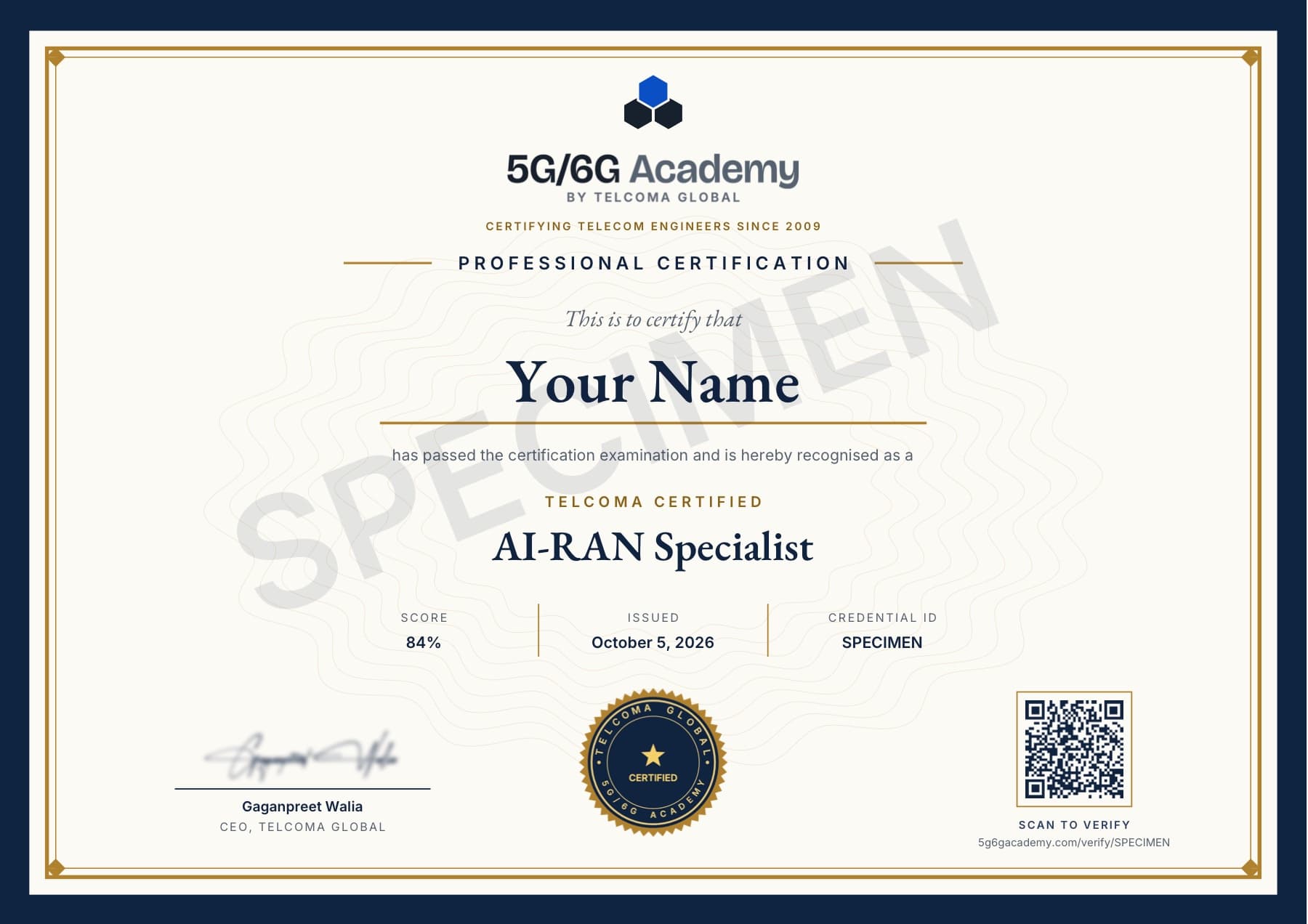
Earn the TELCOMA Certified AI-RAN Specialist
Pass the 42-question exam with 65% or more, and the certificate is yours to show anyone.
- Show proofEvery certificate carries a QR code and a public page that anyone can check.
- Add it to LinkedInPut it in the Licenses & certifications section of your profile in one click.
- Build a collectionEach of our 13 courses earns its own certificate.
Study materials
Download the AI-RAN & the AI-Native Network question bank and slide deck — every signal check in the course, with answers, plus every figure.
- Question BankPDF42 KB
- Slide DeckPPTX15 MB
Hands-on learning
Do it, don't just watch it
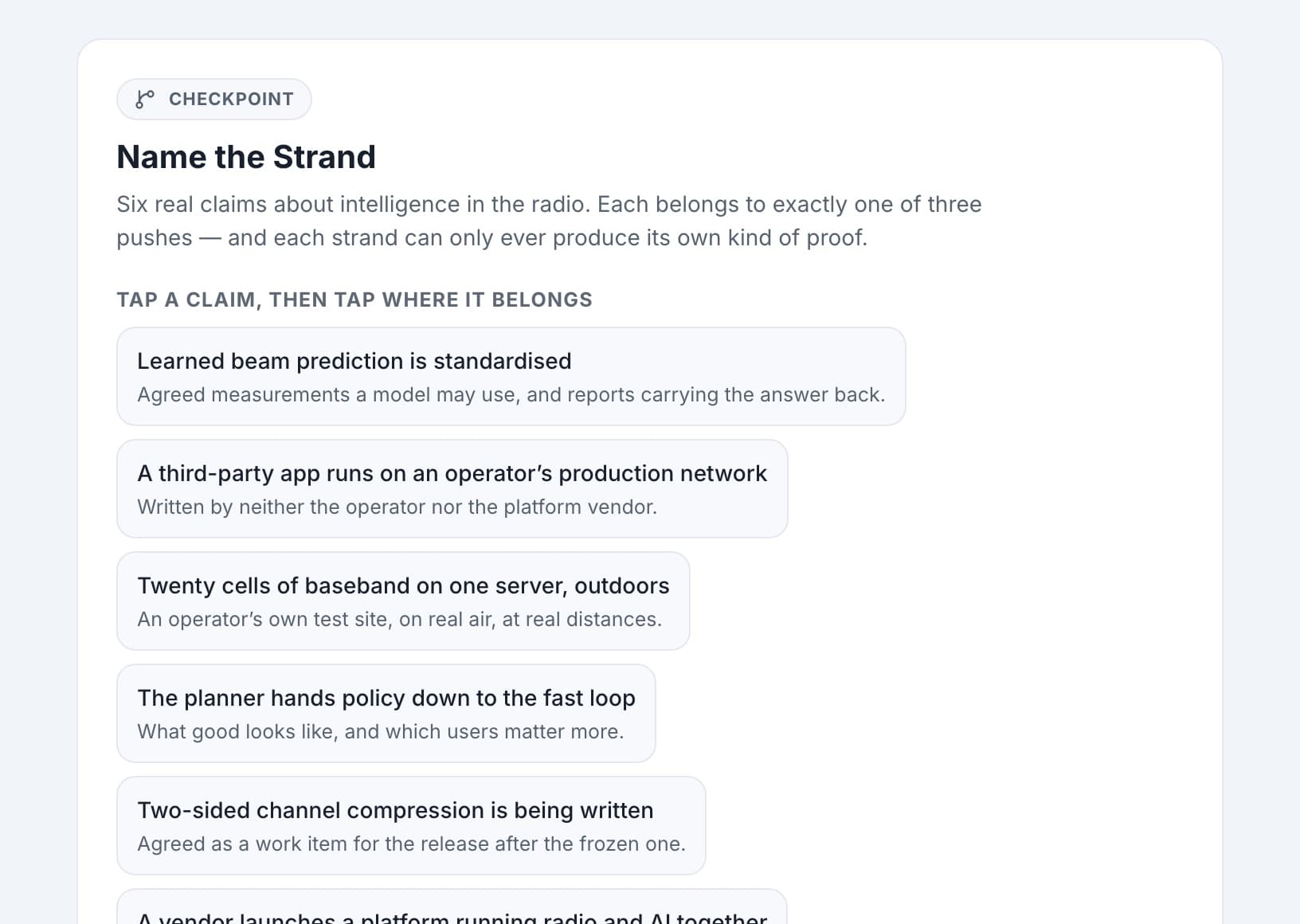
Modules end with a hands-on exercise — 3 labs · 3 checkpoints in this course. You move the controls, the numbers answer back, and a wrong turn tells you why.
Try this one first:
Name the Strand · Checkpoint · ~5 min
Try it freeFree with an account — no card.
What you'll build
3 of 6 — the rest are in the syllabus
- Lab 1Will the Decision Still Be True?Doppler decides how long the channel stays itself. Set speed and band, then choose where the model runs — and find out whether its answer survives the trip.Module 2~5 min
- Lab 2Predict the BeamCut a 32-beam sweep down and watch a predictor guess the rest. Find where the saving stops being free — the answer is a number, not an opinion.Module 3~6 min
- Lab 3Share the MachineOne accelerator runs a site’s physical layer. Sell the rest as AI inference over a real 24-hour load curve — without ever taking a slot from the radio.Module 5~6 min
Ways to learn
Choose the way that fits you.
| Feature | This certification Price loadingonce One credential, yours for good | Recommended Prime Membership Price loading/year Every course, including new ones | Free account Free Every course for your first 7 days, then the first module of each |
|---|---|---|---|
| Lessons and labs in this course | All for your first 7 days, then the first module | ||
| Study pack — question bank and slides | For your first 7 days | ||
| Certification exam and verifiable certificate | This course | Every course | |
| Every other course | First module | All, and new ones | All for your first 7 days, then the first module |
| Full-length practice exams | For your first 7 days | ||
| TelcoMentor AI coach | For your first 7 days, at a smaller daily limit | ||
| Hands-on scenarios — traces, logs, configs | Selected traces | All for your first 7 days, then selected traces | |
One payment · no renewal | See Prime Membership Renews yearly · cancel anytime | Join for free No card needed |
This certification
Price loadingonce
One credential, yours for good
- Lessons and labs in this course
- Study pack — question bank and slides
- Certification exam and verifiable certificate — this course
- Every other course — first module
- Not included: Full-length practice exams
- Not included: TelcoMentor AI coach
- Hands-on scenarios — traces, logs, configs — selected traces
One payment · no renewal
Prime Membership
Price loading/year
Every course, including new ones
- Lessons and labs in this course
- Study pack — question bank and slides
- Certification exam and verifiable certificate — every course
- Every other course — all, and new ones
- Full-length practice exams
- TelcoMentor AI coach
- Hands-on scenarios — traces, logs, configs
Renews yearly · cancel anytime
Free account
Free
Every course for your first 7 days, then the first module of each
- Lessons and labs in this course — all for your first 7 days, then the first module
- Study pack — question bank and slides — for your first 7 days
- Not included: Certification exam and verifiable certificate
- Every other course — all for your first 7 days, then the first module
- Full-length practice exams — for your first 7 days
- TelcoMentor AI coach — for your first 7 days, at a smaller daily limit
- Hands-on scenarios — traces, logs, configs — all for your first 7 days, then selected traces
No card needed
A new free account opens every course for its first 7 days, no card needed: every lesson and lab, the study packs, the full-length practice exams and TelcoMentor. In those 7 days only the certification exam needs a paid option. After them, the first module of every course stays free. Both paid options come with a 7-day money-back guarantee.
Explore more courses
See all 13 courses → AI for Telecom NetworksSupervised & unsupervised MLModel evaluation & driftLLMs & RAG for operationsIntermediate26 lessons~3.8h
 Road to 6GIMT-2030 usage scenariosRel-18 to Rel-21 roadmap6G waveform & bandwidthIntermediate27 lessons~3.5h
 NTN & Direct-to-DeviceLEO, MEO & GEO geometrySatellite link budgetsTransparent vs regenerative payloadsIntermediate27 lessons~3.7h