 Watch free
Free preview · Study item, work item, specification: one ruler for every 6G claim — opens in the course player
Road to 6G: IMT-2030 & the First 6G Specifications
6G as it actually stands, not as it is pitched — the targets ITU-R set, what the 3GPP studies have genuinely agreed, where the spectrum question really sits, and one ruler that tells you which rung any 6G claim is standing on.
Every 5G & 6G course free for 7 days
- Lessons
- 27
- Video
- ≈3.5h
- Hands-on
- 2 labs · 4 checkpoints
- Before you start
- 5G Foundation
About this course
Who it's for. Engineers, architects and technical leads who have to judge 6G claims.
Before you start. 5G Foundation. 5G RAN Specialist helps for the radio module — lesson 1.3 is the waveform and coding bridge.
This course includes
- 27 video lessons — the first needs no account, and all are free for your first 7 days
- Hands-on labs and checkpoints
- Study pack — question bank and slides
- A free mock exam to find your gaps
- Certification exam and a QR-verifiable certificate
Skills you'll gain
- IMT-2030 usage scenarios
- Rel-18 to Rel-21 roadmap
- 6G waveform & bandwidth
- 6G spectrum bands
- Integrated sensing
- AI-native design
- Reading 3GPP & ITU-R outputs
Syllabus
6 modules · 27 lessons · certification exam
Module 1 — From 5G-Advanced to 6G: the bridge
Install the status ruler and the four frames every later claim is measured against — and put the demand question on the table on day one.
4 lessons · 1 checkpoint · ≈32 min
- Lesson 1Study item, work item, specification: one ruler for every 6G claimWatch free8:59
- Lesson 2Rel-18 and Rel-19: the 5G-Advanced ground 6G starts fromFree with an account7:21
- Lesson 3CP-OFDM, DFT-s-OFDM and LDPC: the frames 6G reusesFree with an account7:04
- Lesson 4ITU-R and 3GPP: who sets targets, who builds radiosFree with an account8:41
- CheckpointPlace the Claim · Checkpoint~6 min
Module 2 — IMT-2030: the targets ITU-R set
Read the ITU-R framework exactly — the six jobs, which capabilities carry numbers, what those numbers are and are not, and how a candidate radio is judged against them.
5 lessons · 1 checkpoint · ≈36 min
- Lesson 1IMT-2030's six usage scenarios — the hexagon, re-enteredFree for 7 days with a free account, then with Prime Membership7:29
- Lesson 2Fifteen axes, nine figures: the capabilities under the hexagonFree for 7 days with a free account, then with Prime Membership7:15
- Lesson 3Targets, not requirements: how the framework reads its own numbersFree for 7 days with a free account, then with Prime Membership6:49
- Lesson 4How a radio becomes 6G: submitted, evaluated, acceptedFree for 7 days with a free account, then with Prime Membership6:56
- Lesson 5The layer above the corners: IMT-2030's overarching aspectsFree for 7 days with a free account, then with Prime Membership7:21
- CheckpointNine Carry Numbers, Six Do Not · Checkpoint~5 min
Module 3 — The 6G radio: what the studies have agreed
State precisely what the 6G radio study has agreed, in the study's own vocabulary, and hold the trade-offs behind the parts still being decided.
5 lessons · 1 lab · ≈38 min
- Lesson 1The study's scope, and its agreed namesFree for 7 days with a free account, then with Prime Membership6:49
- Lesson 2What the study kept, and changed: the waveform argumentFree for 7 days with a free account, then with Prime Membership7:08
- Lesson 36G channel bandwidth: the width questionFree for 7 days with a free account, then with Prime Membership7:20
- Lesson 46G beside 5G: standalone, one shared carrier, and a device that movesFree for 7 days with a free account, then with Prime Membership8:00
- Lesson 5The split, and the interface to the core: a trade-off that outlives its decisionFree for 7 days with a free account, then with Prime Membership8:14
- Interactive labThe Width Question · Interactive lab~6 min
Module 4 — Spectrum for 6G: identified, studied, or neither
Read any 6G spectrum claim exactly — which stretch of dial, which of three overlapping names, which regulatory verb, and which region it is true in.
5 lessons · 1 checkpoint · ≈39 min
- Lesson 1The 6G study's evaluation bands — the dial, re-enteredFree for 7 days with a free account, then with Prime Membership7:21
- Lesson 2Three names, one stretch of dialFree for 7 days with a free account, then with Prime Membership7:31
- Lesson 3Studied, not yet identified: two bands, and only one you can plan onFree for 7 days with a free account, then with Prime Membership7:41
- Lesson 4Sub-terahertz, and what was actually saidFree for 7 days with a free account, then with Prime Membership8:04
- Lesson 5Reading a spectrum claim: identified, allocated, licensed, deployedFree for 7 days with a free account, then with Prime Membership8:20
- CheckpointWhich Verb? · Checkpoint~5 min
Module 5 — Sensing and intelligence: the two new abilities
Separate what is frozen from what is being studied on the two abilities 6G is most often sold on — and give "AI-native" a definition that can actually be tested.
4 lessons · 1 checkpoint · ≈31 min
- Lesson 1Sensing runs on two tracksFree for 7 days with a free account, then with Prime Membership7:52
- Lesson 2It already arrived: AI hooks in a release vendors are building toFree for 7 days with a free account, then with Prime Membership7:33
- Lesson 3Where AI is actually central — structural, optional, and how far either has gotFree for 7 days with a free account, then with Prime Membership7:48
- Lesson 4"AI-native": four objects behind one wordFree for 7 days with a free account, then with Prime Membership7:58
- CheckpointWhich Track, Which Layer? · Checkpoint~6 min
Module 6 — Reading the release train: what to track, what to say
Leave the learner able to track 6G without a press release, place any claim on the ladder, and state the demand case fairly in either direction.
4 lessons · 1 lab · ≈35 min
- Lesson 1WP 5D and 3GPP TSG: the outputs worth trackingFree for 7 days with a free account, then with Prime Membership8:39
- Lesson 2Contribution, working group, plenary: how a decision landsFree for 7 days with a free account, then with Prime Membership8:34
- Lesson 3Lab, pilot, announced, shipping: placing a 6G claimFree for 7 days with a free account, then with Prime Membership8:56
- Lesson 4The 6G demand case: what the skeptics get rightFree for 7 days with a free account, then with Prime Membership9:06
- Interactive labCompared to What, Measured How · Interactive lab~6 min
Certification exam
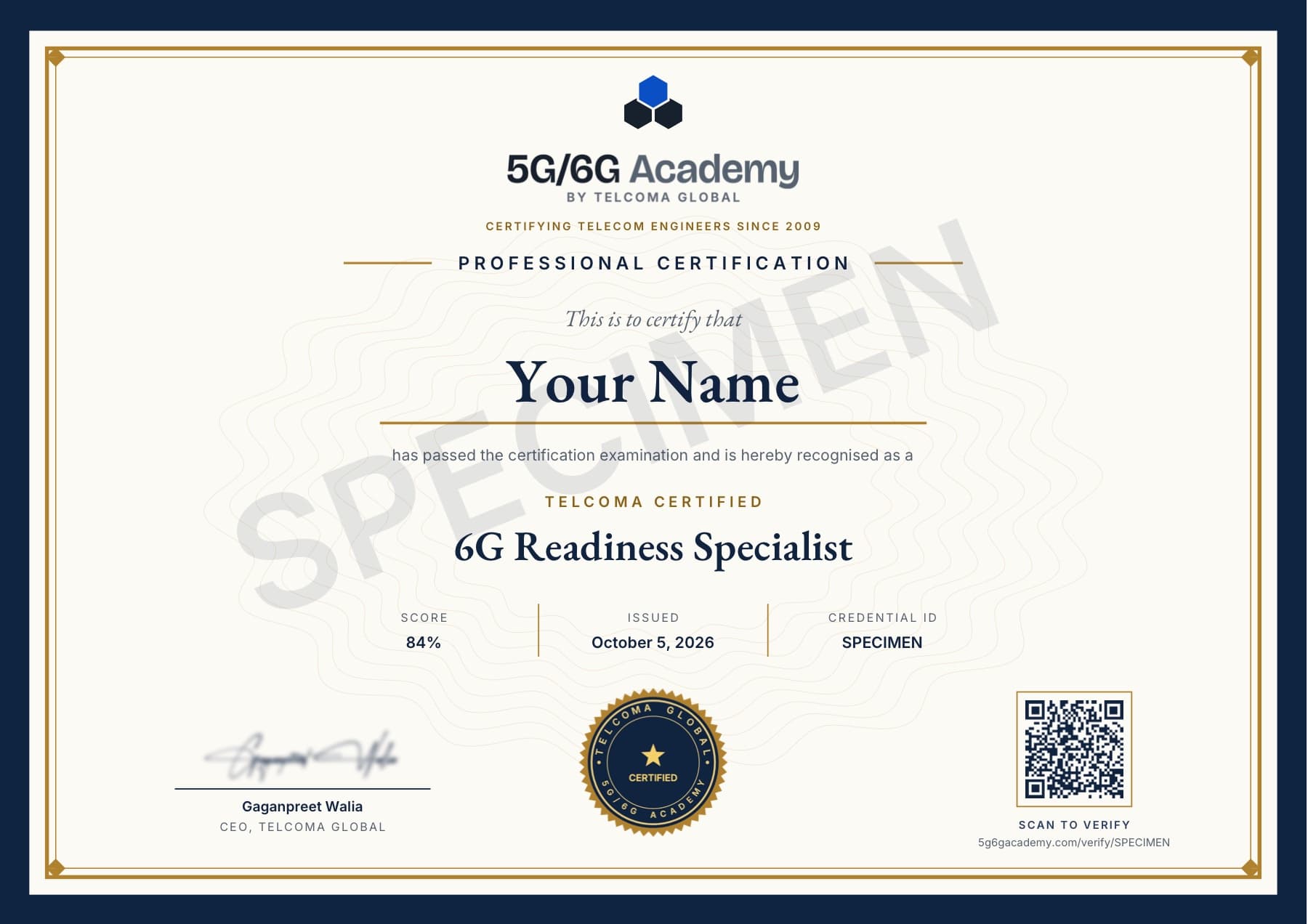
Earns a certificate42 questions · 60 min · 65% to pass — earns your TELCOMA Certified 6G Readiness Specialist, a QR-verifiable certificate.
Not ready yet? Take a free 20-question mock exam first.
Look up any acronym in the telecom glossary
Certification
Earn the TELCOMA Certified 6G Readiness Specialist
Pass the 42-question exam with 65% or more, and the certificate is yours to show anyone.
- Show proofEvery certificate carries a QR code and a public page that anyone can check.
- Add it to LinkedInPut it in the Licenses & certifications section of your profile in one click.
- Build a collectionEach of our 13 courses earns its own certificate.
Study materials
Download the Road to 6G: IMT-2030 & the First 6G Specifications question bank and slide deck — every signal check in the course, with answers, plus every figure.
- Question BankPDF40 KB
- Slide DeckPPTX14 MB
Hands-on learning
Do it, don't just watch it
Modules end with a hands-on exercise — 2 labs · 4 checkpoints in this course. You move the controls, the numbers answer back, and a wrong turn tells you why.
Try this one first:
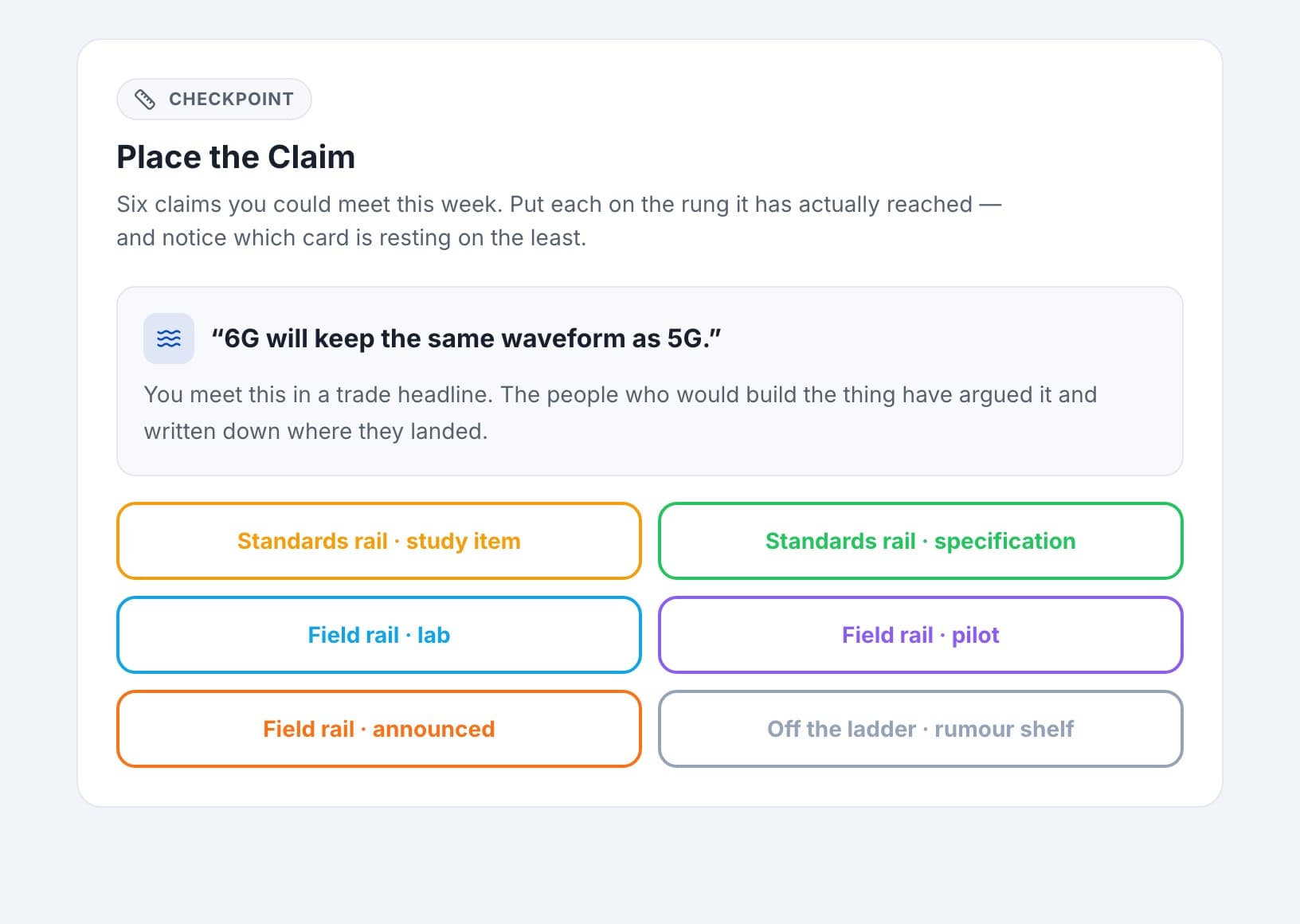
Place the Claim · Checkpoint · ~6 min
Try it freeFree with an account — no card.
What you'll build
3 of 6 — the rest are in the syllabus
- Lab 1The Width QuestionOne dial from three megahertz to four hundred. Watch a spectrum team and a device team disagree about the same number, both correctly, and see where the carrier can still be switched on.Module 3~6 min
- Lab 2Compared to What, Measured HowOne measurement, never changed. Choose its baseline and decide whether to hold the bandwidth constant, then watch the same result read as a breakthrough or a rounding error.Module 6~6 min
- CheckpointFreePlace the ClaimSix claims you could meet this week — a waveform agreement, a prototype, a live trial, a 6G-ready chip. Put each on the rung it has actually reached, and find the card resting on the least.Module 1~6 min
Ways to learn
Choose the way that fits you.
| Feature | This certification Price loadingonce One credential, yours for good | Recommended Prime Membership Price loading/year Every course, including new ones | Free account Free Every course for your first 7 days, then the first module of each |
|---|---|---|---|
| Lessons and labs in this course | All for your first 7 days, then the first module | ||
| Study pack — question bank and slides | For your first 7 days | ||
| Certification exam and verifiable certificate | This course | Every course | |
| Every other course | First module | All, and new ones | All for your first 7 days, then the first module |
| Full-length practice exams | For your first 7 days | ||
| TelcoMentor AI coach | For your first 7 days, at a smaller daily limit | ||
| Hands-on scenarios — traces, logs, configs | Selected traces | All for your first 7 days, then selected traces | |
One payment · no renewal | See Prime Membership Renews yearly · cancel anytime | Join for free No card needed |
This certification
Price loadingonce
One credential, yours for good
- Lessons and labs in this course
- Study pack — question bank and slides
- Certification exam and verifiable certificate — this course
- Every other course — first module
- Not included: Full-length practice exams
- Not included: TelcoMentor AI coach
- Hands-on scenarios — traces, logs, configs — selected traces
One payment · no renewal
Prime Membership
Price loading/year
Every course, including new ones
- Lessons and labs in this course
- Study pack — question bank and slides
- Certification exam and verifiable certificate — every course
- Every other course — all, and new ones
- Full-length practice exams
- TelcoMentor AI coach
- Hands-on scenarios — traces, logs, configs
Renews yearly · cancel anytime
Free account
Free
Every course for your first 7 days, then the first module of each
- Lessons and labs in this course — all for your first 7 days, then the first module
- Study pack — question bank and slides — for your first 7 days
- Not included: Certification exam and verifiable certificate
- Every other course — all for your first 7 days, then the first module
- Full-length practice exams — for your first 7 days
- TelcoMentor AI coach — for your first 7 days, at a smaller daily limit
- Hands-on scenarios — traces, logs, configs — all for your first 7 days, then selected traces
No card needed
A new free account opens every course for its first 7 days, no card needed: every lesson and lab, the study packs, the full-length practice exams and TelcoMentor. In those 7 days only the certification exam needs a paid option. After them, the first module of every course stays free. Both paid options come with a 7-day money-back guarantee.
Explore more courses
See all 13 courses → NTN & Direct-to-DeviceLEO, MEO & GEO geometrySatellite link budgetsTransparent vs regenerative payloadsIntermediate27 lessons~3.7h
 5G RAN Planning & DesignPropagation modelsShadow fading marginsLink budgets & cell radiusIntermediate28 lessons~4.5h
 5G RAN Optimisation & PerformanceCounters & KPIsAccessibility analysisRetainability & radio link failureIntermediate31 lessons~5.1h