Career route
How to become a 5G RAN Engineer
Own the radio — scheduling, beamforming, mobility and the procedures that decide whether a call survives.
Join for freeEvery course on this route free for 7 days
The route
- 15G Foundation
- 25G RAN Specialist
- Courses
- 2
- Video
- ~6.7h
- Certificates
- 2
Who takes this route
Engineers moving into the radio access network, often from a 4G RF or optimisation background.
What you'll be able to do
- Read an RRC or NGAP trace and say why a handover failed
- Explain a CU/DU split and its fronthaul budget
- Reason about beam management and QoS the way a scheduler does
The route, in order
2 courses · 14 modules · about 6.7 hours of video, hands-on labs throughout, and a graded exam at the end of each.
 1TELCOMA 5G Foundation5G Foundation5G system architectureNSA vs SAService-based architectureCore network functionsBeginner34 lessons~3.3h7 modules
 2TELCOMA 5G RAN Specialist5G RAN SpecialistNR numerology & frame structureBandwidth partsSSB & random accessMassive MIMO & beamformingIntermediate31 lessons~3.4h7 modulesBefore this: 5G Foundation, or equivalent working knowledge of 5G architecture
What you earn
2 verifiable TELCOMA certificates, one for each course, issued only after you pass its graded exam. Each carries a number and a QR code to a public page an employer can open without an account.
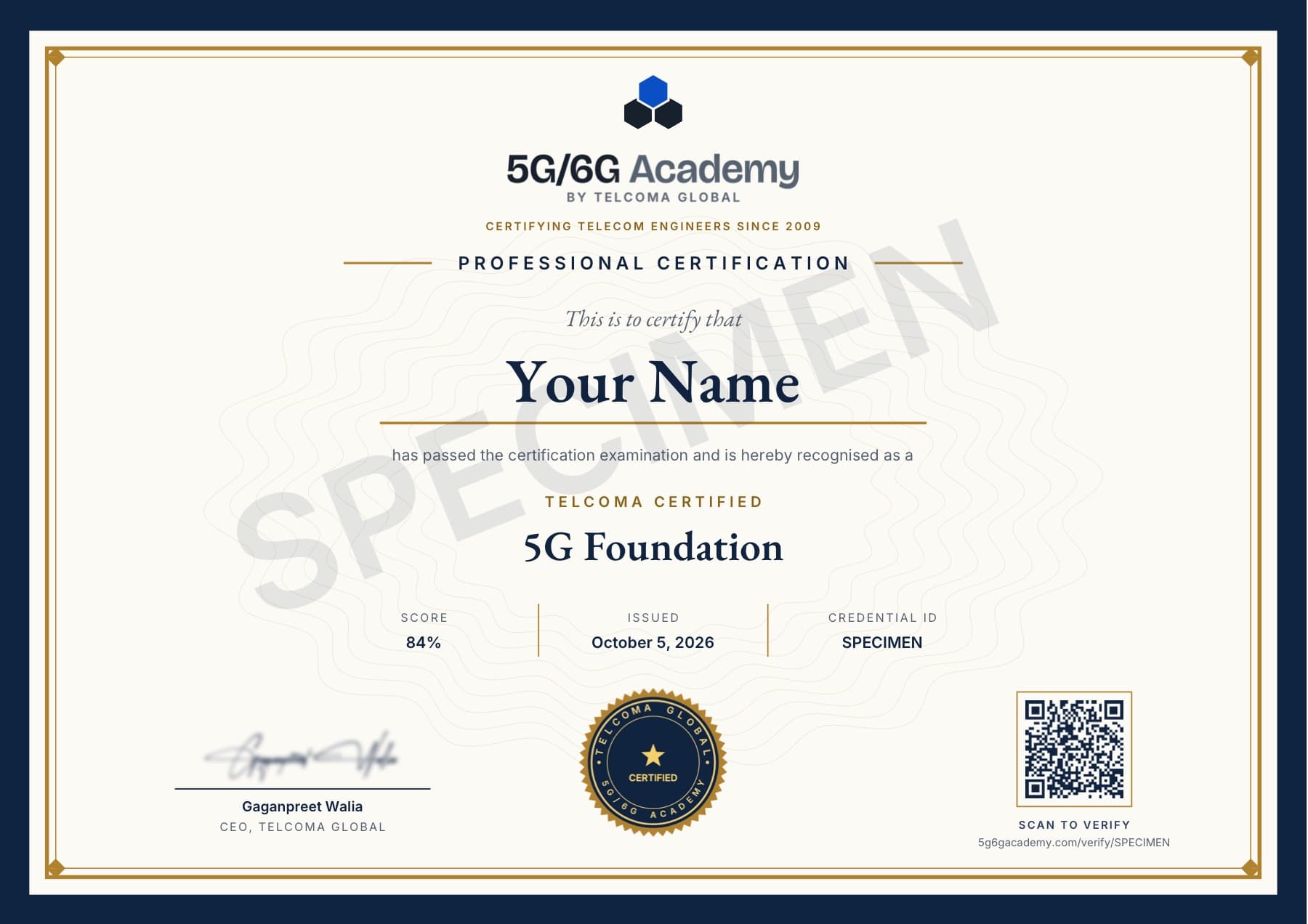
TELCOMA 5G Foundation
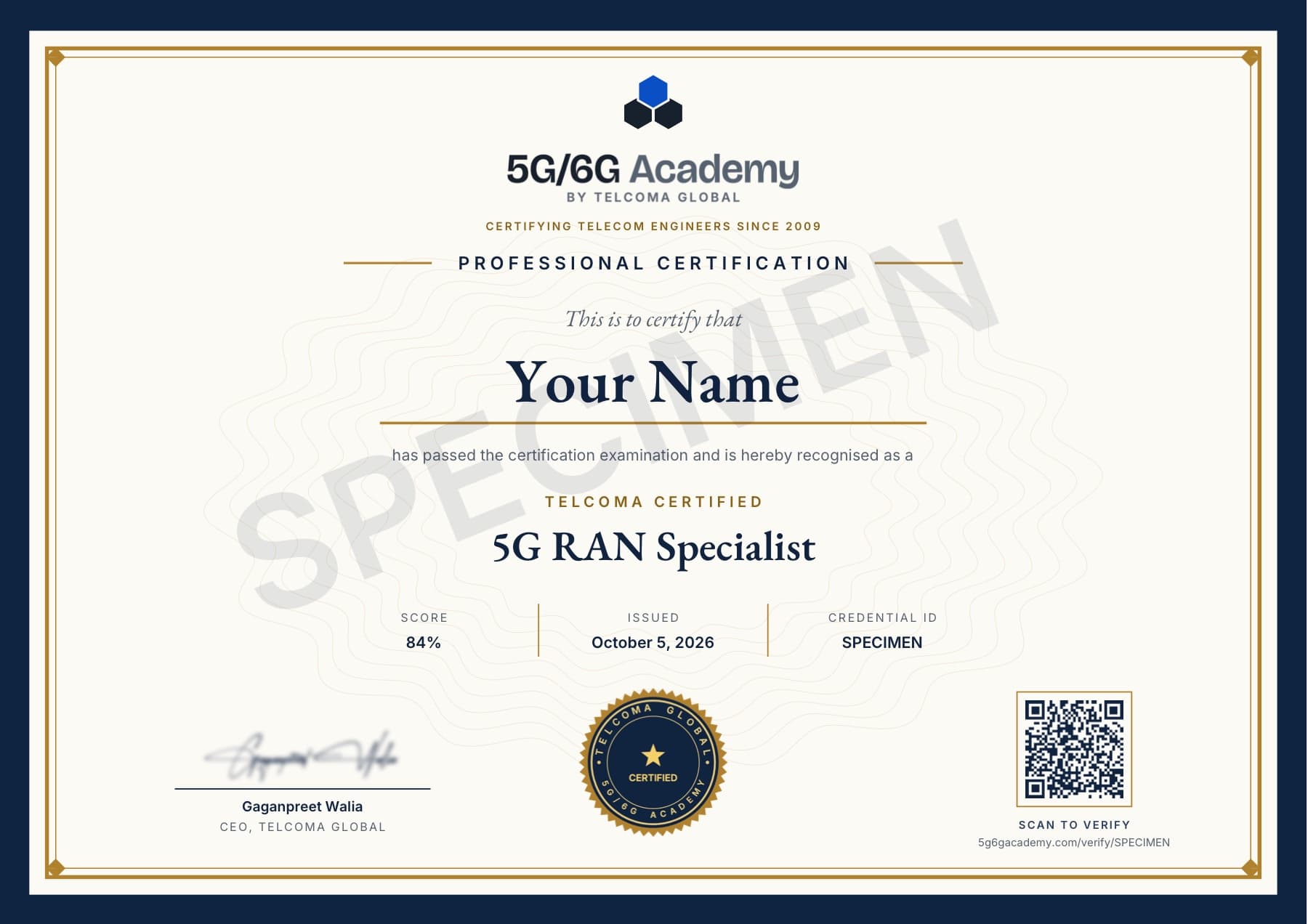
TELCOMA 5G RAN Specialist
Where this goes next
 Once the route is behind youAI-RAN & the AI-Native NetworkTraining vs inferenceBeam & CSI predictionAI positioningAdvanced · 31 lessons · ~3.6h
Not the route you wanted? See all 12 career routes.