What Is 5G-Advanced?
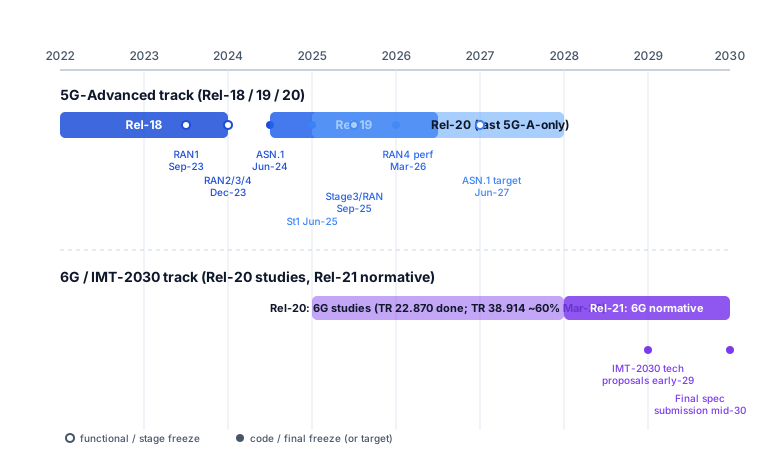
5G-Advanced is the evolutionary phase of 5G NR beginning with 3GPP Release 18. It marks a significant leap from the initial 5G specifications (Releases 15--17) by introducing AI/ML natively into the air interface, expanding IoT support to battery-less devices, and optimizing the system for immersive media (XR/AR/VR). The term "5G-Advanced" was formally adopted by 3GPP in April 2021, and Release 18 was functionally frozen in June 2024 with ASN.1 completion in December 2024.
Release 18 is not a standalone specification -- it builds on the Release 17 baseline. Operators upgrading to Rel-18 need software updates to their gNB and 5GC NFs, plus new UE chipsets that support the enhanced features. The commercial timeline depends on chipset availability from Qualcomm, MediaTek, and Samsung LSI, with first Rel-18-capable chipsets expected in late 2025 and commercial devices in 2026.
Release 18 Feature Overview
Feature Matrix
| Feature | Work Item | 3GPP Spec | Key Benefit | Impact Area |
|---|
| AI/ML for NR Air Interface | FS_NR_AIML_air | TR 38.843 / TS 38.214 | Predictive beam management, CSI compression | RAN intelligence |
| Reduced Capability (RedCap) Phase 2 | NR_RedCap_Ph2 | TS 38.300, TS 38.306 | Lower complexity: 5 MHz BW, 1 Rx, half-duplex | IoT, wearables |
| XR Enhancements | NR_XR_enh | TS 38.300, TS 38.321 | Jitter-aware scheduling, PDU set handling | Immersive media |
| Ambient IoT | FS_NR_Ambient_IoT | TR 38.848 | Backscatter communication, zero-energy devices | Asset tracking |
| Network Energy Saving | NR_NES | TS 38.300, TS 38.213 | Cell DTX/DRX, spatial/frequency adaptation | OPEX, sustainability |
| NR NTN Enhancements | NR_NTN_enh | TS 38.300, TS 38.821 | Regenerative satellite payloads, store-and-forward | Coverage |
| Sidelink Enhancement | NR_SL_enh2 | TS 38.300, TS 38.331 | UE-to-UE relay, commercial sidelink | V2X, public safety |
| MIMO Evolution | NR_MIMO_evo | TS 38.214 | 8 Tx codebook, port selection enhancement | Capacity |
| Duplex Evolution | NR_duplex_evo | TS 38.213 | Subband full duplex, SBFD | Latency, capacity |
AI/ML for the Air Interface
This is the flagship feature of Release 18 and represents the first time 3GPP has standardized ML model lifecycle management for the radio interface. Three use cases are specified in TR 38.843:
Use Case 1: CSI Feedback Enhancement
Traditional CSI feedback uses codebook-based quantization (Type I/II codebooks per TS 38.214). The UE selects the closest codeword to represent the channel, which is lossy. AI/ML-based CSI compression uses an autoencoder:
- Encoder (UE side): Neural network compresses the channel matrix H into a low-dimensional latent vector z
- Decoder (gNB side): Neural network reconstructs the approximate channel matrix H' from z
- Benefit: 4--10x reduction in CSI feedback overhead with < 1 dB throughput loss
Use Case 2: Beam Management
Beam prediction replaces exhaustive SSB/CSI-RS beam sweeps with ML models that predict optimal beams from partial measurements:
- Spatial prediction: Measure N beams, predict best beam from a set of M > N candidates
- Temporal prediction: Predict future best beam from past measurements (useful for mobile UEs)
- Benefit: Reduce beam sweep overhead by 40--75%, lowering latency for beam switching
Use Case 3: Positioning Enhancement
ML models improve positioning accuracy beyond traditional TDOA/AoA methods by learning multipath fingerprints.
Worked Example 1 -- AI/ML Beam Prediction Overhead Savings
Scenario: A gNB is configured with 64 SSB beams (SSB burst set = 64). Exhaustive measurement requires the UE to measure all 64 beams before reporting the best.
Without AI/ML:
SSB beams to measure: 64
Measurement periodicity: 20 ms (per SSB burst)
Overhead per measurement cycle: 64 SSB resources
Beam report: Best beam index + L1-RSRP (4 beams reported)
With AI/ML Beam Prediction (spatial domain):
SSB beams measured: 16 (subset of 64)
ML model at gNB predicts best beam from 16 partial measurements
Prediction accuracy: 92% top-1, 98% top-3 (per TR 38.843 evaluation)
Overhead reduction: (64-16)/64 = 75%
Latency saving: 3 SSB bursts saved = 60 ms faster beam acquisition
Throughput impact: When top-1 prediction is wrong (8% of cases), fallback to exhaustive sweep adds 60 ms latency. Average throughput loss:
0.08 * (60ms delay penalty) = 4.8 ms average additional delay, which is negligible for most applications but relevant for URLLC.
3GPP defines the ML model management framework in Release 18 normative specifications: model training, validation, inference, monitoring, and fallback to legacy operation when model performance degrades.
RedCap Phase 2
Release 17 introduced NR Reduced Capability (RedCap) for mid-tier IoT devices -- smartwatches, industrial sensors, and video cameras that need more capability than LTE-M/NB-IoT but less than full NR. Release 18 Phase 2 further reduces complexity:
RedCap Evolution
| Parameter | Full NR (Rel-15) | RedCap Phase 1 (Rel-17) | RedCap Phase 2 (Rel-18) | NB-IoT |
|---|
| Max bandwidth | 100 MHz (FR1) | 20 MHz | 5 MHz | 200 kHz |
| Rx antennas | 2 or 4 | 1 or 2 | 1 | 1 |
| MIMO layers (DL) | Up to 4 | 1 or 2 | 1 | 1 |
| Duplex mode | Full duplex FDD/TDD | Full or half duplex | Half duplex FDD only | Half duplex |
| Peak DL rate | > 1 Gbps | ~85 Mbps (20 MHz, 2 Rx) | ~10 Mbps (5 MHz, 1 Rx) | ~0.25 Mbps |
| UE complexity | Baseline | 50--65% of full NR | 25--35% of full NR | 10% |
| Target use cases | eMBB, URLLC | Wearables, cameras | Sensors, meters, trackers | Massive IoT |
Worked Example 2 -- RedCap Phase 2 Throughput Calculation
Configuration: RedCap Phase 2 UE on TDD n78, 5 MHz bandwidth, 30 kHz SCS, 1 Rx antenna, 64QAM.
Resource blocks in 5 MHz at 30 kHz SCS: 11 RBs (per TS 38.101-1 Table 5.3.2-1)
Subcarriers per RB: 12
Symbols per slot (normal CP): 14
Slots per subframe (30 kHz SCS): 2
TDD pattern: DDDSU (3.5 DL slots per 5-slot period = 70% DL)

DL resource elements per slot: 11 * 12 * 14 = 1,848 REs
Subtract DMRS overhead (~14%): 1,848 * 0.86 = 1,589 REs
Bits per RE (64QAM, code rate 0.65): 6 * 0.65 = 3.9 bits
Bits per slot: 1,589 * 3.9 = 6,197 bits
Slots per second: 2,000 (30 kHz SCS, 2 slots per ms)
DL slots per second (70% TDD): 2,000 * 0.7 = 1,400

Peak DL throughput: 6,197 * 1,400 = 8.68 Mbps
With 10% overhead (SIB, paging, etc.): ~7.8 Mbps
This throughput is sufficient for smart metering (< 100 kbps), asset tracking (< 1 Mbps), and industrial sensor aggregation (1--5 Mbps).
Network Energy Saving
Release 18 introduces three RAN-level energy saving features specified in TS 38.213 and TS 38.300:
| Feature | Mechanism | Saving Potential | Impact on UE |
|---|
| Cell DTX/DRX | gNB enters sleep within active cell, DL/UL alignment with UE DRX | 10--20% | Requires UE Rel-18 awareness |
| Spatial domain adaptation | Reduce MIMO layers/antenna ports during low traffic | 15--30% | Transparent to legacy UEs |
| Frequency domain adaptation | Reduce active BWP or switch off carriers | 10--25% | BWP switch signaling to UEs |
Deutsche Telekom reported a 23% RAN energy reduction in a Rel-18 trial across 500 sites in Berlin using spatial domain adaptation (reducing from 64T64R to 32T32R during off-peak) combined with carrier shutdown on the 3.5 GHz layer between midnight and 6 AM.
Ambient IoT
Ambient IoT is one of the most disruptive features in Release 18. It enables zero-energy devices that harvest energy from the NR signal itself (or ambient RF) and communicate via backscatter modulation. This targets use cases where battery replacement is impractical:
- Warehouse asset tracking: Billions of items with passive NFC-like tags that can be read at 10+ meter range using 5G NR signals
- Smart logistics: Package-level tracking through supply chains without batteries
- Smart agriculture: Soil and crop sensors with indefinite lifetime
3GPP TR 38.848 defines three device categories:
| Category | Energy Source | Range | Data Rate | Complexity |
|---|
| Device A (passive) | RF energy harvesting only | 1--10 m | 1--10 kbps | Lowest (tag-like) |
| Device B (semi-passive) | Small energy storage + harvesting | 10--50 m | 10--100 kbps | Low |
| Device C (active-assisted) | Battery-assisted with harvesting | 50--200 m | 100 kbps--1 Mbps | Medium |
Operator Adoption Data
China Mobile -- Rel-18 Trial Network
China Mobile deployed Rel-18 trial sites across 10 cities in 2025:
- AI/ML beam management: 42% reduction in beam sweep overhead at mmWave (26 GHz) sites
- Network energy saving: 19% energy reduction using cell DTX combined with spatial adaptation
- RedCap Phase 2: Deployed 50,000 smart meter modules at 5 MHz bandwidth
- Scale: 2,000 trial sites with Huawei and ZTE equipment
KDDI (Japan) -- XR Optimization
KDDI focused Rel-18 deployment on XR services for their enterprise customers:
- XR jitter performance: P95 jitter reduced from 12 ms (Rel-17) to 4.5 ms (Rel-18 PDU set awareness)
- XR frame drop rate: Reduced from 2.1% to 0.3% with jitter-aware scheduling
- User capacity per cell for AR (50 Mbps requirement): Increased from 8 to 12 simultaneous users
- Technology: Rel-18 MAC-level enhancements with PDU set identification per TS 38.321
Run the Beam-Prediction Trade Yourself
The 75% overhead saving above comes from the TR 38.843 evaluations, and those use
trained models on realistic channel assumptions. It is worth seeing where the
saving comes from before you rely on the number, because the mechanism is simple
enough to reproduce and the shape of the curve is what you actually need when
somebody proposes this on your network.
Predict the Beam
is that experiment: a beam grid you can sub-sample, with the link cost of every
choice computed as you cut the measurement set.
Two things it will show you that a percentage cannot.
Being one beam off is nearly free. Top-1 accuracy is the headline metric and
it overstates the damage of a miss, because neighbouring beams overlap. The
number that matters operationally is the decibels you give up, and it stays small
long after top-1 starts slipping.
There is a sampling floor, and no model gets under it. Once the measured set
is sparser than the main lobe is wide, some users have no sample anywhere near
their peak, and the information simply is not in the measurements. A better
predictor cannot recover it. That is why the specification work is as much about
measurement-set design as about the model.
Worth naming the gap: the lab uses plain interpolation with no training at all,
and it is measurably less optimistic than the 92% figure above. That difference is what training buys — which is the honest way to read any
AI/ML-for-air-interface claim. Ask what the baseline was before you decide what the model added.
Deploying This, Versus Reading About It
This page covers what Release 18 contains. If your question is which of it you
can actually put in a network next year, that is a different question with a
different answer, and it has its own page:
5G-Advanced Rel-18 and Rel-19: what ships in 2026, and what to defer — the planner's view.
Why "frozen" needs four asterisks, the deployable Rel-18 baseline, how to read
study items against work items, and a budget / defer / watch call on each
feature.
Timeline and Roadmap
| Milestone | Date | Status |
|---|
| Release 18 study items approved | 2022 Q1 | Complete |
| Release 18 work items approved | 2022 Q4 | Complete |
| Release 18 functional freeze | 2024 Q2 (June) | Complete |
| Release 18 ASN.1/protocol freeze | 2024 Q4 (December) | Complete |
| First Rel-18 chipsets (Qualcomm X80) | 2025 Q4 | Sampling |
| First commercial Rel-18 devices | 2026 H1 | Expected |
| Release 19 functional freeze | 2025 Q4 | In progress |
| Release 19 ASN.1 freeze | 2026 Q2 | Planned |
Release 19 continues the 5G-Advanced evolution with enhanced ISAC (Integrated Sensing and Communication), advanced AI/ML (multi-cell coordination), and further NTN improvements including direct-to-device satellite.
> Key Takeaway: 5G-Advanced Release 18 is the most feature-rich 3GPP release since Release 15 launched 5G NR. AI/ML for the air interface (TR 38.843) brings predictive beam management with 75% overhead reduction. RedCap Phase 2 drops UE complexity to 25% of full NR, enabling 5G for billions of IoT sensors. Network energy saving features deliver 20%+ RAN power reduction as demonstrated by Deutsche Telekom and China Mobile trials. With ASN.1 frozen in December 2024 and first chipsets sampling in late 2025, operators should begin Rel-18 feature planning and trial deployments now.