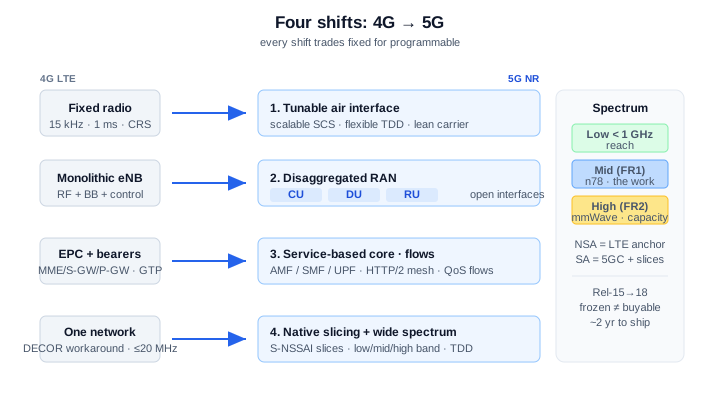
5G NR: The Foundation of Modern Wireless
5G New Radio (NR) is the air-interface specification developed by 3GPP beginning with Release 15 (frozen December 2017) and continuously enhanced through Release 18 (5G-Advanced). Unlike LTE, which was designed around a single 15 kHz subcarrier spacing, NR introduces a scalable OFDM-based numerology that allows operators to adapt the physical layer to frequencies from 410 MHz up to 71 GHz.
The specification is anchored in TS 38.300 Section 4, which defines the overall NR architecture, and TS 38.211 Section 4.2, which specifies the numerology framework. NR was designed from the ground up to support three usage pillars: enhanced Mobile Broadband (eMBB), Ultra-Reliable Low-Latency Communication (URLLC), and massive Machine-Type Communication (mMTC).
NR vs LTE: Technical Comparison
The differences between NR and LTE go far beyond peak throughput. The table below captures the most significant parameters side by side.
| Parameter | LTE (Release 15) | 5G NR (Release 17) |
|---|
| Max channel bandwidth | 20 MHz | 400 MHz (FR2), 100 MHz (FR1) |
| Subcarrier spacing | 15 kHz fixed | 15, 30, 60, 120, 240 kHz |
| Max MIMO layers (DL) | 8 | 16 (per UE, up to 256 antenna ports at gNB) |
| CP-OFDM UL | No (SC-FDMA) | Yes, with optional DFT-s-OFDM |
| Minimum scheduling unit | 1 ms TTI | 0.125 ms (mini-slot, 2 OFDM symbols at 120 kHz SCS) |
| Duplex modes | FDD, TDD | FDD, TDD, SDL, SUL, dynamic TDD |
| User-plane latency | ~4 ms | ~1 ms (URLLC target 0.5 ms) |
| Peak DL throughput | ~1 Gbps (Cat-20) | ~20 Gbps (theoretical FR2 CA) |
| Core network | EPC (4G Core) | 5GC (Service-Based Architecture) |
NR's flexible slot structure — defined in
TS 38.213 Section 11.1 — enables mini-slot scheduling of as few as 2 OFDM symbols, critical for URLLC services like industrial automation.
NR Numerology Framework
NR defines five numerology configurations indexed by the parameter μ (mu). Each increment of mu doubles the subcarrier spacing and halves the OFDM symbol duration. This is specified in TS 38.211 Table 4.2-1.
| μ | Subcarrier Spacing | OFDM Symbol Duration | Slot Duration | Slots per Subframe | Typical Use Case |
|---|
| 0 | 15 kHz | 66.67 μs | 1 ms | 1 | FR1 FDD, IoT |
| 1 | 30 kHz | 33.33 μs | 0.5 ms | 2 | FR1 TDD (most common) |
| 2 | 60 kHz | 16.67 μs | 0.25 ms | 4 | FR1/FR2 boundary, URLLC |
| 3 | 120 kHz | 8.33 μs | 0.125 ms | 8 | FR2 mmWave data |
| 4 | 240 kHz | 4.17 μs | 62.5 μs | 16 | FR2 SS/PBCH block only |
Worked Example: Slot Capacity at μ = 1
Consider a 100 MHz TDD carrier with 30 kHz SCS (mu = 1):
- Usable subcarriers:
100 MHz / 30 kHz = 3,276 subcarriers (accounting for guard bands, 3GPP specifies 273 RBs × 12 subcarriers = 3,276)
- Each slot contains
14 OFDM symbols
- Slot duration:
0.5 ms, giving 2,000 slots/s
- With
256-QAM and 8 bits/symbol, single-layer throughput per slot: 3,276 × 14 × 8 = 366,912 bits
- Aggregate single-layer:
366,912 × 2,000 = 733.8 Mbps
- With 4 MIMO layers:
733.8 × 4 ≈ 2.94 Gbps peak (before coding overhead)
After applying a typical 0.93 coding rate and ~25% TDD DL ratio overhead (DDDSU pattern), practical peak is approximately 2.94 × 0.93 × 0.75 ≈ 2.05 Gbps.
NR Protocol Stack and Architecture
The NR radio access network (NG-RAN) connects to the 5G Core (5GC) through two reference points defined in TS 38.300 Section 4.2.1:
- NG interface — between gNB and 5GC (split into NG-C for control plane and NG-U for user plane)
- Xn interface — between gNB nodes (Xn-C and Xn-U)
User-Plane Protocol Stack
The NR user-plane stack consists of four layers, top to bottom:
- SDAP (Service Data Adaptation Protocol) — maps QoS flows to DRBs, specified in TS 37.324. This layer is new in NR and does not exist in LTE.
- PDCP (Packet Data Convergence Protocol) — header compression (ROHC), ciphering, integrity protection, in-order delivery, and duplicate detection.
- RLC (Radio Link Control) — segmentation, ARQ (in AM mode), and reordering.
- MAC (Medium Access Control) — multiplexing, HARQ, scheduling, and logical-channel prioritization.
Control-Plane Protocol Stack
The control plane adds RRC (Radio Resource Control) above PDCP for connection management, measurement configuration, and handover signaling, as specified in TS 38.331.
CU-DU Split Architecture
NR supports a functional split of the gNB into a Central Unit (CU) and one or more Distributed Units (DU), connected via the F1 interface (TS 38.470). The CU handles RRC and PDCP, while the DU handles RLC, MAC, and PHY. This architecture enables centralized coordination, fronthaul optimization, and cost-effective densification.
| Split Option | CU Functions | DU Functions | Fronthaul Bandwidth (100 MHz) |
|---|
| Option 2 (3GPP standard) | RRC, PDCP | RLC, MAC, PHY | ~4.5 Gbps |
| Option 7.2x (O-RAN) | RRC, PDCP, high-RLC | Low-RLC, MAC, high-PHY | ~10 Gbps |
| Option 8 (CPRI-like) | All L2/L3 | RF + low-PHY | ~25 Gbps |
Real-World Deployments
T-Mobile US — Nationwide n41 Rollout
T-Mobile deployed over 2,500 n41 (2.5 GHz) sites by Q2 2025, leveraging 100 MHz TDD channels with massive MIMO (64T64R). Field measurements across 25 US cities reported:
- Median DL throughput:
350 Mbps
- P90 DL throughput:
115 Mbps (cell-edge)
- Median latency:
12 ms round-trip
T-Mobile's deployment uses μ = 1 (30 kHz SCS) with a DDDSU slot pattern, allocating approximately 75% of slots to downlink.
Verizon — mmWave and C-Band Dual Strategy
Verizon activated ~18,000 mmWave (n261, 28 GHz) small cells in dense urban areas by end of 2024 and simultaneously deployed C-band (n77) across 200+ markets with 60 MHz initial bandwidth (expanded to 100 MHz in 46 markets).
Reported C-band performance:
- Median DL:
210 Mbps (60 MHz), 350 Mbps (100 MHz)
- mmWave peak:
>3 Gbps (LOS, single device)
- mmWave cell radius:
200–300 m typical
Worked Example: Coverage Radius Estimation (n41 vs n261)
Using free-space path loss (FSPL) at cell edge:
n41 at 2.5 GHz, 1 km distance:
FSPL = 20·log10(2500) + 20·log10(1000) + 20·log10(4π/c)
     = 67.96 + 60 + (-27.55) = 100.4 dB
n261 at 28 GHz, 200 m distance:
FSPL = 20·log10(28000) + 20·log10(200) + 20·log10(4π/c)
     = 88.94 + 46.02 + (-27.55) = 107.4 dB
Even at one-fifth the distance, mmWave loses 7 dB more than mid-band, explaining the dense small-cell requirement. Adding ~15 dB beamforming gain from a 256-element array partially compensates, bringing effective loss to ~92.4 dB.
NR Key Features Beyond LTE
- Bandwidth Parts (BWP): NR defines up to four BWPs per serving cell, allowing UEs to switch active bandwidth dynamically for power saving (TS 38.213 Section 12).
- Beam Management: FR2 operations require beam sweeping, with SS/PBCH blocks transmitted across up to 64 beams in a
5 ms burst (TS 38.213 Section 4).
- LDPC and Polar Codes: NR uses LDPC for data channels and Polar codes for control channels, replacing LTE's Turbo codes for improved performance at high throughput.
- Grant-Free UL (Configured Grant): Pre-configured uplink resources eliminate scheduling request delays for URLLC traffic (TS 38.214 Section 6.1.2.3).
- Lean Design: NR minimizes always-on reference signals compared to LTE's CRS, reducing inter-cell interference and improving energy efficiency.
> Key Takeaway: 5G NR is not merely a faster version of LTE. Its scalable numerology, flexible slot structures, CU-DU split architecture, and native URLLC support represent a fundamental redesign of the radio access network. Engineers preparing for 5G roles must understand the interplay between numerology selection, deployment band, and target use case to design effective networks.
The bands and the arithmetic behind them
NR band reference has the FR1 and FR2 allocations,
NR-ARFCN calculator converts channel numbers both
ways, and numerology planner covers the subcarrier
spacing that decides slot timing.
For how those choices land in a deployment, the
RAN specialist track works the trades with
real numbers.