Why Non-Terrestrial Networks
Approximately 90% of the Earth's land area lacks mobile broadband coverage. Non-Terrestrial Networks (NTN) extend 5G NR connectivity via satellites, High-Altitude Platform Systems (HAPS), and Unmanned Aerial Systems (UAS) to serve rural, maritime, aviation, and emergency scenarios where terrestrial infrastructure is economically unviable.
3GPP began studying NTN in Release 15 (TR 38.811) and delivered the first normative NTN specifications in Release 17 (TS 38.300, TS 38.321, TS 38.331). The NTN work is arguably the most transformative 5G feature, enabling direct-to-device satellite connectivity using standard smartphones.
Orbit Comparison
The choice of orbit fundamentally determines latency, coverage footprint, satellite count, and system cost.
| Parameter | LEO | MEO | GEO | HAPS |
|---|
| Altitude | 300--2,000 km | 2,000--35,786 km | 35,786 km | 20 km |
| One-way propagation delay | 2--13 ms | 13--120 ms | 120 ms | < 1 ms |
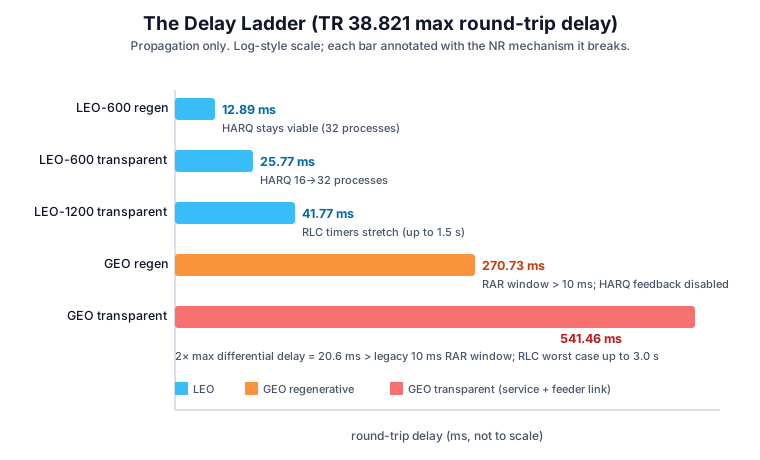
| Round-trip latency (total) | 10--50 ms | 50--250 ms | 550--600 ms | 2--5 ms |
| Coverage per satellite | 500--2,500 km diameter | 5,000--15,000 km diameter | ~34% of Earth surface | 50--200 km diameter |
| Satellites for global coverage | 600--12,000 | 10--20 | 3 | N/A (regional) |
| Doppler shift (max) | +/- 24 ppm | +/- 0.5 ppm | ~0 ppm | Negligible |
| Satellite lifetime | 5--7 years | 10--15 years | 15+ years | Hours--months |
| Handover frequency | Every 2--8 min (LEO-600) | Every 30+ min | None (geostationary) | Rare |
| Typical use case | Broadband, direct-to-device | Navigation, regional broadband | Broadcasting, maritime | Emergency, rural broadband |
| System cost | $5B--$15B (constellation) | $2B--$5B | $500M--$1B per satellite | $10M--$50M |
LEO constellations are the dominant architecture for direct-to-device 5G because they offer the lowest latency compatible with NR protocol timers. GEO satellites remain relevant for broadcast services and maritime connectivity where latency tolerance is higher.
3GPP NTN Standardization Timeline
| Release | Year | Scope | Key Specifications |
|---|
| Rel-15 | 2018 | Study item: NTN channel models, deployment scenarios | TR 38.811 (Study on NTN) |
| Rel-16 | 2020 | Study item: Solutions for NR-NTN | TR 38.821 (Solutions for NTN) |
| Rel-17 | 2022 | Normative: NR-NTN for transparent satellite, IoT-NTN | TS 38.300, TS 38.321, TS 38.331 (NTN enhancements) |
| Rel-18 | 2024 | Enhanced NTN: regenerative payload, mobility, MIMO | TS 38.300 updates, NTN coverage enhancements |
| Rel-19 | 2025--2026 | Advanced NTN: direct-to-device broadband, NTN-TN integration | Store-and-forward, NTN spectrum sharing |
introduced two NTN operation modes:
- Transparent payload: The satellite acts as a bent-pipe relay. All baseband processing occurs at the ground gateway. This is simpler but requires a ground station within the satellite footprint.
- Regenerative payload: The satellite performs full gNB processing onboard. This enables autonomous operation and inter-satellite link (ISL) routing without continuous ground connectivity.
Protocol Adaptations for NTN
Standard 5G NR was designed for terrestrial propagation delays of microseconds. Satellite links introduce milliseconds to hundreds of milliseconds of delay, requiring fundamental protocol changes defined in TS 38.300 Section 16 and TS 38.321 Section 5.1.1a.
| Protocol Aspect | Terrestrial NR | NTN Adaptation | Specification |
|---|
| Timing Advance (TA) | 0--0.67 ms (max Nta=3846) | Pre-compensated TA based on GNSS + ephemeris; UE-side compensation up to ~45 ms | TS 38.321 Section 5.1.1a, TS 38.213 Section 4.2 |
| HARQ round-trip | 4--8 ms | Disabled or extended (8--16 processes); LEO: ~20 ms RTT, GEO: HARQ disabled | TS 38.321 Section 5.4.1 |
| Random Access (RACH) | ra-ResponseWindow: 10 ms | Extended RA window: up to 40 ms for LEO, 600+ ms for GEO | TS 38.321 Section 5.1.4 |
| DRX cycle | 10--2560 ms | Extended eDRX for IoT-NTN: up to 10,485.76 s | TS 38.321 Section 5.7 |
| Handover | Event A3 (serving/neighbor) | Conditional Handover (CHO) with satellite ephemeris prediction | TS 38.331 Section 5.3.5.13 |
| Doppler compensation | gNB-side, small corrections | UE pre-compensates using GNSS position + satellite ephemeris data | TS 38.213 Section 4.1 |
| Cell selection | RSRP-based | Modified for moving cells; cell ID changes as satellite moves over ground | TS 38.304 Section 5.2.4 |
Timing Advance: The Critical Challenge
In terrestrial NR, the maximum timing advance (N_TA,max = 3846 * T_c) supports a cell radius of approximately 100 km. For LEO at 600 km altitude, the one-way delay is ~4 ms (round-trip ~8 ms), far exceeding this limit.
The NTN solution in Rel-17 introduces UE-based TA pre-compensation: the UE uses its GNSS position and broadcast satellite ephemeris data to calculate the propagation delay to the satellite and pre-adjusts its uplink transmission timing. The residual TA (after pre-compensation) fits within the standard NR TA range.
Total delay (LEO 600 km, 30 deg elevation):
  Propagation: d = 600 / sin(30) = 1200 km
  One-way delay: 1200 / 3e5 = 4.0 ms
  Round-trip: 8.0 ms

UE pre-compensation: 7.5 ms (computed from GNSS + ephemeris)
Residual TA for gNB to adjust: 0.5 ms (within standard NR range)
Worked Example: HARQ Impact on Throughput
For a GEO satellite with 600 ms round-trip delay, calculate the HARQ efficiency:
Standard NR HARQ: 16 processes, 4 ms RTT
  -> 16 * 1 ms slot = 16 parallel transmissions per RTT
  -> Utilization: ~100% (processes fill the pipeline)

GEO NTN with HARQ enabled: 16 processes, 600 ms RTT
  -> Each process waits 600 ms for ACK/NACK
  -> Only 16 / (600/1) = 2.7% utilization
  -> Effective throughput drops to ~2.7% of peak

Solution: Disable HARQ for GEO, rely on RLC ARQ
  -> RLC ARQ with 1.2 s RTT adds ~5% overhead for 1% BLER
  -> Far more efficient than HARQ at GEO delays
This is why 3GPP disabled HARQ feedback for GEO NTN and extended HARQ processes to 32 for LEO in Rel-18.
Real Deployments and Trials
AST SpaceMobile
AST SpaceMobile launched BlueWalker 3 in September 2022 as a technology demonstrator and achieved the first-ever direct-to-standard-smartphone broadband call from space in September 2023 using a 64 m2 phased array antenna. Key technical data:
- Orbit: LEO at 510 km
- Frequency: Standard LTE/5G bands (licensed from MNO partners)
- Partners: AT&T, Vodafone, Rakuten
- BlueWalker 3 throughput: 14 Mbps downlink demonstrated to unmodified Samsung Galaxy S22
- Commercial constellation (BlueBird): First 5 satellites launched September 2024; planned 168-satellite constellation for global coverage
- Antenna size: 225 m2 per BlueBird satellite (largest commercial phased array in orbit)
T-Mobile + SpaceX (Starlink Direct to Cell)
T-Mobile and SpaceX announced "Direct to Cell" partnership in August 2022, using modified Starlink V2 Mini satellites with dedicated cellular antennas operating on T-Mobile's PCS/AWS spectrum.
- Orbit: LEO at 340 km
- Frequency: T-Mobile mid-band spectrum (1900 MHz PCS, 1700/2100 MHz AWS)
- Service: Texting launched January 2025; voice and data expected 2025--2026
- Coverage: Targets ~500,000 sq mi of coverage gaps in rural US
- Architecture: Transparent payload relaying to Starlink ground gateways connected to T-Mobile core
- Satellite count: ~840 Direct to Cell-capable V2 Mini satellites planned
Qualcomm Snapdragon X80 and Satellite Support
Qualcomm's Snapdragon X80 modem (announced February 2025) is the first to integrate 3GPP Rel-17 NTN support natively alongside standard NR:
- Supports both NR-NTN (5G) and IoT-NTN (NB-IoT) satellite modes
- Pre-compensation for LEO timing advance and Doppler built into baseband
- Dual connectivity: simultaneous terrestrial 5G + satellite NTN bearer
- Target devices: Flagship smartphones from 2025--2026
NTN Architecture: Transparent vs Regenerative
Transparent Satellite Architecture
UE <-- NR-Uu --> Satellite (bent-pipe) <-- feeder link --> Gateway
  gNB (ground)  <-->  5GC (AMF, SMF, UPF)
The satellite amplifies and frequency-converts the signal without baseband processing. The gNB is located at the ground gateway. This architecture is simpler and cheaper but requires continuous feeder link connectivity.
Regenerative Satellite Architecture
UE <-- NR-Uu --> Satellite (onboard gNB) <-- ISL --> Satellite
  <-- feeder link --> Gateway <--> 5GC
The satellite performs full gNB-DU or gNB processing onboard, enabling store-and-forward and inter-satellite link routing. This architecture supports autonomous operation during feeder link outages and reduces ground infrastructure requirements.
IoT-NTN: Connecting Billions of Sensors
Rel-17 also standardized IoT-NTN using NB-IoT and eMTC over satellite links, targeting massive IoT deployments in agriculture, maritime, and logistics where terrestrial coverage is unavailable.
| Parameter | IoT-NTN (NB-IoT) | NR-NTN |
|---|
| Bandwidth | 180 kHz | Up to 30 MHz (LEO) |
| Peak data rate | 127 kbps DL, 159 kbps UL | 100+ Mbps DL |
| Power class | 14/20/23 dBm | 23 dBm |
| Battery life target | 10+ years | Hours (smartphone) |
| Orbit | LEO/GEO | LEO (GEO limited) |
| HARQ | Disabled (GEO), limited (LEO) | Extended (LEO), disabled (GEO) |
| Use case | Asset tracking, environmental sensing | Broadband, voice, emergency |
Challenges and Future Outlook
- Spectrum coordination: NTN uses existing terrestrial spectrum, requiring careful interference management between satellite and terrestrial cells. 3GPP Rel-19 addresses NTN-TN spectrum sharing with zone-based coordination.
- Link budget: Satellite-to-handset links have extreme path loss. At 600 km LEO altitude and 2 GHz, free-space path loss exceeds 160 dB. Only large satellite antennas (64--225 m2) can close the link to a standard smartphone at 23 dBm.
- Handover: LEO satellites at 600 km orbit the Earth every ~97 minutes, requiring cell handover every 2--8 minutes. Conditional Handover (CHO) with ephemeris-based prediction is the Rel-17 solution per TS 38.331 Section 5.3.5.13.
- Regulatory: Each country must approve satellite-to-terrestrial spectrum sharing. The US FCC granted supplemental coverage from space (SCS) framework rules in March 2024.
> Key Takeaway: 3GPP NTN in Release 17/18 enables standard smartphones to connect directly to LEO satellites using modified 5G NR protocols. UE-based timing advance pre-compensation and disabled/extended HARQ are the critical protocol adaptations. AST SpaceMobile and T-Mobile/Starlink are leading real-world deployments, with Qualcomm's X80 modem bringing native NTN support to flagship devices in 2025--2026.
Orbit is a latency decision
NTN latency is set by orbit before anything else, and the trade against
constellation size and handover rate is arithmetic rather than opinion. The
RAN specialist track works it directly —
what each orbit costs in delay, and what that rules out.
For the radio side of a very long link,
5G propagation models and the
link budget calculator cover the budget.