5G Fundamentals 9 min readMar 28, 2026Updated Sep 21, 2026
5G RedCap (NR-Light): Bridging the Gap Between 5G and IoT
By Gaganpreet Walia
CEO, TELCOMA Global · 21+ years in telecom
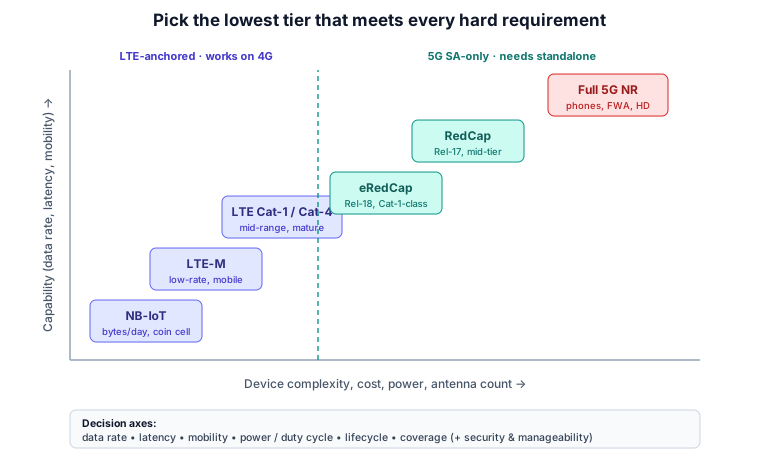
What RedCap and eRedCap strip out of a full-NR radio to cut device cost.
The NR Complexity Gap
Full 5G NR devices are designed for peak performance — supporting up to 100 MHz bandwidth in FR1, 4 Rx MIMO antennas, and continuous full-duplex operation. This capability comes at a cost: NR modems consume significant power, require complex RF front-ends, and drive device prices above $15-20 for the chipset alone.
Many IoT and wearable use cases do not need gigabit throughput. A smartwatch streaming music needs 1-5 Mbps. An industrial sensor reporting temperature readings needs 100 kbps. A video surveillance camera needs 10-20 Mbps. For these devices, full NR is overengineered.
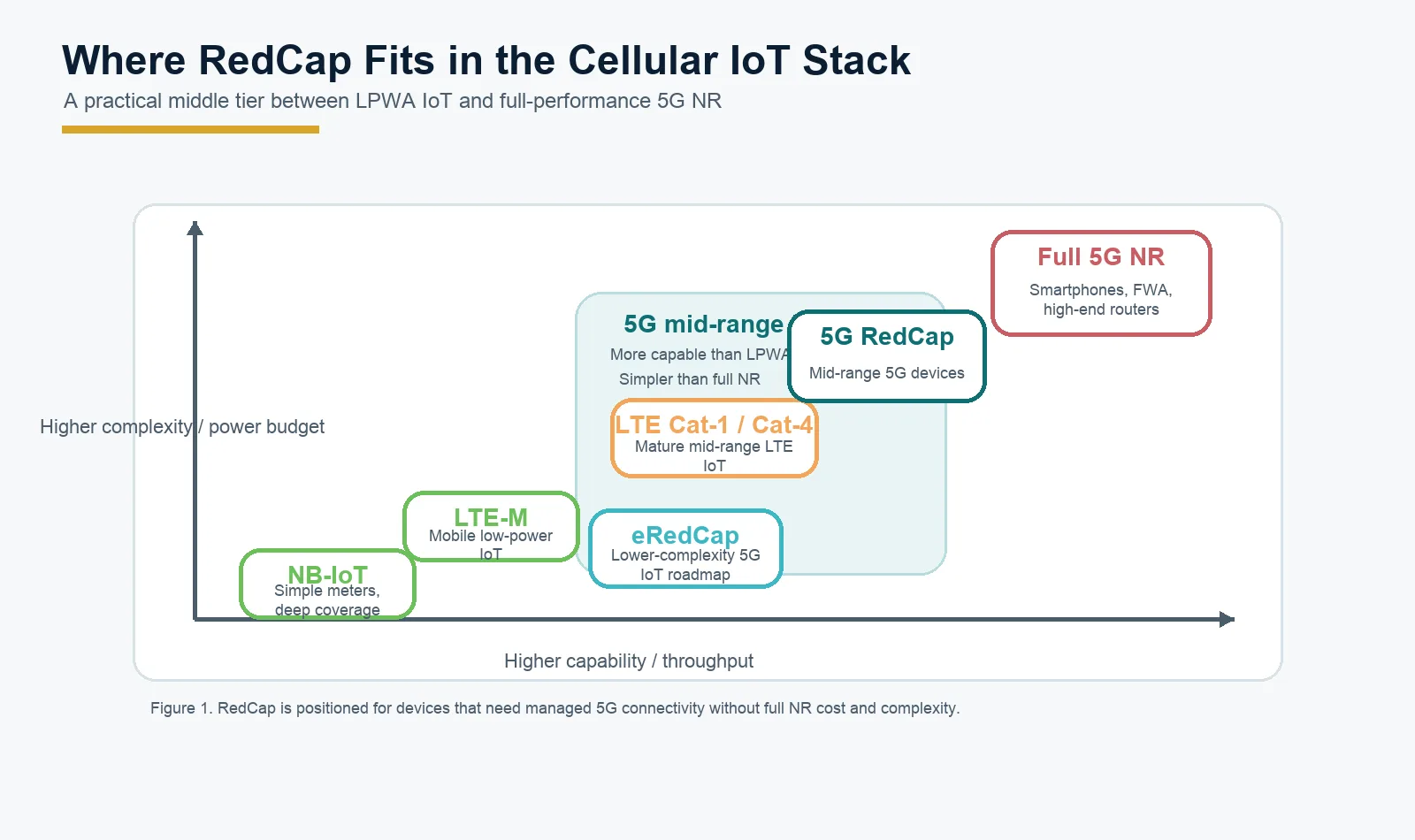
RedCap (Reduced Capability), also known as NR-Light, was introduced in 3GPP Rel-17 (TS 38.306) to create a middle tier: devices with lower complexity, lower cost, and lower power consumption than full NR, but with significantly higher capability than NB-IoT or LTE-M.
Where RedCap and eRedCap sit between low-power IoT (NB-IoT, LTE-M) and full 5G NR — by capability and device complexity.
RedCap Device Classes
3GPP defined RedCap in two phases, with each phase progressively reducing device complexity.
Parameter
Full NR (Rel-15)
RedCap Phase 1 (Rel-17)
eRedCap Phase 2 (Rel-18)
NB-IoT
LTE-M
Max BW (FR1)
100 MHz
20 MHz
5 MHz
180 kHz
1.4 MHz
Max BW (FR2)
200 MHz
100 MHz
100 MHz
N/A
N/A
MIMO (DL)
4 Rx
1 or 2 Rx
1 Rx
1 Rx
1 Rx
Duplex mode
Full FDD/TDD
FDD: HD-FDD optional
HD-FDD baseline
HD-FDD
HD-FDD
Max DL layers
4-8
1-2
1
1
1
Peak DL throughput
~4.5 Gbps
~150 Mbps
~10 Mbps
0.127 Mbps
4 Mbps
UE complexity
Baseline (100%)
~65%
~40%
~15%
~20%
Target device cost
$15-20+
$5-8
$3-5
$2-4
$3-5
Target use case
Smartphones, CPE
Wearables, cameras
Industrial sensors
Smart meters
Asset trackers
Key Complexity Reductions
Bandwidth reduction is the primary cost saver. Reducing from 100 MHz to 20 MHz shrinks the ADC/DAC sampling rate by 5x, directly reducing silicon area and power consumption. Moving to 5 MHz in eRedCap (Rel-18) achieves another 4x reduction.
MIMO reduction from 4 Rx to 1-2 Rx eliminates 2-3 receive chains, each comprising an LNA, mixer, filter, and ADC. This is the second-largest contributor to cost reduction — each Rx chain adds approximately $1-2 to module cost.
Half-duplex FDD (HD-FDD) eliminates the need for a duplexer (which isolates simultaneous Tx and Rx in FDD). Duplexers are expensive, bulky, and introduce ~2 dB insertion loss. HD-FDD switches between Tx and Rx in time, using a simple switch instead.
Throughput Calculations
Worked Example: RedCap Phase 1 Peak Throughput (FR1)
Calculate peak DL throughput for a Rel-17 RedCap device on a 20 MHz TDD carrier with 30 kHz SCS:
The practical peak is approximately 138 Mbps — more than enough for HD video surveillance (10-20 Mbps) or wearable applications (1-5 Mbps), with headroom for bursty traffic.
Worked Example: eRedCap Phase 2 Peak Throughput (FR1)
For a Rel-18 eRedCap device on 5 MHz with 15 kHz SCS:
Practical peak of approximately 11.6 Mbps — suitable for industrial sensors, smart meters, and basic video streaming.
Power Saving Features
RedCap inherits and extends NR power saving mechanisms defined in TS 38.304 and TS 38.331:
Feature
Description
Power Savings
Specification
eDRX
Extended Discontinuous Reception — sleep cycles up to 10,485.76 s (~2.9 hours)
50-80% vs standard DRX
TS 38.304 Section 7.3
RRC Inactive
UE context retained at gNB, UE sleeps without full connection release
30-50% vs RRC Connected
TS 38.331 Section 5.3.13
Reduced PDCCH monitoring
Fewer PDCCH monitoring occasions per DRX cycle
10-20% additional
TS 38.213 Section 10
Relaxed measurements
Reduced neighbor cell measurement frequency in low-mobility scenarios
5-15% additional
TS 38.331 Section 5.5.2
BWP switching
Dynamic narrowing of active bandwidth when traffic is low
15-25% during idle periods
TS 38.213 Section 12
Combining eDRX with RRC Inactive state, a RedCap sensor reporting data every 15 minutes can achieve an average power consumption below 10 µW, enabling 5+ year battery life on a coin cell.
Initial Access and BWP Configuration
RedCap devices face a bootstrapping challenge: the SSB (Synchronization Signal Block) and initial access messages use the cell's full bandwidth configuration, which may exceed the RedCap device's 20 MHz or 5 MHz capability.
3GPP solves this through a dedicated initial BWP for RedCap:
The gNB broadcasts SSB normally (SSB bandwidth is only ~7.2 MHz for 30 kHz SCS, within RedCap's capability)
SIB1 carries a dedicated initial DL BWP configuration for RedCap devices, specified in TS 38.331 Section 5.2.2
The RedCap UE performs RACH on a dedicated initial UL BWP
After connection setup, the UE operates within its configured BWP (up to 20 MHz for Rel-17, 5 MHz for Rel-18)
The cell can simultaneously serve full NR devices on 100 MHz and RedCap devices on 20 MHz BWPs — no separate carrier required.
Capability Signaling
RedCap devices identify themselves through UE capability information defined in TS 38.306. The key capability flags include:
redcapPhase: distinguishes Phase 1 (Rel-17) from Phase 2 (Rel-18)
The network uses these capabilities to configure appropriate BWPs, scheduling parameters, and DRX settings.
Use Cases in Depth
Wearables
Smartwatches, fitness trackers, and AR glasses need cellular connectivity but cannot accommodate full NR power consumption or antenna count. RedCap Phase 1 with 1 Rx and 20 MHz bandwidth provides:
Sufficient throughput for music streaming, notifications, and health data sync
Compact modem footprint fitting wrist-worn form factors
2-3 day battery life with aggressive DRX configurations
Video Surveillance
IP cameras in smart cities and retail environments require 5-20 Mbps sustained uplink for HD video. RedCap Phase 1 delivers this throughput while reducing modem cost from $15+ (full NR) to $5-8, making cellular-connected cameras economically viable for large-scale deployments.
Industrial Sensors
Factory sensors monitoring vibration, temperature, pressure, and humidity typically transmit small payloads (50-500 bytes) at intervals (1 second to 15 minutes). eRedCap (Rel-18) at 5 MHz provides ample capacity while targeting device costs below $5 and multi-year battery life.
Real-World Deployments and Chipsets
T-Mobile RedCap Trial
T-Mobile demonstrated RedCap in a live network trial in late 2024, showcasing industrial sensor and wearable use cases on their n41 (2.5 GHz) network. Key results:
Median DL throughput:85 Mbps (Phase 1, 20 MHz)
Latency:15 ms round-trip (comparable to full NR)
Power consumption:40% reduction vs full NR modem
Coverage: Identical to full NR (same cell sites, same bands)
Qualcomm Snapdragon X35
Qualcomm's Snapdragon X35 was the industry's first commercial RedCap modem, announced in 2023 and shipping in devices from 2024. Specifications:
Supports Rel-17 RedCap: 20 MHz FR1, 100 MHz FR2
Peak DL: 220 Mbps, Peak UL: 100 Mbps
Integrated with Snapdragon W5+ platform for wearables
4 nm process, ~50% smaller die area vs X55 (full NR)
MediaTek T300
MediaTek's T300 chipset targets industrial and FWA RedCap applications:
Rel-17 compliant with 20 MHz FR1 support
Dual-SIM support for enterprise redundancy
Integrated GNSS for asset tracking
Supports SA and NSA modes
Power consumption: 30% lower than comparable full NR at equivalent throughput levels
Both Qualcomm and MediaTek have announced Rel-18 eRedCap chipsets targeting 5 MHz operation with device costs projected below $4 at volume.
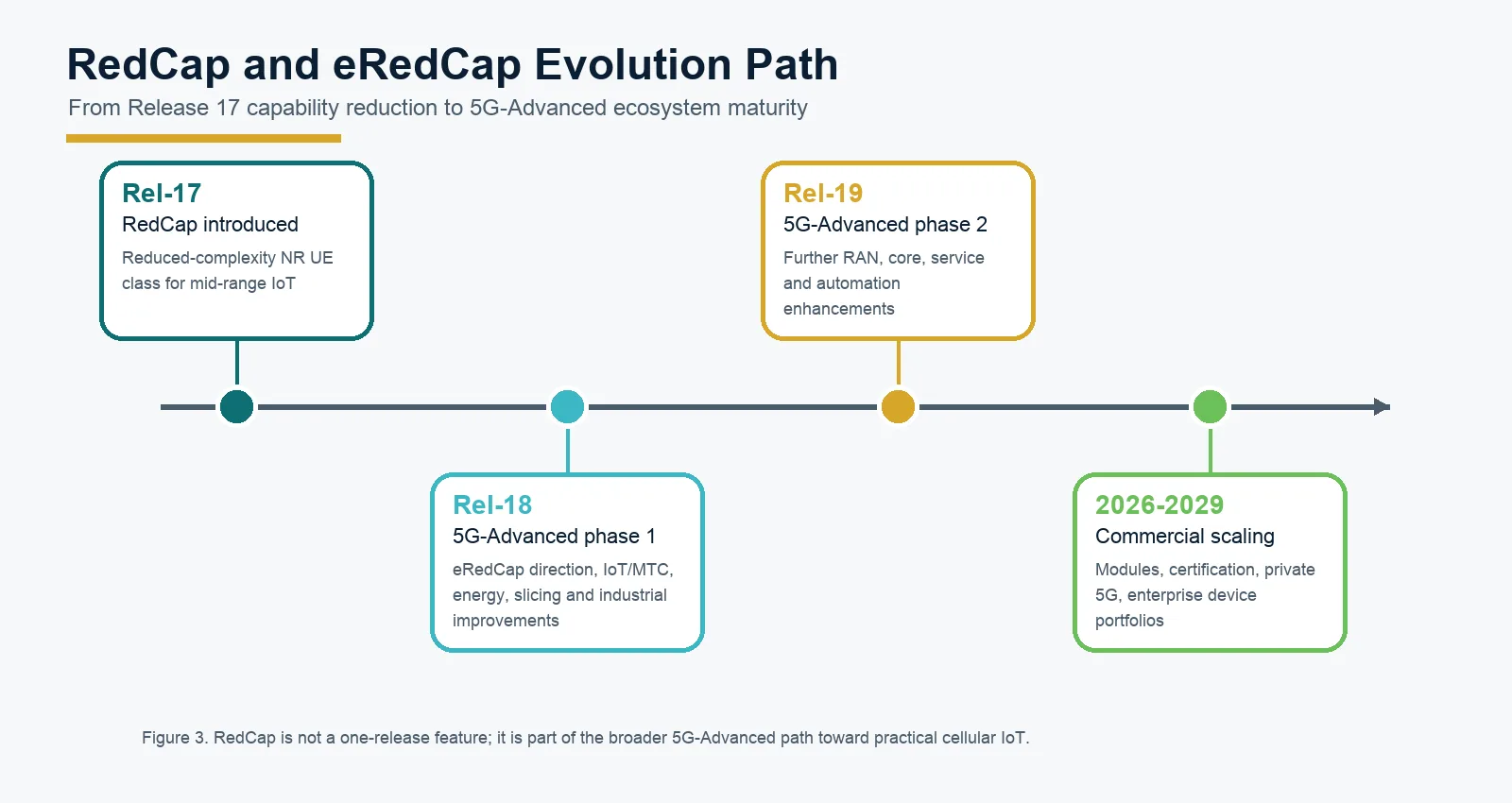
The trajectory is set: Rel-17 covers wearables and cameras today, Rel-18 eRedCap is reaching industrial-sensor cost points, and Rel-19 continues hardening the system — positioning, energy efficiency, and slicing — around these devices.
> Key Takeaway: RedCap fills the critical gap between full NR and LPWAN technologies, delivering 5G-level latency and security with IoT-appropriate complexity and cost. Rel-17 Phase 1 serves wearables and cameras at ~$5-8 per modem; Rel-18 eRedCap pushes into industrial sensor territory at ~$3-5. Engineers designing IoT solutions should evaluate RedCap as the default 5G choice for devices that need more than NB-IoT but less than a smartphone modem.
The features, and whether they are in your network
RedCap reaches full-NR economics by removing bandwidth, a receive antenna, full duplex and fast processing — cuts 3GPP quantifies at roughly 67% of a reference NR device's cost. GSA counts 42 operators investing and fourteen with commercial RedCap live; eRedCap chipsets are only now emerging.
Go deeper — get the full technical whitepaper
This article is the primer. The whitepaper is the full analysis, with figures and primary sources. Add your email to unlock the PDF — plus the next whitepaper the day it publishes. Unsubscribe in one click.
Go Deeper
5G RAN Specialist — get the NR air interface properly, then see what RedCap removes.