The Energy Challenge in 5G
Mobile networks consume approximately 1% of global electricity — over 150 TWh annually. As operators deploy 5G with wider bandwidths, more antennas (massive MIMO), and denser sites, energy consumption per network is projected to increase 2-3x compared to 4G unless aggressive countermeasures are applied.
This is not just an environmental concern. Energy is the second-largest operational expense for mobile operators, typically 20-30% of OPEX. With electricity prices rising globally, energy efficiency directly impacts profitability. Every 10% reduction in network energy consumption saves a Tier-1 operator approximately $100-200 million annually.
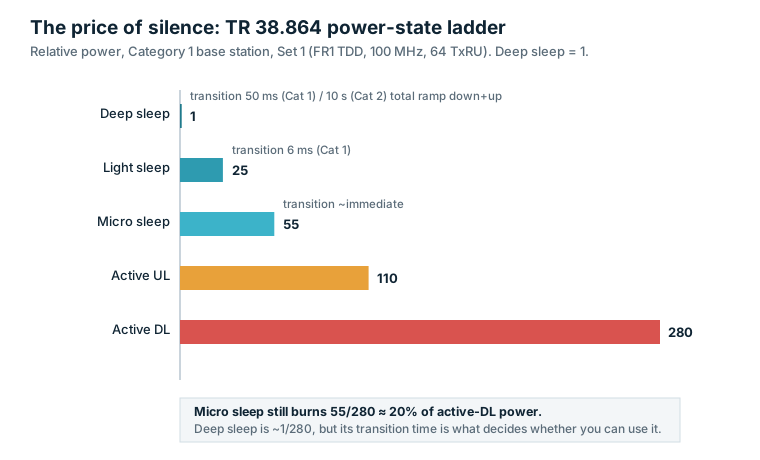
3GPP recognized this urgency by introducing a dedicated Network Energy Saving (NES) study item in Rel-18 (TR 38.864), evaluating techniques across the RAN, core, and transport domains.
Energy Consumption Breakdown
Understanding where energy is consumed is essential for prioritizing saving techniques. Field measurements across multiple operators consistently show the same distribution.
| Network Segment | Energy Share | Primary Consumers | Saving Potential |
|---|
| RAN | ~73% | Power amplifiers, baseband, cooling | High (40-60%) |
| Core network | ~12% | Servers, storage, routing | Moderate (20-30%) |
| Transport (backhaul) | ~10% | Routers, switches, fiber/MW equipment | Moderate (15-25%) |
| Data centers / edge | ~5% | Compute, cooling, power conversion | Moderate (20-40%) |
The RAN dominates energy consumption, and within the RAN, the power amplifier (PA) accounts for 50-65% of total site power. This makes PA efficiency and radio sleep modes the highest-impact optimization targets.
Site-Level Power Breakdown
A typical 3-sector 5G macro site with 64T64R massive MIMO draws approximately 6-8 kW total:
| Component | Power per Sector | 3-Sector Total | Share |
|---|
| Power amplifiers | 800-1,200 W | 2,400-3,600 W | 45-50% |
| Baseband processing | 300-500 W | 900-1,500 W | 15-20% |
| RF front-end (excl. PA) | 150-250 W | 450-750 W | 8-10% |
| Cooling (active) | 400-800 W | 400-800 W | 8-12% |
| Power supply losses | 300-500 W | 300-500 W | 5-8% |
| Transport equipment | 100-200 W | 100-200 W | 2-4% |
| Total | | ~4,500-7,350 W | 100% |
Energy Saving Techniques by Time Granularity
Energy saving techniques span a wide range of time scales, from microseconds (symbol-level) to hours (site hibernation). Finer-granularity techniques preserve user experience better but save less per activation; coarser techniques save more but require traffic to be offloaded.
| Technique | Time Granularity | Activation Trigger | Savings per Activation | User Impact | 3GPP Reference |
|---|
| Symbol-level shutdown | ~71 µs (1 OFDM symbol) | Empty DL symbols | 5-15% | None (transparent) | TR 38.864 Section 5.1 |
| Slot-level DTX | 0.5-1 ms | No scheduled data in slot | 10-20% | None | TR 38.864 Section 5.2 |
| Channel shutdown | 100 ms - seconds | Low traffic on carrier | 15-30% | Reduced peak throughput | TS 38.300 Section 15 |
| Carrier shutdown | Seconds - minutes | Traffic below threshold on secondary carrier | 20-40% per carrier | Capacity reduction, UEs handed over | TS 38.300 Section 15.1 |
| Cell sleep (deep) | Minutes - hours | Near-zero traffic (e.g., night) | 40-60% per cell | Coverage gap, UEs served by neighbors | TR 38.864 Section 5.3 |
| Site hibernation | Hours | Scheduled low-traffic periods | 70-85% per site | Full coverage loss, requires macro overlay | Vendor-specific |
Symbol-Level and Slot-Level Shutdown
During low-traffic periods, many OFDM symbols and slots carry no user data. The gNB can turn off the PA and RF chain for these empty symbols/slots, saving energy proportional to the idle time.
In a typical urban cell at 3 AM, traffic utilization drops to 5-10% of peak. This means 90-95% of symbols are empty. Symbol-level shutdown can save up to 50% of PA power during these periods — translating to ~25% of total site power.
The key constraint is that certain always-on signals must be maintained: SSB (Synchronization Signal Block), CORESET#0 (for paging), and CSI-RS (for measurements). These occupy a small fraction of total resources but prevent complete shutdown.
Carrier Shutdown
Multi-carrier deployments (e.g., n41 + n77) can shut down secondary carriers when traffic can be served by the primary carrier alone. The gNB monitors load and triggers:
- Inter-frequency handover for UEs on the secondary carrier
- PA and baseband power-down for the secondary carrier
- Periodic wake-up to reassess traffic load
Worked Example: Carrier Shutdown Savings
A 3-sector site operates two 100 MHz TDD carriers on n77, each with 64T64R massive MIMO:
Per-carrier power consumption:
  PA (64 elements × 2 polarizations × 0.5W avg): 64 W per element
  Total PA per sector:                            800 W
  Baseband per carrier:                           300 W
  RF front-end per carrier:                       150 W
  Carrier total per sector:                       1,250 W

During low-traffic (22:00 - 06:00):
  Traffic load:           15% of peak
  Single carrier capacity: sufficient for 15% load

Shutdown of second carrier:
  Savings per sector:     1,250 W
  Savings per site:       1,250 × 3 = 3,750 W
  Daily savings (8 hours): 3,750 × 8 = 30,000 Wh = 30 kWh

Annual savings:           30 × 365 = 10,950 kWh per site
At $0.15/kWh:            $1,642.50 per site per year

For a 10,000-site network: $16.4 million annual savings
Worked Example: Cell Sleep Capacity Impact
Before enabling cell sleep, engineers must verify that neighbor cells can absorb the traffic. Consider a cluster of 3 cells with the following loads:
Cell A: 25% load (candidate for sleep)
Cell B: 35% load (neighbor)
Cell C: 30% load (neighbor)

Cell A traffic distribution after sleep:
  60% of Cell A users → Cell B
  40% of Cell A users → Cell C

New loads:
  Cell B: 35% + (60% × 25%) = 35% + 15% = 50%
  Cell C: 30% + (40% × 25%) = 30% + 10% = 40%

Both cells remain below 70% utilization threshold → safe to sleep Cell A.
If Cell B would exceed 70%, the sleep action should be deferred or partial (e.g., carrier shutdown instead of full cell sleep).
3GPP Rel-18 NES Study (TR 38.864)
3GPP's Rel-18 NES study item, documented in TR 38.864, evaluated network-level and UE-assisted techniques for energy saving. Key conclusions:
Network-side techniques:
- Spatial domain adaptation: reduce the number of active antenna elements (e.g., 64T64R → 32T32R) during low load, reducing PA power by up to
50%
- Frequency domain adaptation: dynamic bandwidth reduction (BWP narrowing)
- Time domain adaptation: symbol/slot/carrier shutdown as described above
- Power domain: reduce transmit power when coverage allows
UE-assisted techniques:
- UE provides traffic arrival predictions to help gNB plan sleep schedules
- UE reports preferred wake-up configurations to minimize paging overhead
- UE supports wake-up signal (WUS) per TS 38.213 Section 10.1A — a lightweight signal that wakes the UE only when data is pending, avoiding unnecessary PDCCH monitoring
The study concluded that combining spatial, frequency, and time domain adaptations can achieve 30-50% RAN energy reduction without measurable impact on user-perceived throughput during low-traffic hours.
Power Amplifier Efficiency
Since the PA consumes 50-65% of site power, PA efficiency technology has outsized impact on overall energy consumption.
| PA Technology | Peak Efficiency | Average Efficiency (with traffic) | Typical Use | Notes |
|---|
| Class AB | 40-50% | 15-25% | Legacy 4G | Poor back-off efficiency |
| Doherty | 55-65% | 30-40% | Current 5G macro | Good efficiency at 6-8 dB back-off |
| Envelope Tracking (ET) | 65-75% | 40-50% | Advanced 5G, small cell | Dynamic supply voltage modulation |
| Digital Doherty | 60-70% | 35-45% | Next-gen massive MIMO | Digital pre-distortion integrated |
| GaN (wideband) | 70-80% | 45-55% | 5G-Advanced, 6G | Higher saturated power, wider bandwidth |
Upgrading from Class AB to Doherty PAs (as part of site modernization) typically delivers 15-20% total site energy reduction. The further step to GaN-based envelope tracking can add another 10-15%.
ETSI ES 203 228 Energy Metrics
Standardized metrics enable consistent comparison across vendors and deployments. ETSI ES 203 228 defines the primary energy efficiency KPIs:
- Energy Consumption (EC): Total energy consumed by the network element over a measurement period, in
kWh
- Energy Efficiency (EE): Data volume delivered per unit of energy consumed, in
bits/Joule or Gbits/kWh
- Power Proportionality Factor: Ratio of power consumption at zero load to power consumption at full load. Ideal = 0 (zero power at zero load); typical 5G = 0.5-0.7
A power proportionality factor of 0.6 means the site still draws 60% of its peak power even when carrying zero traffic. Reducing this factor through aggressive sleep modes is a key objective of NES techniques.
AI-Based Traffic Prediction for Sleep Scheduling
The most advanced energy saving implementations use AI/ML models to predict traffic patterns and proactively schedule sleep modes. Rather than reacting to current load (which causes transition delays and potential service impact), predictive models:
- Forecast per-cell traffic load 15-60 minutes ahead
- Pre-schedule carrier shutdown and cell sleep windows
- Coordinate across cells to ensure coverage continuity
- Adapt to anomalies (events, outages, weather) in real time
The model architecture typically combines:
- LSTM or Transformer for temporal traffic patterns (daily, weekly seasonality)
- Graph Neural Network for spatial correlation between neighboring cells
- Reinforcement Learning for optimal sleep/wake scheduling policy
Ericsson demonstrated this approach at SK Telecom, where AI-based sleep scheduling achieved 25% energy reduction across 1,000 base stations in Seoul. The AI model predicts traffic 30 minutes ahead with 94% accuracy (within 5% of actual load), enabling proactive carrier shutdown with zero detectable impact on user throughput KPIs.
Real-World Results
Vodafone — Cell Sleep Deployment
Vodafone deployed cell sleep functionality across 18,000 sites in Europe (2024-2025), targeting low-traffic hours (23:00-06:00). Results:
- 15% reduction in RAN energy consumption (annual average)
- 28% reduction during night hours specifically
- Zero degradation in network KPIs (throughput, accessibility, drop rate)
- Savings of approximately 45 GWh annually across the deployment
The deployment uses rule-based triggers with per-cell load thresholds, validated by a coverage analysis tool that confirms neighbor cells can absorb traffic before approving sleep.
Ericsson's AI-based energy saving solution deployed across 1,000 sites in SK Telecom's Seoul network demonstrated:
- 25% overall energy reduction (annual average)
- 35% reduction during off-peak hours
- Predictive accuracy: 94% traffic forecast within 5% error band
- Payback period: 8 months (energy cost savings vs solution investment)
- Implemented techniques: symbol shutdown, carrier shutdown, spatial adaptation (64T → 32T)
The AI model runs on Ericsson's centralized Intelligent Automation Platform, processing KPIs from all 1,000 sites every 15 minutes and generating optimized sleep schedules every 30 minutes.
Orange — Site Modernization Combined with Software Features
Orange France's comprehensive energy program combined hardware modernization with software features across 25,000 sites (2023-2025):
- Hardware: replacement of legacy equipment with latest-generation RUs (GaN PAs, liquid cooling)
- Software: symbol shutdown, carrier management, spatial adaptation
- Combined result: 40% energy reduction per site (average)
- Annual savings: approximately 180 GWh across the French network
- Carbon impact: ~45,000 tonnes CO2 avoided annually
Orange's approach demonstrates that maximum savings come from combining hardware efficiency improvements (PA technology, cooling) with intelligent software-driven sleep modes. Neither approach alone achieves the full 40% — hardware modernization delivers approximately 20-25% and software features add another 15-20%.
Implementation Best Practices
Engineers implementing energy saving should follow a structured approach:
- Baseline measurement: Deploy ETSI ES 203 228 metrics across all sites to establish current consumption patterns
- Traffic analysis: Profile per-cell traffic over 4+ weeks to identify low-load windows
- Coverage simulation: Verify neighbor cell coverage before enabling cell sleep — use propagation models to confirm no coverage holes
- Phased rollout: Start with symbol/slot shutdown (zero risk), then carrier shutdown, then cell sleep
- KPI monitoring: Track throughput, latency, accessibility, and drop rates alongside energy consumption — any degradation triggers automatic rollback
- AI integration: Deploy traffic prediction models after 3+ months of data collection for proactive scheduling
> Key Takeaway: 5G energy saving is not optional — it is an operational imperative. The RAN consumes 73% of network energy, with power amplifiers as the dominant consumer. Techniques range from transparent symbol-level shutdown (5-15% savings) to AI-optimized cell sleep (40-60% per cell). Real operator deployments from Vodafone, SK Telecom, and Orange demonstrate 15-40% reductions are achievable today. Engineers must master the full technique spectrum — from PA physics to AI traffic prediction — to design networks that meet both performance and sustainability targets.
The features, and whether they are in your network
This overlaps 5G-Advanced Release 18, which is the
page to start from for the release itself — including the AI/ML and
energy-saving work items and the beam-prediction trade worked with numbers.
Before accepting that a vendor feature is a release feature, the
3GPP release timeline has the check: find the
work item rather than the marketing name, and remember that specified,
implemented and enabled are three different claims. The
RAN specialist track covers the radio
features in practice.