5G Fundamentals 8 min readJun 22, 2026Updated Sep 18, 2026
The 5G Lean Carrier: Why NR Deleted the Always-On Reference Signal
By Gaganpreet Walia
CEO, TELCOMA Global · 21+ years in telecom
An LTE cell never shuts up
Put a spectrum analyser on any LTE cell at 3 a.m. with not a single UE attached, and you will still see it transmitting. Not idle, not silent — actively radiating a pattern across the whole band, every millisecond, like a lighthouse that can't find its off switch. Those are the cell-specific reference signals, the CRS, and they are the most always-on thing in the entire LTE air interface.
5G NR simply deletes them. There is no cell-wide pilot in NR at all, and an idle NR cell can go very nearly silent. That single decision is the lean carrier, and it reshapes energy, interference, forward compatibility, and — the part that bites an LTE engineer first — the way you measure and demodulate anything at all.
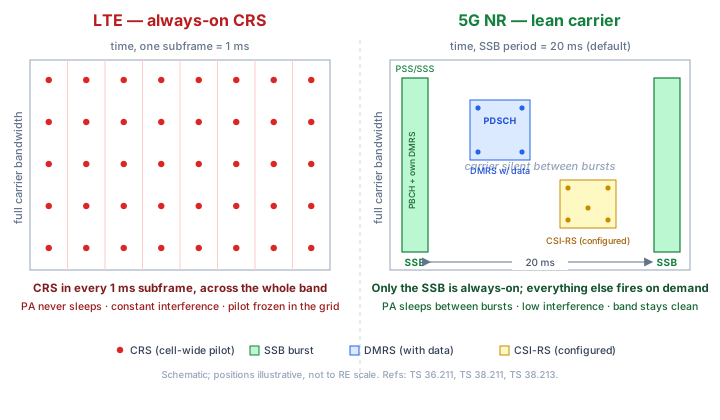
LTE's always-on CRS grid in every 1 ms subframe versus the 5G lean carrier transmitting only an SSB burst every 20 ms plus on-demand DMRS and CSI-RS
What CRS actually did for you in LTE
Before you celebrate its removal, respect what CRS carried. In LTE the cell-specific reference signal was the workhorse pilot, mapped into every downlink subframe across the full carrier bandwidth, independent of how much traffic — or none — was flowing (TS 36.211 §6.10.1). It sat at fixed resource-element positions keyed to the physical cell ID, and three different jobs leaned on it at once:
Demodulation. CRS was the phase-and-amplitude reference the UE used to coherently demodulate PDSCH and the control channels. The pilots were cell-wide, so any UE in the cell could use the same grid.
Measurement. RSRP, RSRQ, the handover trigger — all measured on CRS. Your whole mobility and coverage intuition is built on a signal you could count on being there, on every cell, at all times.
The always-on cell. CRS is also what made an empty LTE cell detectable. The beacon was the cell.
That worked. The problem was never that CRS failed at its jobs — it was the word always. Because it was always on, CRS imposed three permanent taxes:
Energy. The power amplifier could never sleep. Even an empty cell had to keep painting the band with pilots, a fixed power draw decoupled from any actual demand.
Interference. Every cell's CRS spilled into its neighbours' band continuously, so even with zero user traffic the network generated a constant inter-cell interference floor that depressed everyone's SINR.
A pinned design. With millions of deployed UEs assuming CRS at exactly those resource elements, you can never move it, reshape it, or reclaim those REs for something better. The always-on pilot is a constant you are stuck carrying forever.
NR looked at all three and made the same call: stop transmitting when there is nothing to transmit.
The lean carrier principle: silence by default
The lean-carrier principle is one sentence — minimise always-on transmissions — and NR follows it almost to the letter. In an NR cell, the only periodic, always-on downlink signal is the SS/PBCH Block, the SSB, sent as a short burst. Everything that used to ride on CRS is now sent strictly on demand:
DMRS (demodulation reference signal) is transmitted only alongside actual data or control, front-loaded in the same allocation and beamformed with it. No data, no DMRS.
CSI-RS (channel-state-information reference signal) is configured — switched on only when the network wants channel feedback, beam management, or tracking. The tracking flavour, the TRS, is just a CSI-RS configured for fine time/frequency tracking.
There is no cell-specific reference signal at all (TS 38.211 §7.4.1).
So between SSB bursts, with no UE scheduled, an NR carrier transmits essentially nothing. Compare the duty cycles directly. LTE CRS: every 1 ms subframe, forever. NR SSB: a burst confined to a 5 ms half-frame window, repeating by default every 20 ms (TS 38.213 §4.1). The period is itself configurable — ssb-PeriodicityServingCell takes {5, 10, 20, 40, 80, 160} ms (TS 38.331) — but 20 ms is the initial-access default. Twenty milliseconds between mandatory transmissions, versus one. That ratio is the lean carrier.
This does not mean the cell is hard to find or the link is flaky. Sync still happens, broadcast still happens, demodulation still happens — they just happen in a burst, or on demand, instead of continuously. The carrier defaults to silence and speaks only when it has something to say. If you are debugging this in the field, that quiet is exactly what an idle cell should look like, which matters when you are working an attach failure and need to know whether the cell is healthy or dark.
Inside the one signal that survived: the SSB
If the SSB is the only always-on transmission left, know its anatomy cold — every NR cell-search, every initial measurement, every beam decision starts here. One SS/PBCH block occupies 4 OFDM symbols in time by 240 subcarriers in frequency, and 240 subcarriers is exactly 20 resource blocks (TS 38.211 §7.4.3). That is a compact, fixed rectangle, the same shape regardless of carrier width. Inside it:
Symbol 0 carries the PSS (Primary Synchronisation Signal), 127 active subcarriers. This is what a UE correlates against first to grab symbol timing and part of the cell ID.
Symbol 2 carries the SSS (Secondary Synchronisation Signal), also 127 subcarriers. PSS and SSS together resolve the physical cell ID — NR has 1008 of them (336 SSS sequences × 3 PSS) versus LTE's 504.
Symbols 1 and 3, plus the edges of symbol 2, carry the PBCH (Physical Broadcast Channel), which ships the MIB and essential timing/SFN information.
The PBCH carries its own DMRS woven into its resource elements — its dedicated demodulation pilot, so the broadcast channel is self-sufficient and needs no external reference.
Read that last point against LTE and the whole philosophy snaps into focus: even the broadcast channel brings its own demodulation reference inside its own block. There is no appeal to a cell-wide pilot, because there isn't one. The SSB is a self-contained beacon.
And it is beam-swept. Inside that 5 ms window the gNB does not send one SSB — it sends the same broadcast on beam 1, then beam 2, then beam 3, up to L candidate positions, each beam carried by its own SSB at its own time index. L scales with band: up to 4 below 3 GHz, up to 8 for FR1 3–6 GHz, and up to 64 in millimetre-wave FR2 (TS 38.213 §4.1). A UE finds the cell on whichever swept beam points at it and reports that beam back as an SSB index. CRS never had to do this because LTE leaned on wide, mostly-omnidirectional coverage; NR's pencil beams make a swept burst the only sane way to broadcast. The full beam lifecycle — SSB sweep, CSI-RS refinement, P1/P2/P3 — is its own subject, covered in 5G NR beamforming.
The three payoffs
Deleting the always-on pilot buys three things, and they map one-to-one onto the three taxes CRS imposed.
1. Energy efficiency and cell sleep. This is the headline. Because an idle NR cell only emits a short SSB burst every 20 ms, the power amplifier can drop into low-power states between bursts — there is nothing it is obliged to transmit. That enables genuine energy-saving modes and cell micro-sleep that LTE's always-on CRS could never permit: an empty LTE cell burns near-full PA power painting pilots into the void, while an empty NR cell barely sips. At network scale, where a huge fraction of cells are lightly loaded most of the day, this is a real operating-cost and sustainability win. It is also the foundation the more aggressive network energy-saving techniques build on top of.
2. Far lower inter-cell interference. With no continuous cell-wide pilot, empty and lightly-loaded NR cells are not blasting reference signals into their neighbours' band. The constant interference floor that CRS created across an LTE network simply isn't there. Less neighbour noise means a higher SINR floor, which means you can pack cells denser — tighter frequency reuse — before interference eats the gains. The lean carrier quietly improves the link budget of every cell around it just by staying quiet.
3. Forward compatibility. This one is strategic, and it is why 3GPP treats lean-carrier as a foundational principle (TS 38.300). Because NR does not bake a heavy always-on signal into fixed resource elements that a billion devices depend on, the band stays clean. Future releases can introduce new signals, numerologies, and features into otherwise-empty resources without colliding with a legacy beacon that must transmit forever. LTE's CRS is a permanent occupant of the grid; NR deliberately refused to create one, so the carrier stays open for whatever comes next. You are not carrying dead weight into 6G.
The LTE-engineer gotcha: there is no pilot to measure on
Here is where careers built on CRS get tripped, so say it plainly: demodulation in NR is DMRS-based, not CRS-based. The reference you demodulate against is per-UE, sent inside that UE's own allocation, and beamformed with the data — the only thing that works when the data arrives on a steered pencil beam, because a cell-wide pilot pointed everywhere at once would tell the UE nothing about its beam. DMRS is the right tool precisely because it is narrow and on-demand. But it means there is no cell-wide demodulation grid sitting in the background for you to lean on.
Measurement moves too. There is no CRS to compute RSRP on. In NR you measure on the SSB (SS-RSRP / SS-RSRQ / SS-SINR) and, when configured, on CSI-RS — that is what mobility, beam selection, and link adaptation key off now.
LTE
5G NR
Always-on RS
CRS, every subframe
none — lean carrier
Sync / broadcast
PSS/SSS/PBCH at band centre
SSB, beam-swept burst
How often
every 1 ms
every 20 ms (default)
Demod pilots
cell-wide CRS
UE-specific DMRS, on demand
Channel-state ref
CRS-based
CSI-RS, configured
Three practical consequences fall out of that table:
Don't go hunting for a continuous reference in a trace or on an analyser. Between SSB bursts an idle cell is supposed to look nearly empty — that is health, not a fault.
Your RSRP intuition rebases onto SSB. Because SSB is beam-swept, a measurement is implicitly tied to a beam (an SSB index), not to one omnidirectional cell reading.
The SSB period is a knob you now own. Stretch it for more energy saving and you slow initial cell detection and lengthen battery-draining search windows on the UE; shorten it and you spend more downlink airtime. Coverage, latency-to-attach, and battery all hinge on getting ssb-Periodicity right — a tuning decision LTE never offered, because CRS timing was a fixed constant. If your mental model of the NR frame and subframe structure is rusty, that is where the periodicity math lands.
If you are coming from LTE and want the full air-interface picture rebuilt from scratch — what changed and why — start with what 5G NR actually is. And if you want to drill the NR reference-signal framework hands-on rather than just read about it, you can start a free 7-day trial (no credit card) and work through the lab exercises.
The takeaway
LTE's cell-specific reference signal did three jobs well — demodulation, measurement, and being the always-on heartbeat of the cell — and paid for all three with constant energy, constant interference, and a pilot frozen permanently into the grid. NR refused that bargain. It keeps exactly one periodic always-on signal, the beam-swept SSB burst every 20 ms, and pushes every other reference — DMRS, CSI-RS, TRS — to fire only when there is real work to reference.
That is the lean carrier: silence by default, energy saved, interference dropped, a band left clean for the future. The engineering cost is that the cell-wide pilot you measured and demodulated on for your entire LTE career is gone. So retrain the instinct now: in NR you measure on SSB and CSI-RS, you demodulate on DMRS, and you treat a quiet carrier as exactly what it should be.