 Watch free
Free preview · Operations agent deployments: job, authority, evidence — opens in the course player
Agentic AI for Telecom Operations: Autonomous Networks and Intent-Driven Management
On the Agentic Network Operations Engineer route →An operations agent is a model placed in one job of the detect, diagnose, decide, change and verify chain. This course teaches the machinery that decides how far it may act — TS 28.312 intents, tool scopes and credentials, verification before a change, fail-closed policy, signed approvals, confirmed commits, limits and a kill switch — and the evidence that earns an agent more autonomy, one workflow at a time.
The first module of every course, free
This course ends in a graded exam and a publicly verifiable TELCOMA certificate.
- Lessons
- 37
- Video
- ≈5.3h
- Hands-on
- 18 exercises
- Before you start
- 5G Foundation, with AI for Telecom Networks helpful but not assumed
About this course
Who it's for. Working telecom engineers in NOC and operations, OSS and automation, RAN, core and transport, and SRE and platform teams.
Career route. Part of the Agentic Network Operations Engineer route: 5G Foundation → Agentic AI for Telecom Operations.
Before you start. 5G Foundation, with AI for Telecom Networks helpful but not assumed. Alarms, intents, autonomy levels, MCP, A2A, NETCONF and closed control loops are built from zero where the course needs them.
This course includes
- 37 video lessons — the first needs no account, and Module 1 is free with one
- 18 hands-on exercises — interactive labs and checkpoints
- Study pack — question bank and slides
- Certification exam and a QR-verifiable certificate — with Prime Membership or this certification
- “Stuck?” help on every exercise — a nudge, the method, the worked answer, and the lesson moment to rewatch
Skills you'll gain
- Agent job & authority classification
- Agent reliability (pass^k)
- TS 28.100 autonomy levels
- MCP tool design & scoped credentials
- TS 28.312 intents & TMF921
- Change gates & fail-closed policy
- Confirmed commit & canary rollout
- Closed control loops (ZSM, TS 28.535)
- Agent evaluation & safety cases
Syllabus
8 modules · 37 lessons · certification exam
Module 1 — Agentic operations baseline: deployments, tool calls, reliability, levels
Classify agent deployments by job, authority and evidence, trace a tool call through its gates, compute multi-step reliability, and read TS 28.100 autonomy levels.
4 lessons · 1 lab · 3 checkpoints · ≈34 min
- Lesson 1Operations agent deployments: job, authority, evidenceWatch free9:07
- Lesson 2Tool-call path: host, model, policy gate, tool serverFree with an account8:39
- Lesson 3Agent reliability: per-step compounding, pass^k and pass@kFree with an account8:21
- Lesson 4TS 28.100 autonomy levels: task ownership per workflowFree with an account8:06
- CheckpointRead the Record · Checkpoint~7 min
- CheckpointOwn the Hop · Checkpoint~6 min
- Interactive labGate the Unattended Action · Interactive lab~7 min
- CheckpointCompute the Level · Checkpoint~6 min
Module 2 — Detection and diagnosis: alarm records, read tools, root cause
Map one alarm across X.733, TS 28.111 and TMF642, read an MCP exchange, bound an agent’s read tools, score root-cause candidates and contain prompt injection.
5 lessons · 1 lab · 1 checkpoint · ≈42 min
- Lesson 1Alarm records and correlation: TS 28.111 and TMF642Prime Membership8:41
- Lesson 2MCP tool access: discover, list and callPrime Membership8:10
- Lesson 3Tool-surface design: bounded reads, effect classes, scoped credentialsPrime Membership8:26
- Lesson 4Root-cause analysis: topology traversal, change correlation, evidence citationPrime Membership8:58
- Lesson 5Indirect prompt injection: alarm, log and ticket textPrime Membership8:05
- CheckpointAudit the Tools List · Checkpoint~8 min
- Interactive labScore the Root Cause · Interactive lab~7 min
Module 3 — Intent-driven management: TS 28.312 intents and TMF921
Write a schema-valid TS 28.312 intent, dry-run it with a feasibility check, read its reports and lifecycle states, resolve conflicts, and map TMF921 onto it.
5 lessons · 1 lab · 1 checkpoint · ≈40 min
- Lesson 1TS 28.312 intent: expectation object, targets and contextsPrime Membership8:23
- Lesson 2Intent pre-evaluation: feasibility check, recommended values, fulfilmentPrime Membership7:49
- Lesson 3Intent lifecycle and reports: Rel-20 states, fulfilment resultsPrime Membership8:12
- Lesson 4Intent conflicts: conflict types, intentPriority, utility selectionPrime Membership7:34
- Lesson 5TMF921 intent decomposition: Annex C mapping, natural-language gatePrime Membership8:12
- CheckpointDry-Run the Intent · Checkpoint~8 min
- Interactive labRead the Report · Interactive lab~8 min
Module 4 — Change control: outage findings, procedures, verification, approval
Turn outage findings into change gates: procedures written as checkable data, verification before the write, blast radius with fail-closed policy, and signed approval records.
5 lessons · 1 lab · 1 checkpoint · ≈46 min
- Lesson 1Outage review findings: risk tiers, peer review, protective limitsPrime Membership7:44
- Lesson 2MOP and write-tool design: machine-checkable checks, compare-and-setPrime Membership9:57
- Lesson 3Pre-change verification: validator coverage and twin jobsPrime Membership9:42
- Lesson 4Blast radius and policy decisions: impact scope, risk tiers, fail-closedPrime Membership9:40
- Lesson 5Tool-call approval: input_required, approval record, retryPrime Membership8:56
- CheckpointGate the Change · Checkpoint~9 min
- Interactive labSize the Blast Radius · Interactive lab~9 min
Module 5 — Change execution: canaries, confirmed commit, post-checks, rollback
Size a canary wave, revert automatically with confirmed commit, attribute KPI changes with control groups, set error-budget limits and a kill switch, and plan rollbacks.
5 lessons · 1 lab · 1 checkpoint · ≈41 min
- Lesson 1Staged rollout: canary power, wave plan, rollback reservePrime Membership7:33
- Lesson 2Confirmed commit: candidate datastore, confirm timeout, automatic revertPrime Membership7:46
- Lesson 3Post-change verification: control groups, difference-in-differences, scoped monitoringPrime Membership7:35
- Lesson 4Automation limits: velocity caps, kill switch, error-budget gatePrime Membership11:06
- Lesson 5Rollback planning: recovery load, revert objects, decision recordPrime Membership7:06
- Interactive labSize the Canary · Interactive lab~8 min
- CheckpointCommit, Confirm or Revert · Checkpoint~8 min
Module 6 — Closed loops under intent: assurance, energy saving, escalation
Read closed control loops in ZSM 009-1 and TS 28.535, an assurance loop’s goals and locks, RAN energy saving under an intent, and when a loop must escalate.
5 lessons · 1 lab · 1 checkpoint · ≈41 min
- Lesson 1Closed control loop stages: ZSM 009-1 and TS 28.535Prime Membership7:36
- Lesson 2Assurance closed control loop: TS 28.536 goals, disallowed attributesPrime Membership6:41
- Lesson 3Production closed loops: closed-box realisation, control interface, evidencePrime Membership9:01
- Lesson 4RAN energy saving under intent: throughput floor to energy-saving policyPrime Membership8:24
- Lesson 5Loop escalation and coordination: confidence thresholds, pre-execution conflictsPrime Membership9:46
- CheckpointMap the Loop · Checkpoint~8 min
- Interactive labEscalate or Act · Interactive lab~9 min
Module 7 — Multi-agent operations: placement, delegation, trust, traces
Decide workflow or agent by deadline, delegate tasks between agents under ZSM 022 and A2A, secure the agent supply chain, and record every write as a traceable decision.
4 lessons · 2 checkpoints · ≈35 min
- Lesson 1Agent placement: workflow or agent, timescale, standards placementsPrime Membership8:08
- Lesson 2Agent task delegation: ZSM 022 negotiation, A2A task statesPrime Membership9:03
- Lesson 3Agent supply chain: pinned servers, signed cards, gated memoryPrime Membership9:05
- Lesson 4Agent observability: OpenTelemetry spans, decision records, token costPrime Membership9:00
- CheckpointWorkflow or Agent · Checkpoint~8 min
- CheckpointBudget the Trace · Checkpoint~7 min
Module 8 — Autonomy evaluation and operating model: evidence, approval, promotion
Size an agent evaluation with honest intervals, size human approval capacity, test autonomy-level claims against their evidence, and write promotion criteria with a safety case.
4 lessons · 1 lab · 1 checkpoint · ≈34 min
- Lesson 1Agent evaluation: golden incidents, sample size, model selectionPrime Membership8:54
- Lesson 2Human approval capacity: review load, queueing delay, approver rolesPrime Membership8:41
- Lesson 3Autonomy level claims: evaluation object, validation, outcome evidencePrime Membership7:49
- Lesson 4Autonomy promotion criteria: evidence gates, rollback coverage, safety casePrime Membership8:43
- Interactive labSize the Evaluation · Interactive lab~10 min
- CheckpointPromote or Demote · Checkpoint~9 min
Certification exam
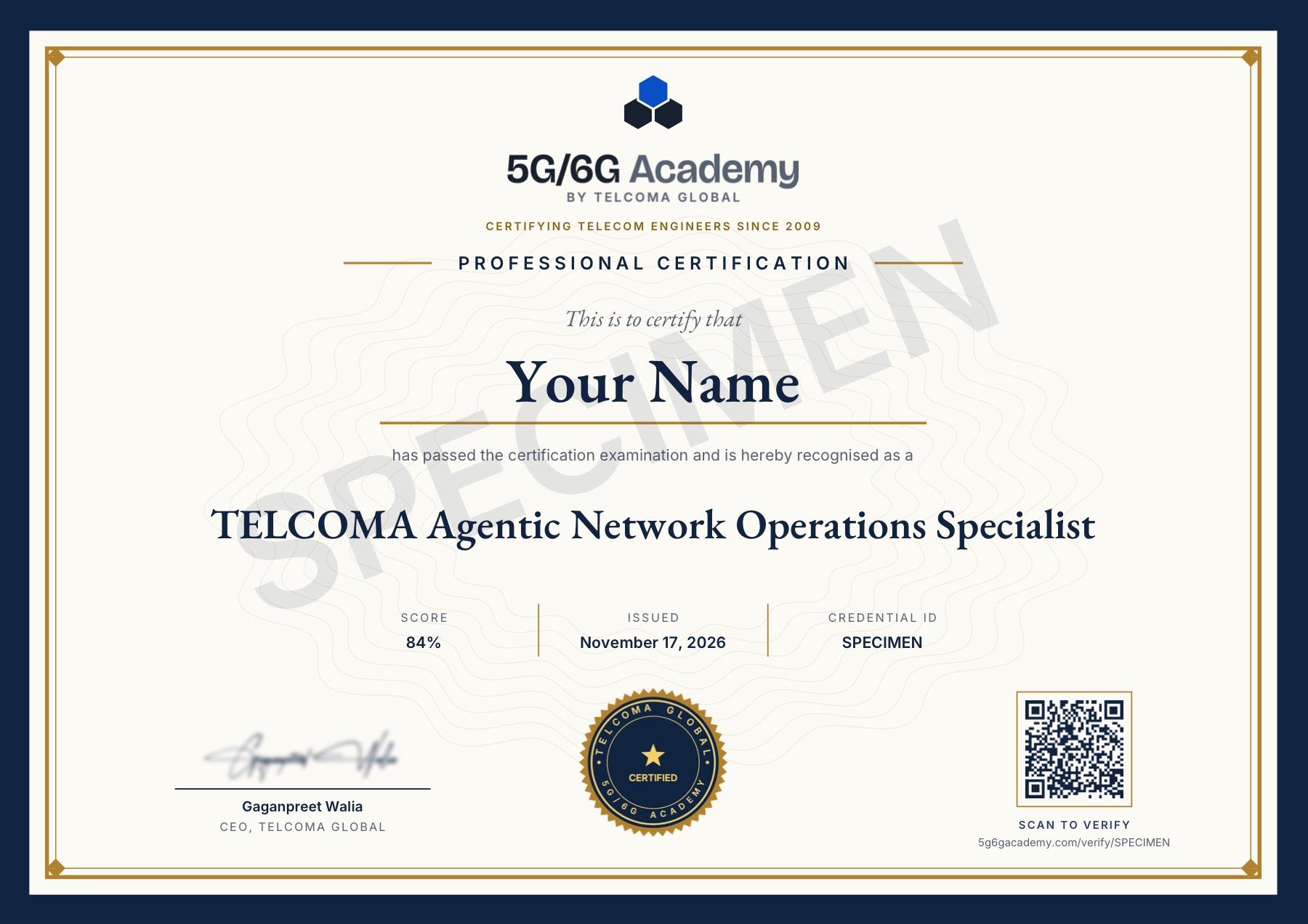
Earns a certificate56 questions · 60 min · 65% to pass — earns your TELCOMA Agentic Network Operations Specialist, a QR-verifiable certificate.
Look up any acronym in the telecom glossary
Certification
Earn the TELCOMA Agentic Network Operations Specialist
Pass the 56-question exam with 65% or more, and you hold a certificate any employer can check.
- Show any employerEvery certificate is numbered, with a QR code to a public verification page anyone can check.
- Add it to LinkedInUnder Licenses & certifications on your profile, in one click.
- Build your routeEvery course on a career route earns its own certificate — 14 courses in all.
The first module free with an account, no card. The exam comes with Prime Membership or this certification.
Study materials
PrimeDownload the Agentic AI for Telecom Operations: Autonomous Networks and Intent-Driven Management question bank and slide deck — every signal check in the course, with answers, plus every figure.
- Question BankPDF52 KB
- Slide DeckPPTX21 MB
The question bank and slides come with Prime Membership or this certification. A free account opens the first module of every course — no card.
Hands-on learning
Do it, don't just watch it
Modules end with a hands-on exercise — 18 in this course. You move the controls, the numbers answer back, and a wrong turn tells you why.
Stuck? Every exercise points you to the exact lesson moment to rewatch, and TelcoMentor answers on the exercise itself. TelcoMentor comes with Prime Membership.
Try this one first:
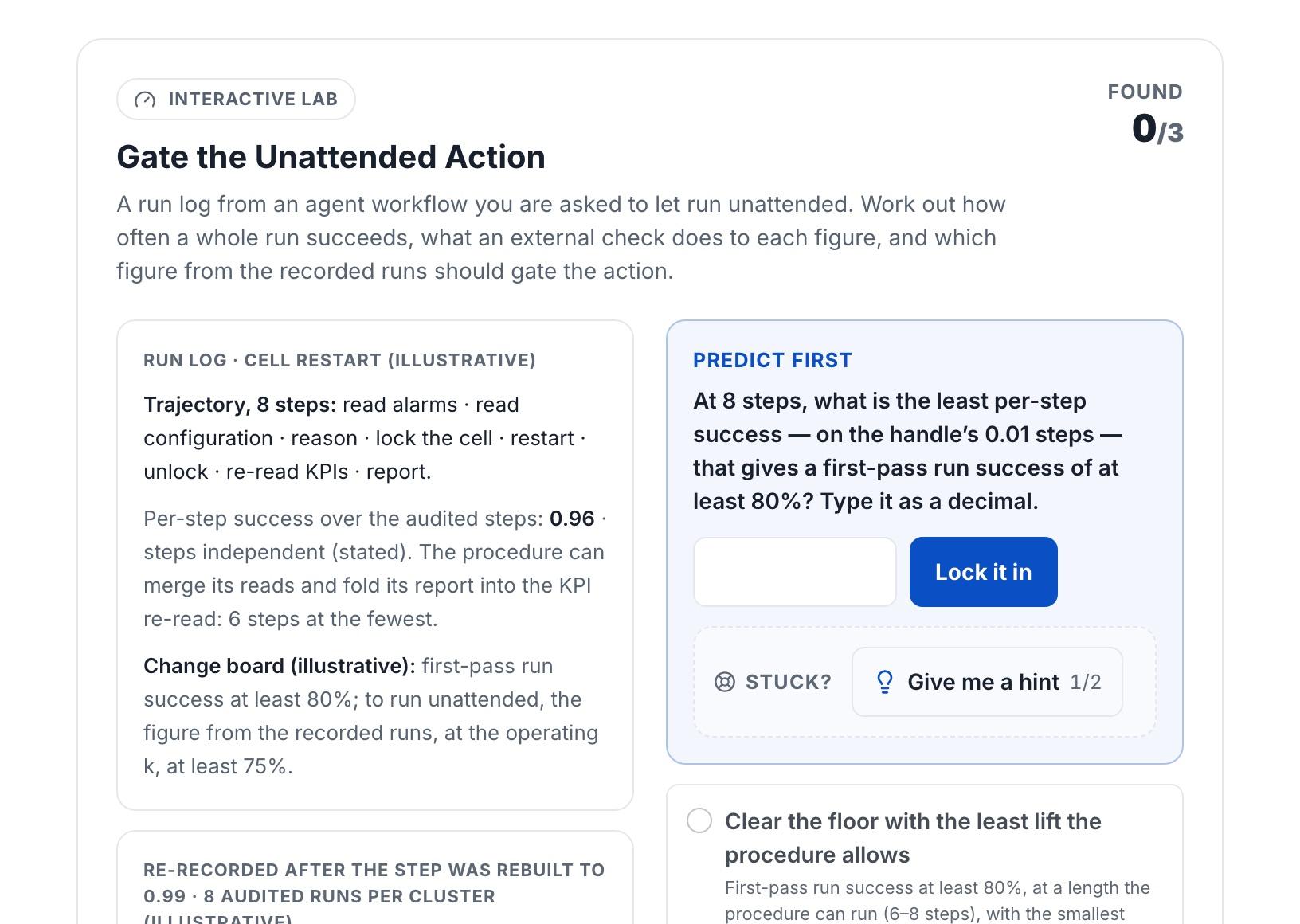
Gate the Unattended Action · Interactive lab · ~7 min
Try it freeFree with an account — no card.
What you'll build
3 of 18 — the rest are in the syllabus
- Lab 1FreeGate the Unattended ActionA run log from an agent workflow you are asked to let run unattended. Work out how often a whole run succeeds, what an external check does to each figure, and which figure from the recorded runs should gate the action.Module 1~7 min
- Lab 2Score the Root CauseWhat a diagnosing agent’s read tool is handed from a day of alarms, then root-cause candidates from different methods over synthetic incidents. Compute what the filter and the scorecard say, then run the change join the ways a reviewer might propose and find what each one costs.Module 2~7 min
- Lab 3Read the ReportA subnetwork reading in its indicator’s own unit, then intents that share cells. Find where the figure first claims the capacity target fails, read the conflict report and resolve it as the consumer with the least change, then let a utility choose between outcomes.Module 3~8 min
Ways to learn
One certification, or every career route.
| Feature | This certification Price loadingonce One credential, yours for good | Recommended Prime Membership Price loadingonce, for life 14 courses · 441 lessons · ~57 h · 214 hands-on exercises | Free account Free The first module of every course |
|---|---|---|---|
| Lessons and labs in this course | First module | ||
| Study pack — question bank and slides | |||
| Certification exams and verifiable certificates | 1, for this course | All 14 | |
| Every other course | First module | All, and new ones | First module |
| Full-length practice exams | |||
| TelcoMentor AI coach | |||
| Hands-on scenarios — traces, logs, configs | Selected traces | Selected traces | |
One payment · no renewal | Get Prime Membership You create a free account first, then go straight to Prime. Paid once · nothing to renew | Join for free No card needed |
Prime Membership
Price loadingonce, for life
14 courses · 441 lessons · ~57 h · 214 hands-on exercises
- Lessons and labs in this course
- Study pack — question bank and slides
- Certification exams and verifiable certificates — all 14
- Every other course — all, and new ones
- Full-length practice exams
- TelcoMentor AI coach
- Hands-on scenarios — traces, logs, configs
You create a free account first, then go straight to Prime.
Paid once · nothing to renew
This certification
Price loadingonce
One credential, yours for good
- Lessons and labs in this course
- Study pack — question bank and slides
- Certification exams and verifiable certificates — 1, for this course
- Every other course — first module
- Not included: Full-length practice exams
- Not included: TelcoMentor AI coach
- Hands-on scenarios — traces, logs, configs — selected traces
One payment · no renewal
Free account
Free
The first module of every course
- Lessons and labs in this course — first module
- Not included: Study pack — question bank and slides
- Not included: Certification exams and verifiable certificates
- Every other course — first module
- Not included: Full-length practice exams
- Not included: TelcoMentor AI coach
- Hands-on scenarios — traces, logs, configs — selected traces
No card needed
A free account opens the first module of every course, for good — no card needed. Both paid options come with a 7-day money-back guarantee.
Explore more courses
See all 14 courses → AI for Telecom NetworksSupervised & unsupervised MLModel evaluation & driftLLMs & RAG for operationsIntermediate26 lessons~3.8h
 AI-RAN & the AI-Native NetworkTraining vs inferenceBeam & CSI predictionAI positioningAdvanced31 lessons~3.6h
 5G Foundation5G system architectureNSA vs SAService-based architectureFoundation34 lessons~3.3h