Emerging Tech 13 min readJul 18, 2026Updated Oct 16, 2026
Open RAN in Practice: The 2026 Deployment, Market, and TCO Reality Check
By Gaganpreet Walia
CEO, TELCOMA Global · 21+ years in telecom
Open RAN won the argument and lost the share war
By 2026, the architectural debate is over. Every flagship RAN tender now demands open interfaces. Specifications ship through ETSI and ATIS. Security is graded against GSMA NESAS. If you are a working RAN engineer, "do you support O-RAN interfaces" is no longer a question you ask a vendor — it is a checkbox they already ticked.
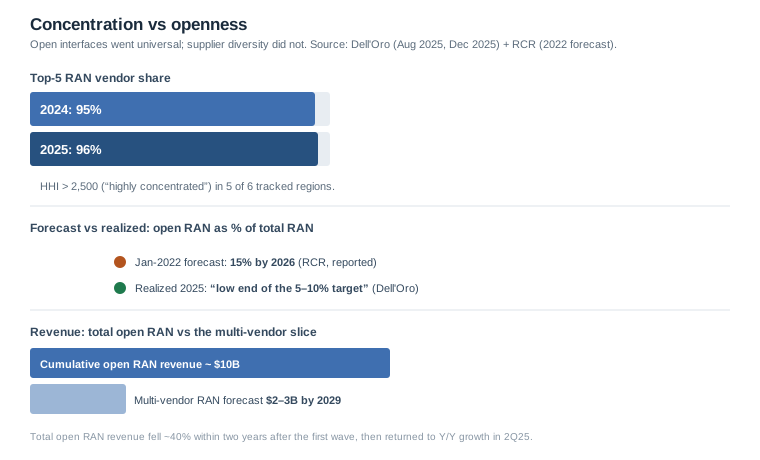
And yet the market told a different story than the 2018 pitch. Dell'Oro's August 2025 read is blunt: cumulative open RAN revenues are approaching $10 billion, but total open RAN revenue declined roughly 40% within two years of the initial Japan/US scaling wave before returning to year-on-year growth in 2Q25. The 2026 outlook is a "flat-growth thesis," with open RAN landing "at the low end of the 5% to 10% target for the year." Set that against Dell'Oro's own January 2022 forecast — open RAN at 15% of total RAN revenue by 2026 (RCR's secondary write-up of that forecast) — and you have the spread that defines this whole piece: the realized number came in well under the projection.
The sharpest data point is the one that should worry anyone who bought "open equals diverse": the top five RAN suppliers held 96% of the 1Q25–3Q25 RAN market, up from 95% in 2024 (Dell'Oro, 11 Dec 2025). The market is "highly concentrated" — HHI above 2,500 in five of six tracked regions. Dell'Oro projects multi-vendor RAN at only $2–3 billion by 2029. Openness arrived. Vendor diversity did not. What openness actually delivered was option value and procurement leverage — the ability to credibly threaten a swap — not the multi-supplier patchwork the original thesis promised.
This article is the practice-layer pillar for that reality. It deliberately skips the architecture — splits, the 7.2x fronthaul, E2/A1/O1, the RIC control loops. Those are covered, and covered well, in What Is O-RAN?, the 7.2x fronthaul deep-dive, and the RIC and xApps guide. Here we audit deployments, count what is actually multi-sourced in production, grade the RIC's commercial reality, and reconcile every citable savings claim against the counter-evidence. Confidence is graded inline: confirmed means a primary source; reported means credible secondary; interpretation flags analyst framing.
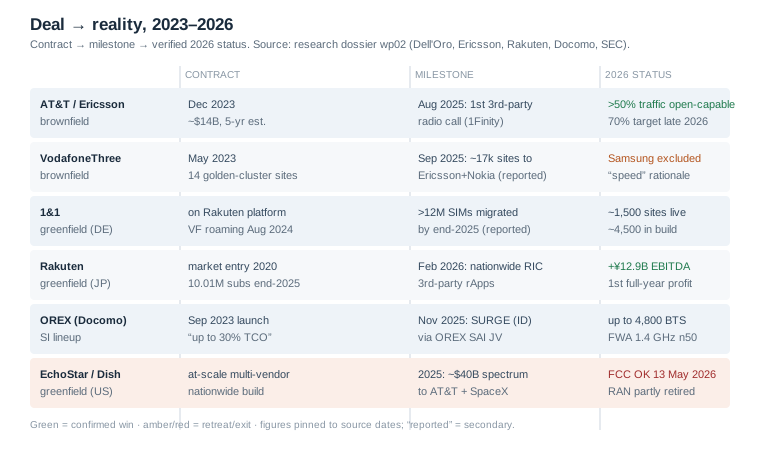
Figure 1 — Deal to reality: six flagship open RAN programs, 2023–2026, from contract signing to verified 2026 status
Every 5G & 6G certification course, free for 7 days.
A free account opens all 13 courses — 404 video lessons, labs and full practice exams — for 7 days, no card. Prime Membership keeps them and adds the certification exam and a verifiable certificate.
Six programs carry the weight of the open RAN narrative. One honest paragraph each.
AT&T / Ericsson — the brownfield flagship. December 2023: AT&T awarded Ericsson a deal Ericsson said "could approach roughly $14 billion over the 5-year term" to lead its open RAN build, with a stated ambition of 70% of wireless traffic on open-capable platforms by late 2026 (confirmed; phrase it as ~$14B estimate, not a firm contract value). Status as of March 2026, per AT&T's Rob Soni: more than 50% of the radio-swap program complete, more than 50% of network traffic on open-capable hardware, Cloud RAN live in two cities (confirmed via TelecomTV reprint). The first open RAN call with third-party radios — 1Finity (ex-Fujitsu) radios on an Ericsson RAN Processor 6672 baseband — happened in August 2025, roughly twenty months after signing. Read that gap carefully: the biggest open RAN contract in history ran almost two years before a non-Ericsson radio carried live traffic.
Vodafone UK / VodafoneThree — the golden cluster's fate. May 2023: Vodafone lit the "golden cluster" — 14 live open RAN sites in southwest England (Torquay, Exmouth), billed as Europe's first commercial urban open RAN, with a group pledge of 30% of European sites on open RAN by 2030. Then September 2025 reordered the board: VodafoneThree awarded roughly 17,000 UK sites to Ericsson (~10,000) and Nokia (~7,000), excluding Samsung — the open RAN incumbent, reportedly live at only ~70 of a planned 2,500 sites (reported; Light Reading, the 10k/7k split and the ~70-site count are press reporting, not operator PRs — attribute them). The stated rationale was deployment speed and coverage obligations. The October 2025 group tender softened it: Samsung stays Vodafone's "primary partner for large-scale open RAN and vRAN deployments within Europe," with Wismar slated to become Vodafone's "first fully open RAN-equipped city" by early 2026 (confirmed). The UK champion of open RAN handed its biggest swap to two incumbents for speed.
1&1 — the German greenfield. Built on the Rakuten platform, 1&1 reported migrating its customer base — more than 12 million SIMs — onto its own open RAN network by the regulator-linked end-2025 deadline, with roughly 1,500 own antenna sites live and ~4,500 in development (reported via Light Reading/Opensignal — both blocked direct fetch, so attribute). National roaming moved from Telefónica to Vodafone, launched August 2024 (confirmed via Vodafone PR). A real greenfield, real subscribers — and still leaning on a host network for coverage.
Rakuten — the greenfield survivor. The turn finally came. Rakuten's FY2025 results (12 Feb 2026): Rakuten Mobile posted EBITDA of +¥12.9 billion — its first full-year EBITDA profit since entering the mobile business (a ¥66.7B year-on-year swing), reaching 10.01 million subscriptions at end-December 2025, while Rakuten Symphony booked its first full-year non-GAAP operating profit (all confirmed). The long-standing ~40% lower-capex / ~30% lower-opex claim remains a company self-claim, never independently audited (reported) — do not present it as an industry benchmark.
NTT Docomo / OREX — the systems-integrator play. OREX's headline claim, from its 2023 launch, is "up to 30%" TCO reduction and "up to 50%" base-station power reduction — with the baseline explicitly stated as Docomo's own standard network versus the same network running OREX RAN and SMO (confirmed as a self-claim with that narrow baseline). The commercial action moved offshore: November 2025, the OREX SAI joint venture (Docomo + NEC) signed Indonesia's SURGE for up to 4,800 base stations in an initial 2026 phase, billed as the world's first commercial open RAN FWA system at 1.4 GHz (band n50) with an NEC 5GC (confirmed).
EchoStar / Dish — the cautionary tale. The US's only at-scale multi-vendor greenfield ended not with a technical failure but a balance-sheet decision. EchoStar agreed to sell ~$40B of spectrum — ~$23B to AT&T (3.45 GHz + 600 MHz) and ~$17B to SpaceX (AWS-4 + H-block, for direct-to-cell Starlink) — converting into a "hybrid MNO" that decommissions parts of the Boost Mobile RAN and serves customers on AT&T's network. The FCC approved the sales on 13 May 2026 (confirmed via SEC 8-Ks and SDxCentral). Analysts call it "strategic abandonment" of the standalone open RAN network (interpretation; RCR Analyst Angle) — but the engineering lesson is clean.
The brownfield paradox, quantified
Hold AT&T and EchoStar side by side. Rakuten and EchoStar built near-identical open architectures; in the same six months one printed its first full-year EBITDA profit and the other sold its spectrum and folded into AT&T's network. The differentiator was balance sheet and distribution — not the RAN. That is the rebuttal to technology determinism: the architecture did not decide the outcome.
And the contracts themselves quietly re-concentrated. The largest open RAN deal in history is, in practice, near single-vendor Ericsson. VodafoneThree handed 17,000 sites to two incumbents for speed. Open interfaces are being deployed almost everywhere; multi-vendor mixing mostly is not — which is exactly why Dell'Oro pegs multi-vendor RAN at just $2–3B by 2029. If you want the cost mechanics behind why operators keep choosing one throat to choke — the integration burden, the conditional opex savings — that belongs to O-RAN vs Traditional RAN TCO, and the field of multi-vendor partners is mapped in the O-RAN MVP vendor comparison. The vendor-ecosystem stress is real on its own: Mavenir completed a recapitalization on 29 July 2025 — more than $1.3B of debt eliminated, $300M new senior financing — and exited radio-unit hardware, licensing its designs to ODMs to focus on software (confirmed).
Figure 2 — Concentration versus openness: top-5 vendor share rose to 96% even as open interfaces became universal, against a multi-vendor RAN forecast of only $2–3B by 2029
RIC reality check: rApps shipped, xApps did not
Here is the most useful thing to know if you are deciding where to invest engineering hours: the non-real-time RIC crossed into production, and the near-real-time RIC did not.
The rApp (non-RT RIC) layer became commercially real, twice, in eight months. In July 2025, AT&T deployed — per Ericsson — the first third-party rApp on a live production network, via the Ericsson Intelligent Automation Platform over the O-RAN R1 interface, with Ericsson citing 60+ ecosystem members and 60+ rApps (confirmed; note the PR names neither the rApp vendor nor any performance metric). In February 2026, Rakuten Mobile and Rakuten Symphony announced nationwide RIC deployment across the commercial network, running third-party rApps from AirHop Communications and Future Connections for predictive maintenance, mobility, and traffic optimization (confirmed; again, no quantified results in the PR). The R1 interface — barely discussed in 2022 — is where "open" cashed out first.
The xApp (near-RT RIC) story is the opposite. As of this research pass (June 2026), no named production near-RT xApp deployment with published commercial results could be found. The nearest hits are lab and emulated validations; Light Reading's standing critique that "xApps look stillborn" matches the evidence gap, and major vendors have been reluctant to open near-RT RIC support. SNS Telecom sizes the entire RIC/xApp/rApp segment at roughly $600M by end-2025 — small against a ~$35B/yr RAN market (reported). None of this means xApps are dead; it means the commercial proof is not there yet, and you should budget accordingly. The mechanics of the E2 interface and the xApp lifecycle live in O-RAN RIC and xApps, and if you want to actually build one, the xApp tutorial is the hands-on path. For where the intelligence is migrating — and why so much vendor energy is now badged "AI-RAN" rather than "open RAN" — see AI-RAN explained. The AI-RAN Alliance reached 132 members by MWC 2026 (reported), and the O-RAN Alliance's own MWC Barcelona summit (3 March 2026) was themed around "AI-Enabled Open RAN" and "tomorrow's Open 6G."
If you are upskilling into this layer, the practical move is to learn the non-RT RIC and R1 first — that is where production work exists today. Start a free 7-day trial (no card) if you want the guided path through the RIC stack.
Specs, security, and the geopolitics that almost derailed it
Security flipped from open RAN's biggest liability into its most standardized layer — and that is a citable, spec-by-spec rebuttal to the 2021-era "open equals insecure" critique.
The O-RAN Alliance's WG11 security update (24 February 2026) lists the February 2026 publications: Security Requirements and Controls and Security Protocols at v14.0, Security Tests v12.0, and a Threat Modeling and Risk Assessment technical report at v8.0 — published through ETSI and ATIS, and adopted by TTA (the precision matters: ETSI/ATIS publish; TTA adopts under a cooperation agreement). The program shows progress toward CISA's Zero Trust Maturity Model "Initial" level, a security-assurance program paired with GSMA NESAS, and a NIST SP 800-207 commitment. One correction to honor against sloppy secondary coverage: mandatory TLS/mTLS 1.3 was completed 2025 spec work, not a 2026 deliverable — the genuine 2026 item is publishing SCAS documents for O-RU, O-DU, and SMO (plus 6G-prep on AI security and post-quantum crypto). O-RAN specs also flow into the formal standards corpus as ETSI PAS deliverables — for example ETSI TS 104 104 V9.1.0 (June 2025).
The geopolitics is worth keeping straight because it is routinely misremembered as ongoing. It was not. In August 2021 Nokia paused O-RAN Alliance technical work over US Entity-Listed Chinese members; the Alliance amended its participation procedures (routing technical contributions to a non-confidential directory), and Nokia resumed work on 16 September 2021 (confirmed). Kindroid left; Phytium and Inspur remained. A four-week governance episode, resolved nearly five years ago — not a structural fault in the standard.
The TCO ledger: every savings claim, its baseline, and the counter-evidence
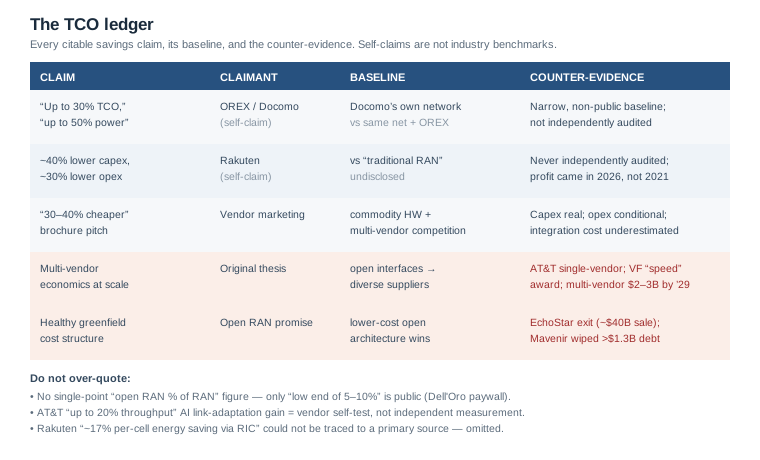
This is the section to bookmark. The open RAN cost case is real but conditional, and almost every headline savings number carries a baseline you have to read before you can use it. The deep category-by-category model — capex versus opex versus integration — belongs to O-RAN vs Traditional RAN TCO; what follows is the pillar-altitude ledger of which claims survive scrutiny.
Figure 3 — The TCO ledger: each savings claim mapped to its claimant, its baseline, and the counter-evidence on the same network
Two patterns recur. First, self-claims with non-public baselines: OREX's "up to 30% TCO / up to 50% power" is benchmarked against Docomo's own network with OREX deployed; Rakuten's "~40% capex / ~30% opex" has never been independently audited. Use neither as an industry figure. Second, the counter-evidence is behavior, not a rebuttal number: there is no clean published "integration cost premium" dollar figure, so the honest argument against frictionless multi-vendor economics rests on what operators actually did — single-vendor awards (AT&T), speed-driven incumbent awards (VodafoneThree), a greenfield exit (EchoStar), a vendor restructuring (Mavenir), and a 40% open RAN revenue drawdown after the first wave.
A few discipline notes carried from the source research, so you do not over-quote: do not print a single-point "open RAN % of total RAN" figure (it sits behind Dell'Oro's paywall — only the public "low end of 5% to 10%" phrasing is citable); treat AT&T's "up to 20% throughput" AI link-adaptation gain as a vendor self-test, not an independent measurement; and the often-cited "~17% per-cell energy saving via RIC" at Rakuten could not be traced to a primary source — omit it.
What an engineer should actually budget for
Strip the narrative and here is the operating picture for 2026:
Interfaces: assume they are table stakes. Demand O-RAN compliance in every RFP — for leverage and future optionality — but do not budget your business case on multi-vendor radio mixing. Dell'Oro's $2–3B multi-vendor forecast for 2029 is your reality check.
RIC: build for the non-RT layer and R1 now. Production rApps exist (AT&T, Rakuten); production near-RT xApps, with named published results, do not yet. Pilot xApps if you must, but do not stake KPIs on them this cycle.
Security: cite the spec. WG11 v14.0, NESAS-paired assurance, CISA ZTMM alignment, SCAS for O-RU/O-DU/SMO landing in 2026 — the "open is insecure" objection is answerable line by line.
TCO: separate capex from opex from integration. Capex savings are the most defensible; opex savings are conditional on your automation maturity; integration cost is the line everyone underestimates and the reason incumbents keep winning on "speed."
The differentiator is not the RAN. Rakuten versus EchoStar is the lesson — balance sheet, distribution, and execution decided the greenfields, not the openness of the architecture.
Open RAN is neither the revolution its 2018 backers promised nor the failure its 2025 obituaries declared. It won the standards war, normalized open interfaces, and hardened its security posture — while the supplier base concentrated and the first real "open" money showed up quietly in the non-RT RIC. Plan for that network, not the one in the slideware.