5G Fundamentals 8 min readJun 18, 2026Updated Sep 16, 2026
What Actually Changed from 4G to 5G: The Four Architectural Shifts
By Gaganpreet Walia
CEO, TELCOMA Global · 21+ years in telecom
Why "Faster" Is the Wrong Mental Model
If you came up through LTE, the 5G marketing does you a quiet disservice. Gigabit peak rates, one-millisecond latency, a billion devices — it all frames 5G as a quantitative step, a faster 4G. The speed is real. But it is the least interesting thing about the system, and if "faster" is your mental model you will be lost the first time a colleague says "the AMF selected an SMF over N11 and the UPF got programmed on N4."
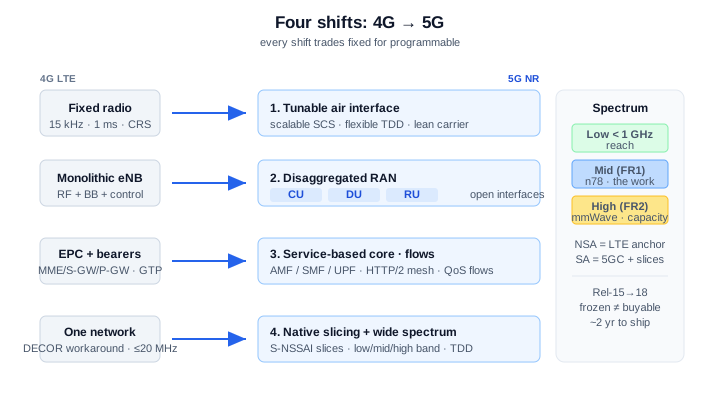
What actually changed is the architecture. Four things were rebuilt from the ground up. Get those four straight and every acronym that follows has a place to live. The through-line, which is worth holding onto before any of the detail: every shift trades fixed for programmable. Speed is a side effect of that, not the point of it.
The four shifts from 4G to 5G: a tunable air interface, a disaggregated RAN, a service-based core, and native slicing.
Shift 1: The Air Interface Became Tunable
LTE handed you one setting and told you to live with it: 15 kHz subcarrier spacing, a 1 ms subframe, FDD-first, and a carrier blanketed in always-on cell-reference signals (CRS). It worked everywhere because it was the same everywhere.
NR turns that fixed setting into a dial. Subcarrier spacing is scalable — 15, 30, 60, 120 kHz — so the same air interface stretches from sub-1 GHz wide-area coverage to mmWave short-range links. TDD is flexible down to the symbol instead of locked to a fixed uplink/downlink ratio. And the carrier is "lean": reference signals go out on demand rather than continuously, which cuts idle-mode interference and power draw. The radio is now configured per deployment instead of being one-size-fits-all. The mechanics — numerology, bandwidth parts, the lean carrier — are worth a separate sitting; start with 5G NR numerology once the four shifts have settled.
Shift 2: The RAN Got Disaggregated
In LTE the eNB is one sealed box — RF, baseband, and control in a single unit at the cell site. Tight, simple, and rigid: you cannot scale baseband independently, centralize control, or mix vendors across the stack.
The 5G gNB splits into three functional units joined by open interfaces:
Unit
What it runs
Where it tends to sit
CU (Central Unit)
RRC, PDCP
Centralized, often a regional data center
DU (Distributed Unit)
RLC, MAC, high-PHY
Cell site or aggregation point
RU (Radio Unit)
Low-PHY, RF
At the antenna
The base station stopped being an appliance and became a distributed, virtualizable system — increasingly software on commodity servers, with an open fronthaul between DU and RU. That openness is the whole premise of Open RAN. The CU/DU/RU split, the F1 interface, and fronthaul bandwidth are covered in depth in the 5G RAN functional split.
Shift 3: The Core Became a Service Mesh
EPC was a set of fixed nodes — MME, S-GW, P-GW — wired together point-to-point with Diameter and GTP-C. Adding a feature often meant touching several interfaces at once.
The 5G Core (5GC) is a set of network functions that expose services to one another over HTTP/2 with JSON, defined by OpenAPI, discovering each other dynamically through the NRF instead of being statically configured. The mental model flips from a chain of boxes to an API mesh. Two structural consequences fall out of this:
Roles got separated cleanly. LTE's MME did both mobility and session control, and the gateways did both control and user plane. 5G splits them: AMF for access and mobility, SMF for session control, UPF purely for forwarding. That control/user-plane separation is what later lets you push a UPF to the network edge while control stays central.
It maps to what you already know. The reference points are the same roles renamed:
5G
LTE
What it carries
N2
S1-MME
gNB ↔ core control
N3
S1-U
user data to the UPF
N6
SGi
out to the data network
N1
NAS over S1-MME
UE ↔ AMF signalling
N11
S11
AMF ↔ SMF
If you can sketch UE → eNB → S-GW → P-GW → internet, you are most of the way to the 5G picture. The full network-function lineup and the SBA design live in the 5G core network architecture.
Shift 4: Slicing and Virtualization Are Native
Running multiple logical networks in LTE meant workarounds like DECOR (dedicated core networks) bolted onto a system that was never built for it. In 5G a slice is a first-class object, identified end-to-end by an S-NSSAI, carved out of one physical network on top of NFV and SDN. One network genuinely behaves as many — an eMBB slice, a low-latency slice, and a massive-IoT slice can share the same hardware with isolated performance.
This is where the SA-versus-NSA distinction stops being academic. If you only take one practical rule from this article, take this one.
The Catch: Is It Even 5G? NSA vs SA
A question that trips people up in the field: is the "5G" you are looking at actually 5G? There are two very different ways to deploy it.
NSA — Non-Standalone is the quick path most operators launched on. The phone uses an LTE cell and a 5G cell at the same time, but LTE stays in charge: all signalling anchors on LTE into the existing EPC. The 5G carrier is essentially an extra data lane bolted on for throughput. This is the Option 3 family.
SA — Standalone is the real thing: a 5G radio talking to a brand-new 5GC, with no LTE anchor.
The distinction decides what you can actually do. NSA gives you faster speeds on the network you already own — cheap and fast to stand up because it reuses your EPC and eNBs. But slicing, genuine URLLC, and the whole new wave of core features live in the 5G core, so they only exist on SA. A deployment can "have 5G" and still have no slicing and no URLLC story. The real question is never "is it 5G," it is which one, and what your installed base commits you to next. The full option matrix — 3, 3a, 3x, Option 2, and the intermediate steps — is mapped in 5G SA vs NSA.
Where 5G Lives: The Spectrum
Why does a 5G phone show "5G" in one spot and crawl in another? Almost always, it is the band. 5G operates across a far wider range than LTE ever used. Think of three neighbourhoods:
Low band (< 1 GHz) — travels far, penetrates walls, but there is little room down there, so it is barely faster than good LTE. Your coverage layer.
Mid band (1–7.125 GHz, FR1) — the workhorse, especially around 3.5 GHz (band n78). Plenty of bandwidth, decent reach. This is where genuinely good 5G happens.
High band (24.25–71 GHz, FR2) — millimetre wave. Enormous bandwidth and blistering speeds, but it barely travels and a wall stops it. Niche capacity, not coverage.
Two concrete deltas from LTE. Channels got far wider — up to 100 MHz per carrier in FR1 and up to 400 MHz in mmWave, against LTE's 20 MHz. And the good mid-band is mostly TDD, not FDD, which ripples into how you plan timing, sync, and interference. The takeaway to carry: low for reach, mid for the real work, high for raw capacity — and "good 5G" almost always means mid-band TDD. The band-by-band detail, link budgets, and trade-offs are in 5G frequency bands explained.
If this is the level you want to operate at across the whole system, you can start a free 7-day trial (no credit card) and work through the structured track instead of stitching it together article by article.
How to Read a 3GPP Release: Frozen ≠ Buyable
One last orientation point that saves a lot of confusion: "5G" is not one thing you buy. It is a stack of 3GPP releases, and "frozen" does not mean "available."
Rel-15 (2018) — the foundation: basic 5G, eMBB, the NSA/SA options.
Rel-17 (2022) — RedCap for cheaper devices, non-terrestrial access, positioning.
Rel-18 (2024) — the first 5G-Advanced release, with AI/ML brought into the air interface.
Here is the catch every engineer needs. A release "freezing" only means the specification is finished. It then takes roughly two years for chipsets and networks to actually ship a feature — Rel-17 froze in 2022, and RedCap devices arrived in volume around 2024. Read the release to know what is coming and when, then add about two years to know when you will really touch it. Frozen is a milestone, not a product. The full lineage from Rel-8 LTE forward is laid out in the 3GPP release timeline.
The Takeaway
Speed is a feature. These four shifts — a tunable air interface, a disaggregated RAN, a service-based core, and native slicing — are the architecture, and they are why 5G behaves so differently from LTE in design, dimensioning, and troubleshooting. If you came up through LTE you have a genuine advantage: you already know the roles. 5G mostly renamed them, split them more cleanly, and made them programmable. Learn it as a set of deltas, and you are standing exactly where the next decade gets built.