The Two Paths to 5G
3GPP defined two fundamentally different approaches for deploying 5G NR: Non-Standalone (NSA), which anchors NR to an existing LTE core (EPC), and Standalone (SA), which pairs NR with the new 5G Core (5GC). The distinction is not merely academic -- it determines which 5G features an operator can actually deliver. Network slicing, URLLC with deterministic latency, edge computing via LADN (Local Area Data Network), and SBA-based service exposure all require SA. This article maps every 3GPP deployment option, compares SA and NSA across twelve technical dimensions, explains EN-DC bearer splitting, and tracks real operator migration timelines.
3GPP Deployment Options: The Complete Picture
3GPP defined seven architecture options in 3GPP TR 23.799 and 3GPP TS 37.340 (multi-connectivity). Each option specifies which RAN technology (E-UTRA or NR) serves as the master node (MN) and which core network (EPC or 5GC) is used.
| Option | Master Node | Secondary Node | Core Network | Architecture Type | 3GPP Release | Status (2026) |
|---|
| Option 1 | eNB | -- | EPC | LTE standalone | R8+ | Production (legacy) |
| Option 2 | gNB | -- | 5GC | NR SA | R15 | Production (target) |
| Option 3 | eNB | gNB (en-gNB) | EPC | NSA (EN-DC) | R15 | Production (most operators) |
| Option 3a | eNB | gNB | EPC | NSA variant | R15 | Limited deployment |
| Option 3x | eNB | gNB | EPC | NSA variant | R15 | Most common NSA |
| Option 4 | gNB | eNB (ng-eNB) | 5GC | NR master + LTE secondary | R15 | Trials only |
| Option 4a | gNB | eNB | 5GC | Variant of 4 | R15 | Trials only |
| Option 5 | ng-eNB | -- | 5GC | LTE connected to 5GC | R15 | Niche (upgrade path) |
| Option 7 | ng-eNB | gNB | 5GC | LTE master + NR on 5GC | R15 | Limited trials |
| Option 7a | ng-eNB | gNB | 5GC | Variant of 7 | R15 | Limited trials |
| Option 7x | ng-eNB | gNB | 5GC | Variant of 7 | R15 | Limited trials |
is the dominant NSA deployment worldwide. In this configuration, the eNB is the master node for control-plane signaling (RRC), while user-plane data can be split between eNB and gNB, or routed entirely through the gNB (the "x" denotes that the secondary node handles the majority of user-plane traffic). The core remains the EPC, meaning all traffic passes through the S-GW and P-GW.
Option 2 (SA) connects the gNB directly to the 5GC via the NG interface (N2 for control plane to AMF, N3 for user plane to UPF). This is the target architecture for all advanced 5G features.
SA vs NSA: Comprehensive Comparison
| Dimension | NSA (Option 3/3x) | SA (Option 2) | Impact |
|---|
| Core network | EPC (4G) | 5GC (SBA) | SA enables SBA, NRF, NSSF |
| Control plane anchor | eNB (LTE RRC) | gNB (NR RRC) | SA has single-technology signaling |
| Network slicing | Not supported | Full support (S-NSSAI) | SA only for enterprise slicing |
| URLLC (< 1 ms) | Limited (EPC bottleneck) | Full support | SA eliminates EPC latency |
| Edge computing (MEC/LADN) | Basic (via S-GW relocation) | Native (UPF selection per LADN) | SA enables per-session UPF |
| Voice | VoLTE (EPS fallback not needed) | VoNR or EPS fallback | SA requires VoNR for native voice |
| Dual connectivity | EN-DC (mandatory) | NR-DC (optional) or standalone | NSA always requires LTE anchor |
| UE power consumption | Higher (two radio links) | Lower (single NR radio) | SA improves battery life 15--30% |
| Handover complexity | LTE + NR coordination | NR only (Xn-based) | SA simplifies mobility |
| Service exposure (NEF) | Not available | Full NEF API exposure | SA enables API monetization |
| Registration | Attach to EPC, then add NR | Register directly to 5GC (AMF) | SA has faster initial access |
| QoS model | QCI (per-bearer) | 5QI (per-flow) | SA enables finer QoS granularity |
Per 3GPP TS 23.501 clause 4.2.1, the 5GC architecture uses a Service-Based Architecture (SBA) where network functions (AMF, SMF, UPF, NSSF, NEF, NRF, etc.) communicate via HTTP/2-based service-based interfaces. This is fundamentally different from the point-to-point reference-point architecture of the EPC (S1-MME, S1-U, S5/S8, etc.).
EN-DC Bearer Split in Option 3x
In EN-DC (E-UTRA--NR Dual Connectivity, per 3GPP TS 37.340 clause 4.1), the UE maintains simultaneous connections to both the eNB (master) and the en-gNB (secondary). Three bearer types exist:
- MCG bearer: Data routed only through the Master Cell Group (eNB). Used for control signaling and low-bandwidth services.
- SCG bearer: Data routed only through the Secondary Cell Group (gNB). Used for high-throughput eMBB traffic.
- Split bearer: Data split at the PDCP layer between eNB and gNB. The eNB's PDCP entity performs flow control, sending packets to whichever leg has capacity.
In Option 3x specifically, the user-plane path for SCG bearers goes directly from the gNB to the S-GW (via the S1-U interface), bypassing the eNB for data. However, the control plane (S1-MME) always terminates at the eNB. This means:
- Downlink: S-GW sends user-plane packets directly to the gNB (or splits between eNB and gNB for split bearers).
- Uplink: gNB sends directly to S-GW. The eNB is not in the user-plane data path for SCG bearers.
- Control plane: All RRC messages from the gNB are encapsulated in X2-AP containers and forwarded via the eNB to the MME.
The X2 interface between eNB and en-gNB carries both control signaling (X2-C) and user-plane data for split bearers (X2-U). Latency on the X2 link directly impacts split-bearer performance. 3GPP recommends X2 latency below 10 ms, but for optimal performance, operators target below 2 ms.
Worked Example: EN-DC throughput aggregation
Consider a UE in EN-DC mode with the following configuration:
- LTE leg: Band 3, 20 MHz, 2x2 MIMO, 256QAM -- peak ~200 Mbps.
- NR leg: Band n78, 100 MHz, 4x4 MIMO, 256QAM -- peak ~2.3 Gbps.
- Split bearer with PDCP aggregation at the eNB.
The combined peak throughput is 200 + 2,300 = 2,500 Mbps = 2.5 Gbps. However, the PDCP reordering timer at the eNB (per 3GPP TS 38.323 clause 5.2.1) adds 10--50 ms of buffering delay when packets arrive out of order across the two legs. This effectively limits latency-sensitive applications; a packet delayed on the LTE leg holds up the entire PDCP window.
SK Telecom reported median EN-DC speeds of 830 Mbps on their n78+LTE Band 3 deployment in Seoul, while their SA deployment on n78 alone delivered 650 Mbps median. The NSA speed advantage comes from LTE aggregation, but SA delivers 12 ms lower median latency (8.1 ms vs 20.3 ms) due to eliminating the EPC and PDCP reordering overhead.
Worked Example: Registration latency comparison
NSA registration flow (per 3GPP TS 23.401 and TS 37.340):
- UE attaches to LTE (EMM Attach: ~120 ms).
- eNB evaluates B1/B2 measurement events for NR (100--500 ms depending on measurement gap configuration).
- eNB sends SgNB Addition Request to gNB via X2 (~5 ms).
- gNB responds with SgNB Addition Request Acknowledge (~5 ms).
- eNB sends RRC Connection Reconfiguration to UE with NR config (~10 ms).
- UE completes random access to gNB (~15 ms).
Total: 255--655 ms from power-on to dual connectivity.
SA registration flow (per 3GPP TS 23.502 clause 4.2.2.2.2):
- UE performs NR cell selection and sends RRC Setup Request (~20 ms).
- gNB forwards NAS Registration Request to AMF via N2 (~5 ms).
- AMF performs authentication (AUSF/UDM, ~30 ms).
- AMF sends Registration Accept, gNB forwards to UE (~10 ms).
- PDU Session Establishment (~25 ms).
Total: ~90 ms from power-on to data session.
The SA path is 3--7x faster for initial registration, which matters for IoT devices that frequently enter and exit idle mode.
Real Operator Migration Timelines
| Operator | NSA Launch | SA Launch | SA Status (Q1 2026) | SA Coverage (% of 5G footprint) |
|---|
| T-Mobile US | June 2019 | Aug 2020 | Full production (nationwide) | 95% |
| SK Telecom | April 2019 | Dec 2023 | Production (urban + suburban) | 72% |
| China Mobile | Nov 2019 | Nov 2020 | Full production (nationwide) | 98% |
| Vodafone Germany | July 2019 | March 2024 | Production (urban) | 45% |
| Reliance Jio | -- | Oct 2022 | Full production (SA-first) | 100% (all 5G is SA) |
| Singtel | May 2020 | May 2023 | Production (island-wide) | 85% |
Reliance Jio is notable as the world's largest SA-first operator, having deployed 5G SA without any NSA phase. By skipping EN-DC, Jio avoided EPC dependencies and immediately offered network slicing and VoNR to its 100+ million 5G subscribers.
T-Mobile US was the first Western operator to launch nationwide SA in August 2020, leveraging their 600 MHz (n71) and 2.5 GHz (n41) spectrum. Their SA network serves as the foundation for their enterprise slicing product launched in 2024.
Why Standalone Matters for Enterprise and Future Services
The following capabilities are exclusively available on SA architecture:
- Network slicing with NSSF: The Network Slice Selection Function (per 3GPP TS 23.501 clause 5.15) only exists in the 5GC. NSA operators cannot offer S-NSSAI-based slice selection.
- Service-Based Architecture exposure: The NEF (Network Exposure Function) enables operators to sell API access to network capabilities -- QoS-on-demand, location services, monitoring events. This is the foundation of GSMA Open Gateway and CAMARA APIs.
- URLLC with deterministic latency: The EPC's GTP-U tunneling through S-GW and P-GW adds 2--5 ms of core latency. The 5GC's UPF can be placed at the network edge with direct N3 connectivity, eliminating this overhead.
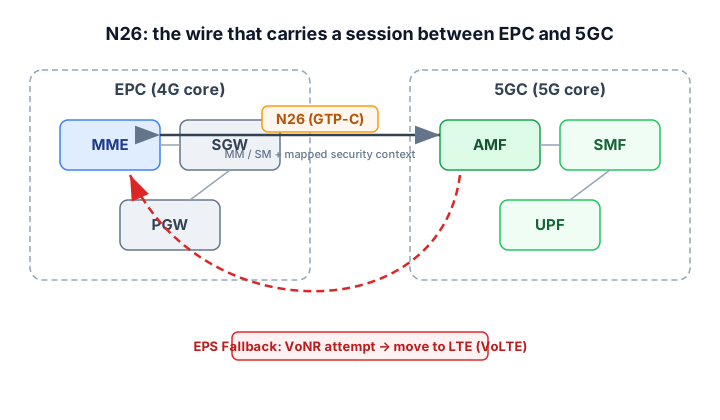
- Dual-registration and interworking: SA supports N26 interface-based interworking with EPC for seamless LTE fallback, or non-N26 with session continuity via SSC modes (per 3GPP TS 23.502 clause 4.11).
Migration Considerations
Operators moving from NSA to SA face several challenges:
- VoNR readiness: SA requires either VoNR (IMS over NR) or EPS Fallback (temporary drop to VoLTE for calls). VoNR requires IMS upgrades and new UE firmware.
- Coverage parity: SA drops the LTE anchor, so NR coverage must be sufficient for continuous service. Operators deploying SA on mid-band only face indoor coverage gaps.
- UE support: Not all 5G UEs support SA mode. Early NSA-only chipsets (e.g., Qualcomm X50) cannot operate on SA networks.
- Core transformation: Migrating from EPC to 5GC is a multi-year project involving containerization (CNFs vs VNFs), cloud-native platforms, and SBA interface integration.
Summary
The NSA-to-SA migration is the most significant architectural transition in 5G deployment. NSA provided a fast path to 5G speeds by reusing existing EPC infrastructure, but SA unlocks the full 5G feature set -- slicing, URLLC, edge computing, and API exposure. With operators like T-Mobile, China Mobile, and Jio running production SA networks at scale, the industry inflection point has passed. Understanding both architectures, the EN-DC bearer model, and the migration trade-offs is essential for anyone designing, deploying, or certifying 5G networks.
What SA actually changes, procedure by procedure
The architectural difference shows up as a different registration. In SA the UE
registers with a 5G core over NAS, and
registration failure — free with an
account — is that procedure caught failing, which is a faster way to learn its
shape than reading it succeed.
5G registration has the message flow, and
the Core & E2E specialist track
covers the standalone core end to end.