Emerging Tech 11 min readJul 14, 2026Updated Oct 16, 2026
5G RedCap vs eRedCap: A Deployment and Tier-Selection Guide
By Gaganpreet Walia
CEO, TELCOMA Global · 21+ years in telecom
RedCap is a decision, not a feature
Most of the published material on Reduced Capability NR answers one question: what is it? The bandwidth trims, the receive-chain reductions, the throughput math, the chipset names — that is settled ground, and our explainer on 5G RedCap (NR-Light) covers the device-class specifications and worked peak-rate calculations in detail. Read it if you need the numbers.
This guide answers the harder question working engineers actually face: given a device, which connectivity tier should it use, and what does committing to RedCap or eRedCap force you to build? That is a selection problem layered on a deployment problem, and getting either wrong is expensive — you either overpay for a smartphone-grade modem on a sensor, or you strand a ten-year asset on a radio tier the network never enables.
The short version: RedCap (3GPP Release 17) and eRedCap (Release 18, part of 5G-Advanced) create two new rungs between low-power wide-area IoT and full 5G NR. They are genuinely useful — but only when the application sits in their band and the network underneath them is a real 5G standalone deployment. The decision and the deployment are inseparable. Treat RedCap as a procurement checkbox and it will disappoint; treat it as an end-to-end design choice and it earns its place.
The seven-tier selection problem
Before RedCap existed, cellular IoT forced a compromise. NB-IoT and LTE-M cover the low-power, low-rate floor — meters, trackers, simple telemetry — but they choke on richer flows like event-driven video clips, multi-sensor gateways, or wearable telemetry with frequent sync. LTE Cat-1 and Cat-4 cover the mid-range, but they tie a new long-life device to LTE at exactly the moment many operators are planning spectrum refarming. Full NR covers everything above that, at full cost, power, and antenna complexity.
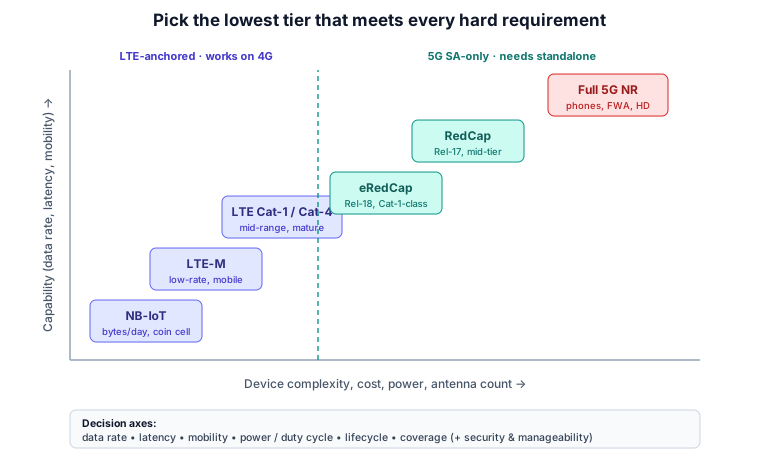
RedCap and eRedCap fill the gap deliberately. The result is a seven-tier ladder, and the engineering job is to place each device on the right rung using six independent axes: data rate, latency, mobility, power/duty cycle, expected lifecycle, and coverage (with security/management as a seventh practical filter).
Figure 1 — Cellular IoT tier-selection map: NB-IoT, LTE-M, LTE Cat-1/4, eRedCap, RedCap, and full NR positioned by capability versus device complexity, with the six decision axes that move a device between rungs.
The single most useful framing is directional, not absolute: pick the lowest tier that satisfies every hard requirement, then stop. Climbing one rung higher than necessary is the most common and most costly error in cellular IoT, because each rung up adds modem cost, RF complexity, antenna constraints, power draw, and certification effort that a moderate-performance device will never use.
A practical reading of the ladder:
Sends a few bytes per day, must last years on a coin cell, deep-indoor or buried. This is NB-IoT territory. RedCap is the wrong tool — it is lower-complexity 5G, not a low-power LPWA technology, and it will not match NB-IoT's coverage or battery profile. (Confidence: high — this matches 3GPP's positioning of RedCap relative to LPWA.)
Low-rate mobile telemetry, occasional voice, modest payloads. LTE-M still fits, and its ecosystem is mature.
Mid-rate, long-life, and you want off the LTE-refarm risk curve. This is the eRedCap / RedCap decision — see below.
Sustained high throughput, continuous HD streaming, premium handset or FWA-class CPE. Full NR. RedCap cannot carry it, and forcing it there just degrades the experience.
For the formal capability comparison across these tiers — bandwidths, MIMO branches, duplex modes, target costs — defer to the explainer's device-class table; reproducing it here would only invite drift between two pages. The companion catalogue of real-world 5G use cases is the better cross-reference when you are mapping a specific vertical (manufacturing, healthcare, logistics) to a service tier.
RedCap vs eRedCap: where the line actually falls
RedCap and eRedCap are not two flavours of the same thing — they are two deliberately separated cost-and-capability points, and the roadmap matters as much as the spec.
RedCap (Release 17) is the mid-tier. It targets devices that have outgrown LPWA but do not justify full NR: wearables, cameras with controlled upload behaviour, industrial gateways, enterprise handhelds. Release 17 is frozen, so RedCap is the more mature of the two.
eRedCap (Release 18) pushes lower, toward the segment historically served by LTE Cat-1 and Cat-1bis — the place where cost and simplicity dominate but a 5G migration path is still desirable. This is the strategically interesting rung: it is where 5G starts to credibly displace legacy LTE IoT categories rather than just sitting above them.
The decision between them is rarely "which is newer." It is:
What does the application genuinely need? If a device is happy at Cat-1-class rates and cost is the binding constraint, eRedCap is the target tier. If it needs the headroom of the RedCap mid-tier, pay for RedCap.
What is mature in your market? Release 17 RedCap is ahead of Release 18 eRedCap on availability, certification, and module pricing. eRedCap should be planned as a roadmap tier — its addressable market opens up as modules, certification, network support, and roaming mature, and that pace varies by region. (Confidence: medium — directional from the standardization timeline; exact regional availability is a moving target you should re-verify at procurement time.)
What lifecycle are you committing to? A device deployed for five to ten years should be matched to the tier that will still be well-supported at the end of its life, not just at launch. That argument generally favours the 5G tiers over a fresh LTE-only build — but only where 5G SA coverage will actually exist for the device's whole service life.
The downstream evolution is worth keeping in view but not overstating: ambient IoT in 6G addresses the battery-less, zero-energy floor below NB-IoT — a different problem entirely. It is not an eRedCap successor and should not be designed into a 2026 deployment as if it were available.
The hidden commitment: RedCap means 5G standalone
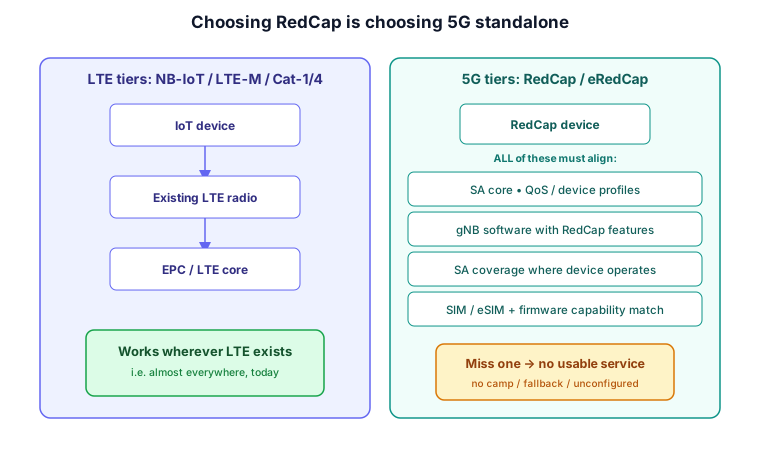
Here is the part that turns a tier choice into an architecture decision, and the one most easily missed in a vendor briefing: RedCap and eRedCap are standalone-only. They live inside the 5G NR radio and the 5G core. There is no NSA RedCap path that leans on an LTE anchor. Choosing RedCap is therefore choosing — and depending on — a real 5G SA deployment for every device, for its whole life.
Figure 2 — The 5G SA commitment: a RedCap device only works when SA core, RAN feature support, and aligned SIM/firmware all line up, whereas LTE-anchored tiers ride existing 4G assets.
This is the cleanest way to separate the LTE tiers from the 5G tiers in a selection conversation:
NB-IoT, LTE-M, LTE Cat-1/4 ride existing 4G assets. They work wherever you have LTE, which today is almost everywhere.
RedCap, eRedCap need SA coverage where the device operates, gNodeB software that actually implements the relevant reduced-capability features, a core configured with the right QoS flows and device profiles, and SIM/eSIM provisioning plus module firmware that all agree on capability. Miss any one of those and the device does not get a usable RedCap service — it may not camp, may fall back, or may register but never get the configuration it needs.
The practical consequence runs in two directions. For an enterprise, RedCap is a strong fit inside a private network you control — a private 5G campus is SA by construction, the coverage is yours to guarantee, and you can validate RAN feature support and provisioning end to end. RedCap is what broadens that campus device ecosystem beyond expensive routers and phones to sensors, cameras, gateways, and wearables on the same managed network. On a public network, RedCap value tracks SA rollout directly: strongest where macro SA coverage is real and feature-complete, weaker and slower where SA is still patchy or NSA-dominated.
There is a second-order point operators care about: RedCap is also a lever to manage LTE-refarm risk. Every new device you put on a 5G tier instead of a fresh LTE Cat-1 build is one fewer long-life asset anchored to spectrum you may want to reclaim. But that lever only pays off if SA coverage genuinely keeps up with the devices' service life — otherwise you have traded a known LTE dependency for a coverage gamble.
The end-to-end rollout, not a device swap
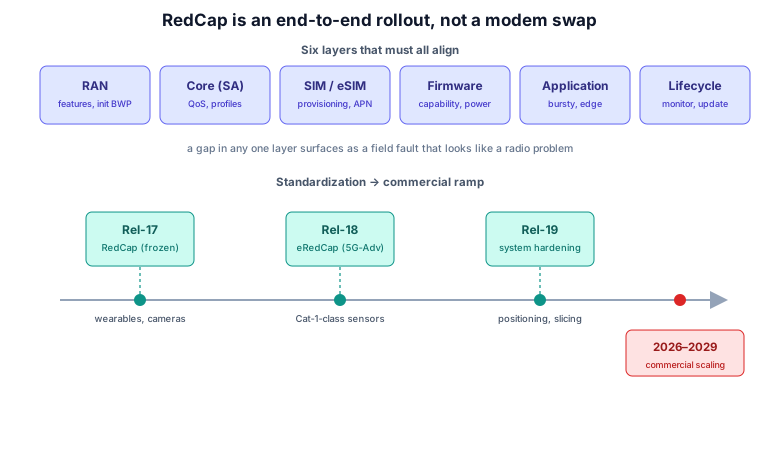
The most reliable way to fail at RedCap is to treat it as a module substitution — drop a RedCap modem into last year's LTE design and ship it. RedCap is an end-to-end productization across six layers, and a gap in any one of them surfaces as a field problem that looks like a radio fault but is not.
Figure 3 — RedCap rollout stack and roadmap: the six alignment layers (RAN, core, SIM/eSIM, firmware, application, lifecycle) above the Release 17 → 18 → 19 evolution feeding the 2026–2029 commercial ramp.
The six layers that must line up:
RAN — gNodeB hardware and software release supporting the required RedCap capabilities, a dedicated initial bandwidth part so the device can complete initial access within its narrower capability, and spectrum/band and channel-bandwidth choices suited to the target devices.
Core — SA core with QoS flows, charging, slicing where used, and device/subscription profiles defined for RedCap services rather than inherited from handset templates.
SIM / eSIM — provisioning that asserts the right capability and subscription, private APN or enterprise policy where required.
Firmware — module firmware whose capability signalling, power-saving behaviour, and band support match what the network expects; firmware quality is a first-order determinant of real battery life and reliability.
Application — traffic design that fits the tier (bursty/event-driven uploads, edge processing to cut what is sent), not sustained broadband assumptions.
Lifecycle — the ability to monitor, troubleshoot, update firmware, and replace devices at scale over a multi-year deployment.
A short, blunt operator readiness check: Is SA coverage real where the customer's devices will live? Do the gNB software releases implement the needed RedCap features, not just claim Rel-17 support? Are RedCap-specific QoS, charging, and device profiles defined in the core? Is there a device onboarding and interoperability test process? Have battery and coverage assumptions been tested under real indoor/factory/edge-of-cell conditions rather than near a test cell? Are tariffs aligned to mid-range IoT economics rather than handset ARPU? The recurring failure mode is treating RedCap as a radio feature and skipping the commercial and operational layers.
A matching enterprise readiness check, starting from the requirement rather than the technology: Does the device need more than LPWA but less than full NR? Is latency or mobility important enough to justify 5G integration at all? What is the real duty cycle and battery target? Will the device live long enough to benefit from a 5G roadmap? Is SA available where it must operate — and if not, can you provide it privately? Do you need SIM/eSIM authentication, a private APN, or slicing? Can your team manage firmware, profiles, failures, and replacements? If a device sends a few bytes a day and must last a decade, NB-IoT is still the better answer; if it streams continuous HD, full NR is. RedCap and eRedCap are strongest in the middle — and only there.
If you want to build this judgement hands-on rather than from a checklist, start a free 7-day trial — no card — and work a RedCap device through SA registration, core QoS policy, and a private 5G config end to end.
Business value, risks, and the 2026–2029 staging
The value case for RedCap is precision, not peak speed. It shows up in four places: it stops overengineering (no smartphone modem on a sensor); it extends 5G monetization beyond phones and fixed wireless into enterprise, utility, logistics, and healthcare device fleets; it gives long-life deployments a more future-facing connectivity layer than a fresh LTE-only build; and it strengthens the private 5G business case by widening the device ecosystem that a campus network can actually serve.
The risks are the mirror image and deserve equal airtime:
Ecosystem maturity. The LTE IoT ecosystem is mature; RedCap module availability, pricing, certification, and carrier support are still catching up, unevenly by region. eRedCap trails RedCap on all of these.
SA dependency. The whole value proposition rests on SA. Where SA coverage is limited, RedCap adoption is correspondingly limited — this is a hard gate, not a soft preference.
Coverage and power assumptions. Battery life and radio performance swing hard with coverage quality. A device that behaves well near a cell can behave very differently underground, deep indoors, or at cell edge. Test the real environment.
Application misfit. Used where LPWA suffices or where full NR is truly needed, RedCap is the wrong call in both directions.
Roaming and interoperability. Long-life IoT crosses operators, regions, and firmware versions; validate provisioning, roaming, and failure handling before scaling.
On staging, the honest near-term picture is sequenced, not a cliff-edge. The strongest early opportunities are enterprise and industrial cases where SA coverage already exists and device volumes justify the integration work — private campuses, utilities, logistics, controlled-upload cameras, and enterprise wearables. As module pricing falls and more operators enable support, RedCap becomes a mainstream mid-range cellular IoT option; eRedCap then extends the addressable market down toward the device classes that rely on LTE Cat-1 and Cat-1bis today. Release 19 and later 5G-Advanced work continue hardening the system around these devices — positioning, energy efficiency, slicing, NTN integration — which is the broader point: 5G is becoming a layered connectivity platform, and RedCap and eRedCap are the rungs that make the layering real for ordinary devices. (Confidence: the direction is well-supported by the standardization roadmap; specific market-size and device-count figures are deliberately omitted here because they are not reliably verifiable and not load-bearing for the decision.)
Recommendations by role
Operators. Build a RedCap product strategy before demand arrives at scale — SA coverage planning, RAN software validation, device certification, IoT tariffs, enterprise onboarding, and operational monitoring. Position it precisely: RedCap is the 5G tier for mid-range devices that need more than LPWA and less than full NR, not a generic replacement for all IoT.
Enterprises and private-network owners. Map your device classes against the six axes first, then select tiers. RedCap belongs on devices that need managed 5G but cannot justify full NR — and a private 5G case gets materially stronger once the network serves cameras, wearables, sensors, and gateways at realistic cost points, not just routers and phones.
Device OEMs and module vendors. Treat RedCap as a product-design exercise, not a modem swap — antenna, battery strategy, firmware behaviour, thermal design, certification, and lifecycle management all move the final value. Plan a portfolio: LPWA for simple sensors, eRedCap for lower-complexity 5G IoT as it matures, RedCap for the mid-range, full NR at the top.
Engineers and learners. RedCap is the cleanest single topic that ties radio capability, core-network policy, device design, IoT economics, and 5G-Advanced evolution together. The progression that works: study SA registration and UE capability signalling, compare the LPWA / LTE IoT / RedCap / full-NR tiers, learn QoS flows and slicing for private 5G, then evaluate real devices against data rate, latency, power, mobility, and lifecycle. The Level 17 — 5G-Advanced track walks that path with labs.
Bottom line
RedCap and eRedCap are not about making every IoT device 5G. They are about making the right devices 5G without overbuilding them — and about being honest that the moment you choose them, you have chosen 5G standalone and an end-to-end rollout to go with it. Select the lowest tier that meets every hard requirement, confirm SA coverage will outlive the device, productize across RAN, core, SIM, firmware, application, and lifecycle, and RedCap delivers exactly what it promises: 5G-grade integration at IoT-appropriate cost. Skip any of those steps and it will not.
The features, and whether they are in your network