Emerging Tech 7 min readJun 30, 2026Updated Oct 15, 2026
The Road to WRC-27: Where 6G Spectrum Actually Gets Decided
By Gaganpreet Walia
CEO, TELCOMA Global · 21+ years in telecom
Watch the treaty conference, not the keynote
If you cut your teeth on LTE, you know the feeling. A band that looked perfect on paper turns out to be carved into regional slivers, half-occupied by incumbents, and usable for roaming only after years of harmonization work. That experience is the right lens for 6G. The headlines will be about terabits and sub-terahertz demos. The thing that actually decides where 6G coverage lives is a treaty conference in 2027, and the groundwork is being laid right now.
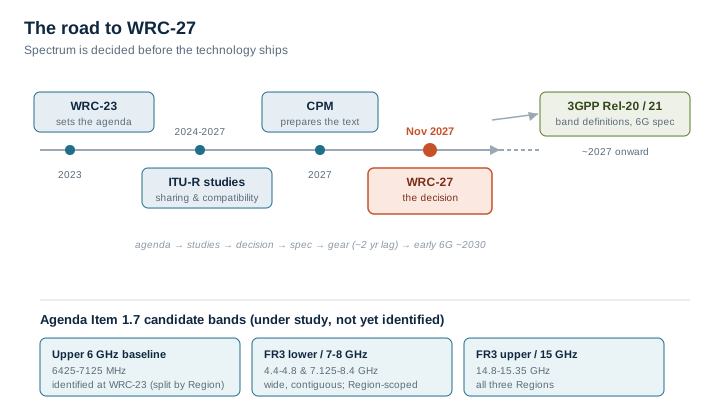
Timeline from the WRC-23 agenda through CPM and the WRC-27 conference (Nov 2027) into 3GPP Rel-20/21, with the Agenda Item 1.7 candidate 6G bands as a side rail.
The argument here is blunt: watch the World Radiocommunication Conference, not the trade-show keynote. A 6G speed record over 6 GHz of bandwidth at 140 GHz proves physics. It tells you nothing about where you will actually buy coverage. For that, you watch WRC-27.
What the WRC is, and why it gates everything
The World Radiocommunication Conference is the ITU treaty meeting, held roughly every four years, where the world's administrations revise the Radio Regulations. Two outputs matter to mobile.
The first is the allocation — which services may use a band at all. The second, more specific, is IMT identification: a footnote in the Radio Regulations marking a band as suitable for International Mobile Telecommunications. Identification is the gate. Until a band is identified for IMT in your Region, it is not part of the harmonized mobile ecosystem — and harmonization is what creates the device volumes, the chipsets, and the roaming that make a band economically real.
So a band is not usable just because a vendor demoed it. What turns a frequency into a deployable, ownable, roamable mobile band is the WRC, plus IMT identification, plus 3GPP band definitions — the machinery that delivers economies of scale. That chain, from spectrum allocation through 3GPP releases, is exactly why WRC-27 outweighs any single 6G milestone.
WRC-23: the baseline we build on
WRC-23 was a strong outcome for mobile and it sets the floor. Governments finalized harmonization of the 3.3-3.8 GHz mid-band — the 5G pioneer band, and one of the workhorse 5G frequency bands — across EMEA and the Americas, and added low-band roadmap items around 600 and 700 MHz (the low bands still need national follow-through).
The headline was the upper 6 GHz band, 6425-7125 MHz, identified for the terrestrial component of IMT — but not uniformly. The identification split by Region:
Region
What was identified
Region 1 (Europe, Middle East, Africa)
Full 6425-7125 MHz for IMT, band also kept available for RLANs (Wi-Fi)
Region 3 (Asia-Pacific)
Only the upper 100 MHz (7025-7125 MHz) broadly; 6425-7025 MHz by footnote for a few countries
Region 2 (Americas)
By individual-country footnote; Mexico and Brazil reported among those taking 6425-7125 MHz
Hold onto that picture, because it is the template for the fight ahead. Even a "win" produced a patchwork, not a single global band. And critically, WRC-23 did not just decide — it set homework. It adopted the resolutions that point the next conference at the bands 6G actually wants.
The WRC-27 agenda is a pipeline, not a press release
Here is the mental model that keeps the timeline honest. WRC decisions move through a pipeline. An agenda item (set at the previous conference) commissions studies — sharing and compatibility analyses run inside the ITU-R study groups over the cycle — and only then, at the conference itself, comes a decision to identify a band or not. WRC-23 set the agenda items; the 2024-2027 cycle runs the studies; WRC-27 makes the calls. Identification is the start of availability, not the end.
The headline WRC-27 item for mobile is Agenda Item 1.7, established by Resolution 256 (WRC-23). It directs studies toward IMT identification in the upper-mid-band, and — as with 6 GHz — the candidate bands are scoped by Region:
4400-4800 MHz, or parts thereof, in Region 1 and Region 3
7125-8400 MHz, or part thereof, in Region 2 and Region 3; and in Region 1, the narrower 7125-7250 MHz plus 7750-8400 MHz
14.8-15.35 GHz in all three Regions
That is the FR3 prize, expressed as a treaty agenda. These are bands under study, not bands already identified — the whole point of the cycle is to determine which slices, if any, survive the compatibility analysis. Qualify accordingly when you cite them.
Agenda Item 1.7 is not the only mobile-relevant item. The same WRC-23 resolutions opened studies on satellite-to-handset connectivity — the "direct-to-device" concept under Agenda Item 1.13 (Resolution 253) — and additional mobile-satellite allocations under Agenda Item 1.14 (Resolution 254). For anyone tracking the 5G-to-6G NTN story, those are the items that decide whether your phone talks to a satellite by treaty rather than by one operator's proprietary arrangement.
Why FR3 / 7-15 GHz is the prize
Walk the dial from left to right and the logic is unavoidable.
Low bands carry far but hold little data.
C-band around 3.5 GHz is the 5G workhorse — a fine compromise, and already full.
Millimeter-wave (FR2) offers enormous bandwidth but propagates so poorly it never escaped hotspots. A decade of mmWave deployments learned that the hard way.
Sub-terahertz, the favorite of 6G hype, is bandwidth heaven and coverage hell — a research frontier, not a coverage layer this decade. The physics of sub-THz make that clear.
That leaves the upper-mid-band, increasingly called FR3, roughly 7.125 to 24.25 GHz, with the 7-to-15 GHz centimetric stretch as the target. It is the one region of the dial that still offers wide, contiguous channels while propagating well enough to build a real network. The 7125-8400 MHz range is especially coveted because it is wide and contiguous — a clean, large block that is hard to assemble anywhere else.
The engineering that makes FR3 viable is a direct extension of 5G's massive MIMO: arrays grow from "massive" toward "gigantic," hundreds of elements forming pencil beams sharp enough to claw back the higher path loss. The working goal vendors frame for the band is coverage parity from existing C-band grids, so operators can reuse sites instead of building new ones. That single question — can FR3 reuse the C-band grid? — is what the trials are really testing. If it cannot, the economics collapse. If it can, FR3 becomes 6G's primary capacity layer. This is the realistic 6G workhorse, not sub-THz. (If you want the full IMT-2030 picture around it, you can start a free 7-day trial — no credit card.)
The contention: spectrum is a negotiation
The catch is that the golden band is not empty. It is full of services that were there first, and identifying it for IMT means proving — band by band, in years of sharing-and-compatibility studies — that mobile can coexist without harming them.
The incumbents to protect across the Agenda Item 1.7 candidates include fixed-satellite (FSS) and mobile-satellite (MSS) systems, Earth-exploration satellites (EESS — the sensors behind weather and climate data), meteorological and space-research systems, terrestrial fixed links, and aeronautical mobile telemetry in 4400-4800 MHz. The 14.8-15.35 GHz band brushes up against radio astronomy in adjacent spectrum.
These tenants are formidable, and the satellite and scientific communities are organized and well-represented in the ITU process. None can simply be evicted; the scientific incumbents in particular have no commercial alternative. So the WRC-27 fight is not really about technology. It is about how many decibels of protection the incumbents require, and whether IMT can live inside that envelope. There is a third party at the table in 6 GHz, too: the Wi-Fi and unlicensed community, which fought hard at WRC-23 to keep the band open for RLANs and will keep pressing its case.
Mobile, satellite, defense, fixed links, science, and unlicensed are all pulling on overlapping bands. The realistic WRC-27 outcome is therefore conditions and a patchwork, not a clean global allocation — which means early 6G devices may face the same band-fragmentation tax that dogged every prior generation.
The engineer's takeaway timeline
Chain the clocks together and the planner's calendar falls out.
When
What happens
Nov 2027
WRC-27 makes the call — which bands, which Regions, under what protection conditions. The real 6G scoreboard.
Then
3GPP turns identifications into NR/6G band definitions (n-numbers and their successors). No 3GPP definition, nothing to buy.
+ ~2 years
The freeze-to-field lag: spec to commercial gear is roughly a two-year affair.
~2030
Early-6G deployments, with meaningful scale a 2031-2032 story as fragmentation and ecosystem maturity sort themselves out.
This lines up with the broader IMT-2030 / 6G timeline: study items in Release 20 around 2027, with Release 21 as the first 6G normative spec.
So when someone shows you a speed record at 140 GHz, file it under physics, not coverage. To know where 6G coverage will actually live, watch WRC-27 — which slices of 4.4-4.8, 7.125-8.4, and 14.8-15.35 GHz get identified, in which Regions, with what conditions. Global harmonization through the WRC and IMT identification is what creates the chipsets, the volumes, and the roaming. That, not any single demo, is why this conference is the one to watch.
The radio keeps getting more capable. Reading honestly which band, which Region, and against whose objections is the skill that does not go out of date — and for the next four years, the answer to "where does 6G live?" is being decided in a treaty room, one decibel at a time.
Spectrum you can plan against today
Allocation decisions at WRC take years to reach a network. What you can act on