Emerging Tech 14 min readJul 8, 2026Updated Oct 15, 2026
Direct-to-Device Satellite over 5G NTN: The Engineering and the 2026 Scoreboard
By Gaganpreet Walia
CEO, TELCOMA Global · 21+ years in telecom
The waveform survived; the timeline didn't
NR did not need a new waveform to work from orbit. The OFDM numerology, the channel coding, the frame structure — all of it survives the trip to a satellite intact. What broke were the timers. Every timing relationship in NR was dimensioned around a terrestrial assumption that almost nobody writes down explicitly: round-trip time under roughly a millisecond. Take that assumption away and the air interface still transmits, but timing advance, the random-access response window, HARQ stop-and-wait, and the RLC retransmission timers all fall apart one by one.
That is the real story of 3GPP Non-Terrestrial Networks (NTN). Release 17 is not a new radio — it is a careful re-dimensioning of NR's hidden terrestrial assumptions so the same waveform closes a link to something 600 km to 35,786 km away. This article works through the physics that breaks (with the exact TR 38.821 numbers), the Rel-17 mechanisms that fix each break, the transparent-versus-regenerative payload debate that shaped Rel-19, the spectrum NTN actually runs in, and the 2026 direct-to-device (D2D) commercial scoreboard. For the orbit/architecture taxonomy and HAPS/UAS context, the companion NTN architecture overview is the place to start; this pillar goes after the device-side D2D story and the spec-level mechanics underneath it.
Why NR almost works from orbit — the four things that break
3GPP's feasibility study, TR 38.821, defines four reference scenarios: A = GEO transparent, B = GEO regenerative, C = LEO transparent, D = LEO regenerative, with GEO at 35,786 km and LEO modelled at 600 km and 1,200 km. Read the worst-case numbers from that study and the engineering problem becomes obvious.
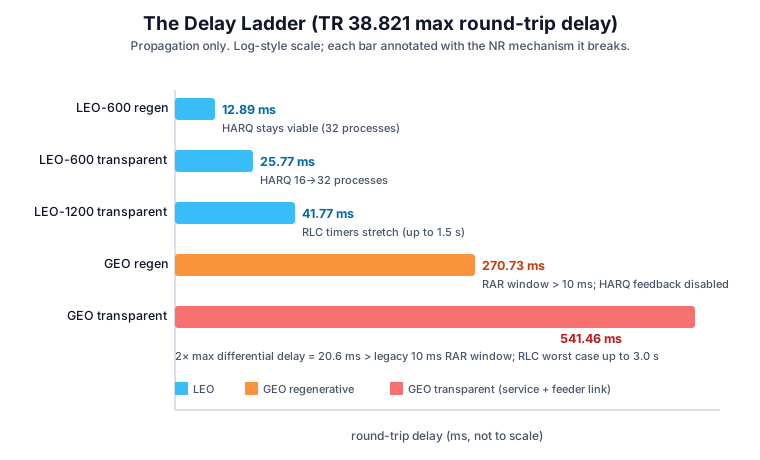
Delay. Maximum propagation round-trip delay is 541.46 ms for GEO transparent (service plus feeder link), 270.73 ms for GEO regenerative (service link only), 25.77 ms for LEO 600 km transparent, 41.77 ms for LEO 1,200 km transparent, and 12.89 / 20.89 ms for the LEO regenerative cases. The minimum RTD bottoms out at 8 ms for LEO 600 km. Terrestrial NR assumes a fraction of a millisecond. That gap is what every downstream fix is paying for.
Figure 1 — The delay ladder: TR 38.821 maximum round-trip delay by reference scenario, annotated with which NR timing mechanism each value breaksDifferential delay, not absolute delay, breaks RACH. Within a single NTN cell the spread between the nearest and farthest UE is up to 10.3 ms at GEO and 3.12 / 3.18 ms at LEO 600 / 1,200 km. TR 38.821 notes that twice the GEO maximum differential delay — 20.6 ms — already exceeds the legacy 10 ms random-access response window. The RAR window has to stretch, and the timing-advance architecture has to absorb the rest.
Doppler. For an earth-fixed UE the maximum Doppler shift is 24 ppm at 600 km (which works out to about ±48 kHz at 2 GHz — a derived figure, not a spec value), 21 ppm at 1,200 km, and 0.93 ppm at GEO. Doppler variation reaches 0.27 ppm/s at 600 km, with delay variation up to ±40 µs/s, driven by a LEO ground-relative speed of 7.56 km/s. A satellite that races across the sky moves the carrier under you continuously, so pre-compensation cannot be a one-shot value.
HARQ. NR's stop-and-wait HARQ assumes the feedback comes back before the buffer drains. With 16 processes and a sub-millisecond RTT that is fine. At 25.77 ms (LEO) or 541.46 ms (GEO) the transmitter stalls waiting for acknowledgements it cannot receive in time. TR 38.821's own RLC analysis makes the consequence concrete: with maxRetxThreshold in the (1, 4) range, worst-case retransmission times round up to 75 ms / 150 ms / 1.5 s / 3.0 s across the scenarios — which is exactly why the MAC/RLC/PDCP timers had to be re-dimensioned.
The handheld assumptions baked into all of this are deliberately brutal: an omnidirectional 0 dBi antenna, power class 3 at up to 200 mW (23 dBm), a 7 dB noise figure, 10° minimum elevation, and a maximum slant range of 1,932 km at the 600 km orbit. Hold those numbers; they decide what a phone can actually do later in this article.
The Rel-17 toolkit
Release 17 fixes each break with a named mechanism. None of them touch the waveform.
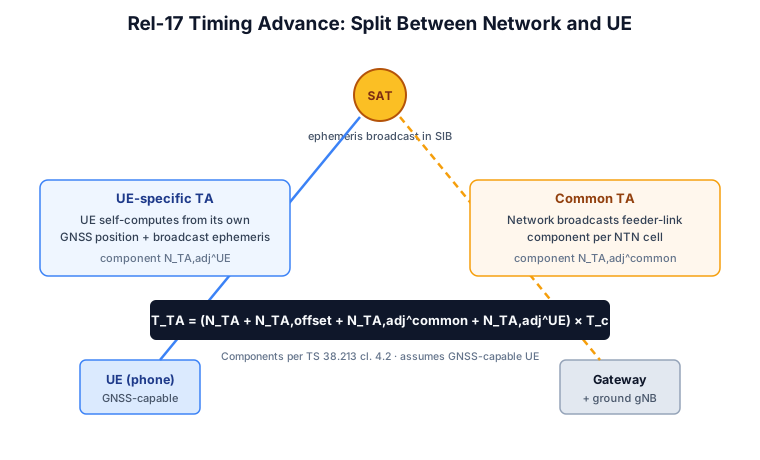
Timing advance, inverted. Classical cellular has the network measure timing and command the UE. NTN inverts that. Rel-17 splits TA into a broadcast common TA — the satellite/feeder-link component, derived from satellite ephemeris and common-TA parameters broadcast per NTN cell — plus a UE-specific TA that the UE computes itself from its own GNSS position and the broadcast ephemeris. The total takes the form T_TA = (N_TA + N_TA,offset + N_TA,adj^common + N_TA,adj^UE) × T_c. The component definitions live in TS 38.213 clause 4.2; the working assumption is a GNSS-capable UE rather than a hard "GNSS required," but in practice a phone with no fix has nothing to compute its TA from. That single-point dependency is worth scrutinising in any NTN design review.
Figure 2 — Rel-17 timing-advance anatomy: broadcast common TA for the feeder link versus UE-self-computed TA from GNSS plus broadcast ephemerisK_offset. A configured scheduling offset added to NR's timing relationships — for example PUSCH timing after a DCI grant, or CSI after a grant — so the network does not expect a response before the signal could physically have made the round trip. A cell-specific value is broadcast and UE-specific updates are possible. The common rule of thumb that K_offset is dimensioned to roughly the service-link RTT plus the common TA is a sizing heuristic from engineering practice, not normative text; treat it as guidance, not a spec quotation.
HARQ, two ways. Rel-17 lets the network disable DL HARQ feedback on a per-process basis — falling back on RLC ARQ, which is the GEO-friendly option where waiting for HARQ acknowledgements is hopeless — and/or extend the number of HARQ processes from 16 to 32, the LEO-friendly option that keeps more transactions in flight to hide the shorter RTT. The relevant timers across MAC, RLC and PDCP are stretched to match the delay ladder above.
The through-line: Rel-17 surfaced NR's terrestrial assumptions and re-parameterised them. Nothing about the modulation, coding, or numerology changed. If you want the building block underneath — how subcarrier spacing and timing scale in the first place — the 5G frequency-bands primer covers the FR1/FR2 split that NTN bands slot into, and the 3GPP release timeline places Rel-17/18/19 in sequence.
Transparent vs regenerative — bent pipe was a choice
Rel-17 and Rel-18 NTN are specified for the transparent ("bent-pipe") architecture only: the gNB stays on the ground, and the satellite is an RF repeater. TR 38.821 studied regenerative payloads back in 2019 (scenarios B and D), but normative work deliberately shipped transparent-only — a choice to limit payload complexity and get a deployable system out the door, not a limitation of the standard.
For Rel-19, 3GPP went the other way. After roughly a year of debate spanning four TSG RAN meetings (the decision landed in December 2023, per Ericsson's account of the process), the group chose to put a full gNB on board rather than split off a DU. A full regenerative gNB natively supports inter-satellite links, inter-satellite mobility, and store-and-forward operation, and it cuts the round-trip for every procedure because the gNB is no longer at the far end of a feeder link. The engineering question underneath — where do you cut the RAN when your fronthaul is the feeder link? — is the cleanest illustration of the CU/DU/RU functional-split trade-off you will find.
Rel-19 NTN, which 3GPP describes as reaching fully implementable specifications at the end of December 2025 (RAN1 functional freeze June 2025, RAN2/3/4 September 2025), adds on top of the regenerative payload: store-and-forward for delay-tolerant IoT with no live feeder link, RedCap device support in FR1-NTN, downlink coverage enhancement via control-channel repetition, uplink capacity gains through orthogonal cover codes, and UE-to-satellite-to-UE communication carrying IMS voice/video within a single PLMN. RedCap in orbit is the one to watch for the wearable and sensor tier — see RedCap (NR-Light) for why a reduced-capability device is the natural fit for narrowband satellite links.
Spectrum reality
NTN runs in two distinct spectrum worlds, and conflating them is the most common mistake in D2D coverage.
FR1-NTN (handsets), Rel-17. Two FDD bands in TS 38.101-5: n255 (L-band, UL 1626.5–1660.5 / DL 1525–1559 MHz) and n256 (S-band, UL 1980–2010 / DL 2170–2200 MHz) — licensed mobile-satellite-service (MSS) spectrum. IoT-NTN (NB-IoT/eMTC over satellite) is a Rel-17 feature, but note the spec lineage: its RF operating-band specification, TS 36.102, exists only as a Release 18 document — there is no Rel-17 version in the 3GPP archive. So the IoT-NTN feature is Rel-17 while its band spec is Rel-18; state it that way.
FR2-NTN (fixed terminals, not phones), Rel-18. Rel-18 opened NR-NTN above 10 GHz with Ka-band bands n510 / n511 / n512, FDD. The downlink is 17.3–20.2 GHz — that is the verified TS 38.101-5 value; 17.7 GHz does not appear in the spec. The uplink is per-band: n510 27.5–28.35 GHz, n511 28.35–30.0 GHz, n512 27.5–30.0 GHz; the often-quoted "27.5–30 GHz" is only the n512 envelope, not a single shared range. These bands carry RF requirements for VSAT-class UE types and RRM for steered-beam terminals — which is the whole point: FR2-NTN is for fixed and mounted terminals, never handsets. Rel-18 also added handheld UL coverage enhancements, NTN↔TN and NTN↔NTN mobility/service continuity, and network-verified UE location using multi-RTT measurements with a single satellite (a regulatory requirement).
The regulatory layer that unlocked D2D. Separately from 3GPP MSS spectrum, the FCC adopted its Supplemental Coverage from Space (SCS) framework on March 14, 2024 — the first such framework worldwide — with rules effective May 30, 2024. SCS lets satellite operators lease terrestrial mobile spectrum from carriers and re-radiate it from orbit. That is the legal foundation for the entire "your existing phone, your carrier's band, from space" model, and it is why the 2026 scoreboard splits cleanly into two camps.
The two religions of direct-to-device
There are two architectures competing for the same phones in 2026, and they are not minor variants — they are different religions.
3GPP NTN over MSS spectrum. Standards-native NTN (NB-IoT-NTN or NR-NTN) operating in licensed MSS bands like n255/n256. Skylo is the clearest example. The trade is standards conformance and clean spectrum rights against the constraint of working within narrow MSS allocations.
Terrestrial waveform from space, under SCS. Take the carrier's existing terrestrial LTE/NR spectrum and re-radiate it from LEO under the FCC's SCS regime, brute-forcing the link with very large satellite apertures. Starlink/T-Mobile and AST SpaceMobile live here. The trade is reusing the phone's existing bands (no special MSS chain) against the engineering cost of closing a terrestrial waveform across a satellite link.
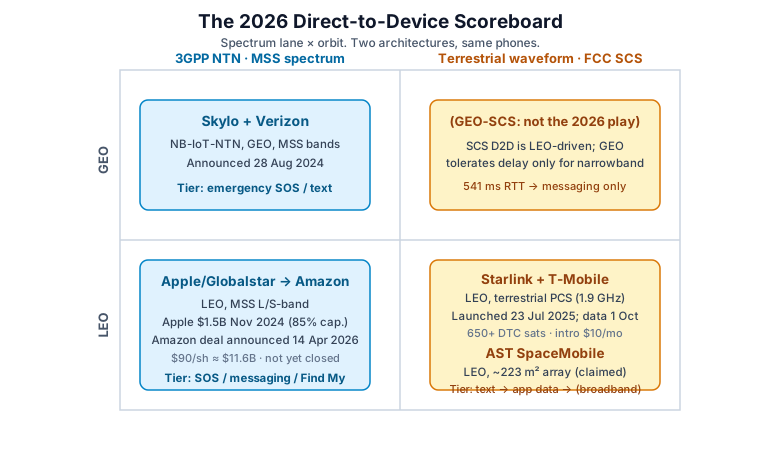
Figure 3 — The 2026 D2D scoreboard: MSS spectrum vs terrestrial-SCS spectrum on one axis, GEO vs LEO on the other, with each operator's launch date and capability tier
The dated scoreboard, as of mid-2026:
Skylo (Verizon) — GEO, MSS, 3GPP NB-IoT-NTN. Verizon and Skylo announced their partnership August 28, 2024, with emergency messaging and location sharing live that fall; Verizon billed itself as the first mobile carrier worldwide to commercially launch supplemental smartphone connectivity on an NTN. It runs standards-native NB-IoT-NTN over licensed MSS spectrum on GEO satellites. The contrarian point: the first commercial mass-market NTN service is GEO, at the worst RTT on the ladder — because NB-IoT's repetitions and narrowband tones tolerate the delay, and one GEO bird covers a continent. For the messaging tier, link closure and economics beat latency.
Starlink + T-Mobile ("T-Satellite") — LEO, terrestrial PCS under SCS. Commercial launch July 23, 2025 (SMS/MMS), with satellite data for approved apps from October 1, 2025. Pricing is an intro $10/month standalone (regularly $15, free on top-tier plans), open to AT&T and Verizon customers, running on T-Mobile PCS (1.9 GHz) spectrum across 650+ direct-to-cell Starlink satellites. This is terrestrial LTE re-radiated from LEO under SCS — not a 3GPP NTN band.
AST SpaceMobile — LEO, terrestrial spectrum under SCS, brute-force apertures. Granted FCC SCS authorization for commercial US service. BlueBird 6 (Block 2) launched December 23, 2025 with what the company describes as a roughly 223 m² array — the largest commercial communications array in LEO, per AST. The company reports a 98.9 Mbps peak demonstrated on a Block 1 satellite, targets intermittent nationwide US service in early 2026 (continuous later in the year) and 45–60 satellites by end-2026, with an AT&T/FirstNet beta in H1 2026 and a Verizon commercial agreement (October 2025) for service from 2026. Treat the 98.9 Mbps and 223 m² figures as company claims, not independent measurements — the underlying 8-K was not directly retrievable.
Apple/Globalstar → Amazon — LEO, MSS L/S-band. Apple committed $1.5 B to Globalstar in November 2024 ($400 M for a ~20% equity stake plus about $1.1 B for a new constellation), with Globalstar allocating 85% of network capacity to Apple. Then on April 14, 2026, Amazon and Globalstar announced a definitive merger at $90.00 per share (cash, or 0.3210 Amazon shares; cash capped at 40%) — valuing the deal at roughly $11.6 B — folding Globalstar into Amazon Leo while continuing to power iPhone and Apple Watch satellite features (Emergency SOS, messaging, Find My, roadside assistance). Note the precision the record demands: Apple's ~20% stake is in Globalstar's licensee entity, not Globalstar common stock; the deal was announced, not closed (close expected 2027); and Amazon intends to buy out Apple's stake.
The pattern across the scoreboard: 2026 is the year both religions went commercial at scale, and the Amazon-Globalstar deal shows hyperscalers buying directly into the MSS lane.
Link-budget reality for a 23 dBm phone
Why does texting work from space while broadband does not? The standardised handheld is the constraint: 23 dBm into a 0 dBi omnidirectional antenna with a 7 dB noise figure. Free-space path loss at 2 GHz, derived from the confirmed TR 38.821 geometry, runs about 154.0 dB at 600 km nadir, about 164.2 dB at the 1,932 km maximum slant range (10° elevation), and about 189.5 dB to GEO. That ~10 dB swing between nadir and low-elevation slant range, on top of an omni UE antenna, is the whole problem.
The uplink only closes with very large satellite receive apertures and narrowband allocations. Published analyses put satellite phased-array gains at roughly 20–30 dB, and distributed beamforming across cooperating satellites is one studied remedy — up to +6 dB from two satellites and +12 dB from four. The aperture arms race is observable in hardware: AST's Block 1 arrays (~64 m²) demonstrated roughly 10 Mbps in early tests and the 98.9 Mbps company-claimed peak, while Block 2 (~223 m²) targets higher rates. Starlink's first-generation direct-to-cell satellites deliver text plus narrowband app data; "5G speeds from space" are deferred to the announced V2 satellites (Starship-launched, ~1,200 satellites, claimed 100× data density) — all of which remain forward-looking vendor statements from MWC 2026, not delivered capability. For the full method behind these FSPL and MAPL numbers, work through the 5G link-budget guide; the takeaway here is structural — a 200 mW omni phone closes a narrowband uplink, and broadband needs apertures measured in hundreds of square metres.
If you want to internalise this end-to-end — the timing math, the HARQ trade, and the link budgets behind each capability tier — you can start a free 7-day trial (no card) and work the NTN modules with the worked examples.
What's next — Rel-19 to 6G
Rel-19 is the inflection point: the regenerative gNB-on-board, store-and-forward IoT, RedCap-in-NTN, and UE-to-satellite-to-UE voice/video move NTN from "emergency text fallback" toward a genuine connectivity tier. The open questions head into Rel-20 and 6G: how MEO constellations fit (TR 38.821 has no MEO reference scenario, so any "~33 ms one-way" figure is illustrative until sourced separately), how regenerative payloads scale across inter-satellite mesh, and whether the two religions converge as hyperscalers absorb MSS spectrum.
The durable engineering lesson is the one we opened with. NR's waveform was space-ready; its schedule was not. Everything Rel-17 through Rel-19 added to NTN is the cost of paying back a single hidden terrestrial assumption — RTT under a millisecond — multiplied across timing advance, RACH, HARQ, and the retransmission stack. Understand that, and the rest of NTN is bookkeeping.
Orbit is a latency decision
NTN latency is set by orbit before anything else, and the trade against
constellation size and handover rate is arithmetic rather than opinion. The