QoS in 5G: A Flow-Based Model
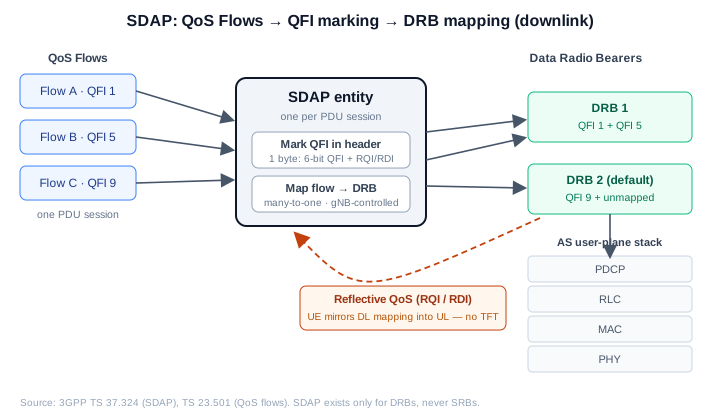
The 5G system introduces a flow-based QoS model that replaces LTE's bearer-based approach. Instead of mapping services to EPS bearers (each with a fixed QoS profile), 5G maps individual QoS flows within a PDU session, each identified by a QoS Flow Identifier (QFI) and associated with a 5G QoS Identifier (5QI).
This architecture is defined in TS 23.501 Section 5.7 and the detailed 5QI-to-QoS-characteristics mapping is specified in TS 23.501 Table 5.7.4-1. The flow-based model provides finer granularity, enabling a single PDU session to carry voice, video, and best-effort data simultaneously with different QoS treatment.
5QI: The QoS Classification System
A 5QI is a scalar value that serves as a pointer to a set of QoS characteristics:
- Resource Type: GBR (Guaranteed Bit Rate), Non-GBR, or Delay-Critical GBR
- Priority Level:
1 (highest) to 127 (lowest)
- Packet Delay Budget (PDB): Maximum one-way delay between UE and UPF N6 interface
- Packet Error Rate (PER): Maximum acceptable error rate for the flow
- Default Averaging Window: For GBR flows, the time window over which the bit rate is measured
- Default Maximum Data Burst Volume: For delay-critical GBR flows
Standardized 5QI Values — Complete Reference
| 5QI | Resource Type | Priority | PDB | PER | Example Service |
|---|
| 1 | GBR | 20 | 100 ms | 10⁻² | Conversational voice (VoNR) |
| 2 | GBR | 40 | 150 ms | 10⁻³ | Conversational video (live) |
| 3 | GBR | 30 | 50 ms | 10⁻³ | Real-time gaming |
| 4 | GBR | 50 | 300 ms | 10⁻⁶ | Non-conversational video (buffered) |
| 5 | Non-GBR | 10 | 100 ms | 10⁻⁶ | IMS signaling (SIP) |
| 6 | Non-GBR | 60 | 300 ms | 10⁻⁶ | TCP-based video (Netflix, YouTube) |
| 7 | Non-GBR | 70 | 100 ms | 10⁻³ | Voice, video, interactive gaming |
| 8 | Non-GBR | 80 | 300 ms | 10⁻⁶ | TCP-based web, email, chat |
| 9 | Non-GBR | 90 | 300 ms | 10⁻⁶ | TCP-based premium data (lower priority than 8) |
| 65 | GBR | 7 | 75 ms | 10⁻² | Mission-critical push-to-talk (MCPTT) voice |
| 66 | GBR | 20 | 100 ms | 10⁻² | Non-mission-critical push-to-talk |
| 67 | GBR | 15 | 100 ms | 10⁻³ | Mission-critical video |
| 69 | Non-GBR | 5 | 60 ms | 10⁻⁶ | Mission-critical signaling |
| 70 | Non-GBR | 55 | 200 ms | 10⁻⁶ | Mission-critical data |
| 75 | Non-GBR | 25 | 50 ms | 10⁻² | V2X messages |
| 79 | Non-GBR | 65 | 50 ms | 10⁻² | V2X messages (lower priority) |
| 80 | Non-GBR | 68 | 10 ms | 10⁻⁶ | Low-latency eMBB (AR/VR) |
| 82 | Delay-Critical GBR | 19 | 10 ms | 10⁻⁴ | Discrete automation (motion control) |
| 83 | Delay-Critical GBR | 22 | 10 ms | 10⁻⁴ | Discrete automation (medium priority) |
| 84 | Delay-Critical GBR | 24 | 30 ms | 10⁻⁵ | Intelligent transport systems |
| 85 | Delay-Critical GBR | 21 | 5 ms | 10⁻⁵ | Electricity distribution (high voltage) |
| 86 | Delay-Critical GBR | 18 | 5 ms | 10⁻⁴ | Discrete automation (highest priority) |
QCI to 5QI Mapping
For operators migrating from LTE to 5G standalone, QCI values map directly to 5QI values for the first nine entries. This backward compatibility is specified in TS 23.501 Section 5.7.4 and TS 23.401 Table 6.1.7.1.
| QCI (LTE) | 5QI (5G) | Service | Resource Type | Key Difference in 5G |
|---|
| QCI 1 | 5QI 1 | VoLTE → VoNR | GBR | SDAP layer added, finer flow control |
| QCI 2 | 5QI 2 | Video call | GBR | Multi-flow support within single PDU session |
| QCI 3 | 5QI 3 | Real-time gaming | GBR | Mini-slot scheduling available |
| QCI 4 | 5QI 4 | Buffered streaming | GBR | Reflective QoS supported |
| QCI 5 | 5QI 5 | IMS signaling | Non-GBR | Served by default QoS flow |
| QCI 6 | 5QI 6 | TCP video | Non-GBR | Per-flow marking via SDAP |
| QCI 7 | 5QI 7 | Voice/interactive | Non-GBR | Can use grant-free UL |
| QCI 8 | 5QI 8 | Web browsing | Non-GBR | Default internet QoS flow |
| QCI 9 | 5QI 9 | Best effort | Non-GBR | Lowest priority data |
The key architectural difference: in LTE, QCI is assigned per bearer, and all packets on that bearer receive the same treatment. In 5G, 5QI is assigned per QoS flow, and multiple flows with different 5QIs can coexist within a single PDU session, each mapped by the SDAP (Service Data Adaptation Protocol) layer to appropriate DRBs.
QoS Flow Architecture: End-to-End Walkthrough
The 5G QoS architecture involves several network functions working in coordination:
QoS Flow Establishment Sequence
- UE → AMF → SMF: PDU Session Establishment Request (NAS), SMF determines default QoS rule (typically 5QI 8 or 9)
- SMF → PCF: Npcf_SMPolicyControl_Create — PCF provides PCC rules including authorized QoS parameters and 5QI for each flow
- SMF: Creates QoS flow(s) with assigned QFI and 5QI values, generates QoS profiles
- SMF → UPF: N4 Session Establishment (PFCP) — installs PDRs with QFI marking, QERs with rate limits, FARs with forwarding rules
- SMF → AMF → gNB: N2 PDU Session Resource Setup — provides QoS flow list with per-flow 5QI, priority, GBR/MBR parameters
- gNB: Maps QoS flows to DRBs based on 5QI (may aggregate compatible flows onto a single DRB), configures MAC scheduler priorities
- gNB → UE: RRC Reconfiguration with SDAP configuration — UE learns the QFI-to-DRB mapping
SDAP Header and QFI Marking
The SDAP protocol (TS 37.324) adds a 1-byte header to each downlink packet containing the QFI (6-bit field, values 0–63) and a Reflective QoS Indication (RQI) bit. In uplink, the UE marks packets with the appropriate QFI based on QoS rules received from the SMF.
Worked Example: VoNR QoS Setup
Voice over New Radio (VoNR) uses the IMS framework with 5G-native QoS. Here is the complete QoS configuration for a VoNR call:
Step 1: PDU Session for IMS
The UE establishes a PDU session to the IMS DNN with:
- DNN:
ims
- SSC mode: 1 (anchor UPF maintained)
- Default QoS flow: 5QI = 5 (IMS signaling), QFI = 1
Step 2: SIP INVITE Triggers Dedicated Flow
When the UE initiates a voice call via SIP INVITE:
- P-CSCF (AF) → PCF: Rx interface — sends media component description (codec: AMR-WB, bandwidth:
23.85 kbps)
- PCF → SMF: Updates PCC rules — authorizes a new GBR QoS flow
- New QoS flow parameters:
| Parameter | Value |
|---|
| 5QI | 1 (conversational voice) |
| QFI | 2 |
| GBR (UL/DL) | 26.4 kbps (AMR-WB 23.85 + overhead) |
| MBR (UL/DL) | 40 kbps |
| Priority Level | 20 |
| PDB | 100 ms |
| PER | 10⁻² |
| ARP (Priority) | 1 (pre-emption capable) |
Step 3: UPF and gNB Configuration
- SMF → UPF (N4): PFCP Session Modification adds a PDR matching SIP media flow (UDP ports, IP 5-tuple), QER enforcing
40 kbps MBR
- SMF → gNB (N2): QoS flow description with 5QI=1, GBR=
26.4 kbps
- gNB: Creates a dedicated DRB for QFI=2 with:
- RLC mode: UM (Unacknowledged Mode) for low latency
- Logical channel priority: 1 (highest, per TS 38.321 Table 5.4.3.1.1-1)
- HARQ configuration: Limited retransmissions (max 2) to meet PDB
Worked Example: QoS Budget Calculation for a Video Conference
A user runs a video conference (HD video + voice) over a single PDU session:
Flows within the session:
| Flow | 5QI | QFI | GBR | MBR | Resource Type |
|---|
| Voice | 1 | 1 | 26.4 kbps | 40 kbps | GBR |
| Video | 2 | 2 | 2 Mbps | 4 Mbps | GBR |
| Screen share | 7 | 3 | N/A | N/A | Non-GBR |
| Signaling (SIP) | 5 | 4 | N/A | N/A | Non-GBR |
Voice flow PRB demand:
26.4 kbps / (168 kbps per PRB at QPSK) = 0.16 PRBs per slot
Video flow PRB demand:
2,000 kbps / (672 kbps per PRB at 16-QAM) = 2.98 PRBs per slot
Total guaranteed PRBs: ~3.14 per slot out of 273 available (1.15% of cell capacity).
The scheduler must reserve these PRBs regardless of cell load for GBR flows, while non-GBR flows (screen share, signaling) compete for remaining resources based on priority level.
Real-World QoS Deployments
Deutsche Telekom — QoS-Aware Gaming Slice
Deutsche Telekom partnered with Riot Games in 2024 to deploy a QoS-optimized slice for mobile gaming:
- Dedicated QoS flow: 5QI = 3 (real-time gaming) with PDB
50 ms and PER 10⁻³
- Edge UPF: Deployed at 12 cities with
<5 ms UPF-to-game-server latency
- Result: Average measured latency
22 ms (vs 65 ms on default 5QI 8 flow), packet loss <0.05%
- Network impact: Gaming flows consumed
<2% of cell resources but generated 15% of slice revenue
Vodafone — VoNR Nationwide Rollout (Germany)
Vodafone Germany activated VoNR across its 5G SA footprint in Q1 2025:
- QoS configuration: 5QI 1 for voice, 5QI 2 for video, 5QI 5 for SIP signaling
- Performance metrics: Call setup time
1.2 s (vs 2.5 s on EPS Fallback), MOS score 4.1 (vs 3.8 on VoLTE)
- Capacity impact: VoNR uses
~40% fewer radio resources than VoLTE due to NR's more efficient coding and scheduling
- Supports seamless handover to VoLTE (SRVCC-like) for coverage continuity on LTE-only areas
Non-Standardized and Dynamic 5QI
Beyond the standardized values, operators can define non-standardized 5QI values (128–254) with custom QoS characteristics. These are signaled explicitly in the QoS profile rather than relying on the default table lookup. This is specified in TS 23.501 Section 5.7.2.2.
Additionally, Release 16 introduced Reflective QoS (TS 23.501 Section 5.7.5), where the UE can derive uplink QoS rules by observing the QFI markings on downlink packets, reducing signaling overhead for symmetric flows.
> Key Takeaway: 5QI is the cornerstone of 5G QoS differentiation. It replaces LTE's bearer-based QCI model with a more granular flow-based system, enabling multiple service types within a single PDU session. Engineers deploying VoNR, enterprise slices, or URLLC services must understand the 5QI table, the SMF-PCF-UPF-gNB interaction chain, and how GBR resources are reserved at the scheduler level. Misconfiguring 5QI values directly impacts service quality — a voice call on 5QI 8 instead of 5QI 1 will lack guaranteed bit rate and suffer during congestion.
The full table, and how to choose
This article explains what a 5QI is. When you need the values, the
5QI reference has every standardised identifier from
TS 23.501 — resource type, priority, packet delay budget, error rate, maximum
data burst — and, more usefully, the four questions to pick one with and the
over-provisioning failure nobody warns about.
The identifiers arrive during PDU session setup, which is worth seeing happen:
establish a PDU session. QoS,
policy and charging are covered in the
Core & E2E specialist track.