The Case for Private 5G
Enterprises are deploying private 5G networks to achieve deterministic latency, guaranteed bandwidth, and full data sovereignty that shared public networks cannot offer. Unlike WiFi, private 5G delivers licensed-grade QoS with seamless mobility across campus-scale deployments, making it essential for Industry 4.0, logistics, and critical communications.
3GPP introduced Non-Public Network (NPN) architectures in Release 16 (TS 23.501 Section 5.30), defining two fundamental models: the Stand-alone NPN (SNPN) and the Public Network Integrated NPN (PNI-NPN).
SNPN vs PNI-NPN vs Network Slice
The choice between these three architectures determines who owns the infrastructure, who manages the spectrum, and how the network integrates with public services.
| Dimension | SNPN | PNI-NPN | Network Slice |
|---|
| Network ownership | Enterprise | Shared (MNO + Enterprise) | MNO |
| Core network | Dedicated on-premise | Shared MNO core | Shared MNO core |
| RAN | Dedicated | Dedicated or shared | Shared |
| Spectrum | Enterprise-held (CBRS, local) | MNO licensed | MNO licensed |
| SIM/credentials | NPN-issued USIM | MNO USIM with NPN ID | MNO USIM with S-NSSAI |
| Identification | NID (Network Identifier) | CAG-ID (Closed Access Group) | S-NSSAI + DNN |
| Data sovereignty | Full (on-premise) | Partial (depends on core location) | Limited (MNO controlled) |
| Regulatory approval | Required (local spectrum) | Via MNO license | Via MNO license |
| Roaming to public | Not natively supported | Supported via PLMN | Native |
| Deployment complexity | High | Medium | Low |
| Typical CAPEX | $500K--$2M+ | $200K--$800K | $50K--$200K |
| Best suited for | High-security campuses | Large enterprises | SMB and temporary sites |
An SNPN operates completely independently from any public PLMN. The UE selects the network using a combination of PLMN ID and NID (Network Identifier) as defined in TS 23.501 Section 5.30.2. A PNI-NPN uses a CAG-ID (Closed Access Group Identifier) broadcast in SIB1 to restrict access to authorized subscribers per TS 38.331 Section 5.2.2.23.
CBRS Spectrum: The US Private 5G Enabler
In the United States, the CBRS band (3550--3700 MHz) is the primary spectrum vehicle for private 5G. The FCC established a three-tier sharing framework managed by Spectrum Access Systems (SAS).
| Tier | Name | Priority | Bandwidth | Protection | Typical User |
|---|
| Tier 1 | Incumbent Access | Highest | Full band | Military radar, FSS earth stations | US Navy, satellite operators |
| Tier 2 | Priority Access License (PAL) | Medium | 10 MHz channels (up to 70 MHz) | Protected from GAA interference | MNOs, large enterprises |
| Tier 3 | General Authorized Access (GAA) | Lowest | Up to 150 MHz | No interference protection | SMBs, enterprises, WISPs |
PAL licenses were auctioned by county in 2020 (Auction 105), raising $4.58 billion. Verizon acquired the most PAL licenses (average of 5 per county), while DISH, Charter, and cable operators secured significant holdings.
GAA access requires no license and allows any certified CBRS device (Citizens Broadband Radio Service Device, CBSD) to operate at up to 30 dBm EIRP for Category A (indoor) and 47 dBm EIRP for Category B (outdoor). All CBSDs must register with an approved SAS before transmitting.
Deployment Architecture Options
Private 5G deployments range from fully on-premise to cloud-hosted, depending on latency requirements and IT maturity.
| Architecture | Core Location | RAN Location | Latency | Data Sovereignty | Ops Complexity |
|---|
| Fully on-premise | On-site server | On-site | < 5 ms | Complete | High |
| Hybrid edge | Regional edge DC | On-site | 5--15 ms | High | Medium |
| Cloud-hosted core | Public cloud (AWS/Azure) | On-site | 15--40 ms | Medium | Low |
| MNO-managed NPN | MNO core | On-site (shared or dedicated) | 10--30 ms | Low--Medium | Lowest |
For Industry 4.0 use cases with sub-10 ms latency requirements (robot control, AGV coordination), only on-premise and hybrid edge architectures are viable.
Real Enterprise Deployments
BMW Group --- Leipzig, Germany
BMW operates one of the largest private 5G networks in manufacturing. Their Leipzig plant uses a SNPN on 3.7--3.8 GHz (German local spectrum allocation) with Nokia DAC (Digital Automation Cloud) as the on-premise core. The network supports 5,000+ AGVs (Automated Guided Vehicles) and robotic welding stations across 400,000 m2. Key metrics: sub-10 ms round-trip latency, 99.999% availability over 12-month measurement period, and 1 Gbps throughput for machine vision quality inspection cameras.
Lufthansa Technik --- Hamburg, Germany
Lufthansa Technik deployed private 5G in their aircraft maintenance hangars using an Ericsson Private 5G platform on German local 3.7 GHz spectrum. The network enables AR-guided maintenance workflows where technicians wear AR headsets displaying real-time aircraft schematics overlaid on physical components. The deployment reduced maintenance task completion time by 25% and documentation errors by 40%. Network configuration: 12 indoor small cells covering 30,000 m2 hangar space with 200 Mbps sustained throughput per AR device.
Bosch --- Stuttgart-Feuerbach, Germany
Bosch deployed a private 5G network at their semiconductor fab in Stuttgart for real-time process control. The network uses 3.7 GHz local spectrum with a PNI-NPN model integrated with Vodafone Germany's core. Roughly 200 sensors per production line transmit process telemetry at 1 ms intervals, enabling closed-loop control of lithography and etching equipment. The private network replaced a dedicated industrial Ethernet installation, reducing cabling costs by 60% while matching wired reliability.
John Deere --- Multiple US Facilities
John Deere acquired PAL licenses in CBRS Auction 105 covering their manufacturing and R&D facilities across Iowa and Illinois. Their private 5G deployment on n48 (CBRS 3.5 GHz) with Qualcomm and JMA Wireless infrastructure supports autonomous tractor testing, digital twin visualization, and factory floor IoT. The network handles 15,000+ connected devices per facility with edge computing nodes running latency-sensitive analytics locally.
TCO Comparison: Private 5G vs WiFi 6E
For a 50,000 m2 manufacturing floor requiring deterministic latency and seamless mobility:
| Cost Component | Private 5G (SNPN) | WiFi 6E | Notes |
|---|
| Spectrum | $50K (CBRS PAL) | Free (unlicensed) | CBRS GAA also free |
| RAN hardware | $180K (15 small cells) | $45K (40 APs) | 5G cells cover larger area |
| Core network | $120K (on-premise) | N/A | WiFi uses existing LAN |
| Edge compute | $80K | $80K | Similar for both |
| Integration and commissioning | $100K | $40K | 5G requires SAS, SIM mgmt |
| Annual OpEx (support, SAS, SIM) | $60K | $25K | SIM lifecycle adds cost |
| 5-Year TCO | $830K | $290K | 5G is 2.9x WiFi |
Private 5G costs 2--3x more than WiFi 6E for equivalent coverage. The premium is justified when the use case demands:
- Deterministic latency below 10 ms (WiFi contention-based MAC cannot guarantee this)
- Seamless handover for mobile assets at 20+ km/h (WiFi roaming causes 50--200 ms gaps)
- Licensed-grade QoS with guaranteed bandwidth per device
- Coverage at range (5G cell covers 3--4x the area of a WiFi AP in industrial environments)
Spectrum Landscape Beyond CBRS
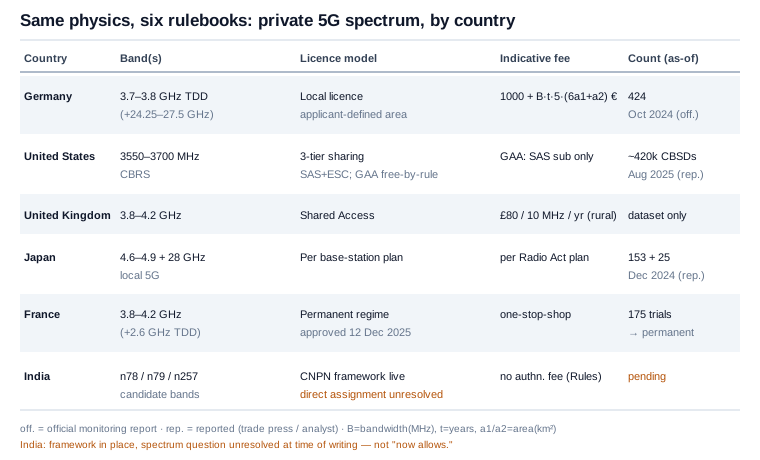
| Region | Band | Bandwidth | Model |
|---|
| USA | CBRS 3550--3700 MHz | 150 MHz | 3-tier (GAA/PAL/Incumbent) |
| Germany | 3700--3800 MHz | 100 MHz | Local licensing by BNetzA |
| UK | 3800--4200 MHz (shared) | 400 MHz | Ofcom shared access |
| Japan | 4600--4800 MHz, 28.2--29.1 GHz | 200 MHz + 900 MHz | Local 5G license by MIC |
| France | 2570--2620 MHz (TDD) | 50 MHz | ARCEP local license |
Germany leads in enterprise adoption with over 250 local 5G spectrum licenses granted by BNetzA as of early 2026, covering automotive, chemical, and logistics campuses.
Planning Considerations
- Spectrum strategy: CBRS GAA for proof-of-concept, PAL for production. In Europe, apply for local spectrum from the national regulator.
- SIM management: SNPN requires enterprise-managed USIM provisioning. Consider eSIM/iSIM with remote provisioning per TS 31.102 to simplify device onboarding.
- Integration with existing IT: Private 5G must integrate with enterprise firewalls, Active Directory, and SIEM systems. The UPF should connect directly to the enterprise LAN.
- Device ecosystem: Ensure devices support the target band and NPN features. CBRS Band 48 support is now standard in Qualcomm Snapdragon X65+ modems and most industrial routers.
- Regulatory compliance: In the US, all CBSDs must be SAS-certified. In Germany, BNetzA requires interference coordination with neighboring licensees.
> Key Takeaway: Private 5G networks give enterprises deterministic QoS and full data sovereignty that WiFi cannot match. SNPN offers maximum control for high-security campuses, PNI-NPN balances capability with simplicity, and CBRS GAA provides a zero-license entry point in the US. Expect 2--3x higher TCO than WiFi 6E, justified by mission-critical requirements.
Deploying one, and running it after
Design an enterprise NSSAI is the
slice-identifier decision a private deployment actually has to make, and
break the core is how you learn which
function you cannot afford to lose on a site with no NOC.
The Core & E2E specialist track
covers the core you would be operating.